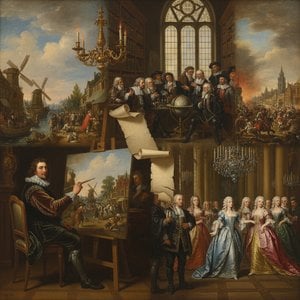
A Life Painted in Light and Shadow: The Story of Govert Teunisz Flinck
Govert Teunisz Flinck, a name that resonates with the golden age of Dutch painting, was more than just a portraitist; he was a conduit between Rembrandt’s revolutionary style and the burgeoning artistic landscape of 17th-century Amsterdam. Born in Kleve, Germany, in 1615 – a city steeped in both German and Dutch influences – Flinck's early life hinted at a path far removed from the world of art. His father, a prosperous cloth merchant, envisioned a future for his son within the trade, but fate intervened with the unexpected guidance of Lambert Jacobsz, a prominent Mennonite preacher and painter who recognized the young man’s innate artistic talent. This pivotal encounter steered Flinck towards Leeuwarden, where he began his formal training under Jacobsz, laying the foundation for a career that would ultimately eclipse his initial aspirations.
The move to Amsterdam in 1633 marked a turning point. There, Flinck entered the studio of Rembrandt van Rijn, a relationship that profoundly shaped his artistic development. Rembrandt’s influence is undeniably present throughout Flinck's oeuvre – particularly in his early works – characterized by dramatic lighting, nuanced expressions, and a masterful manipulation of chiaroscuro. However, unlike Rembrandt, who often embraced theatricality, Flinck gradually developed a more refined and elegant style, incorporating elements of Rubensian dynamism and a heightened sense of realism. This evolution is strikingly evident in pieces like “Isaac Blessing Jacob” (1638), where the composition’s balance and the figures' emotional depth demonstrate a clear departure from Rembrandt’s immediate influence.
The Portraiture of Power and Prestige
Flinck quickly established himself as one of Amsterdam’s most sought-after portraitists, catering to a clientele that included wealthy merchants, civic officials, and prominent members of the Mennonite community. His portraits weren't merely representations of likeness; they were carefully constructed narratives, imbued with social commentary and reflecting the status and aspirations of his subjects. The “Portrait of a Man, probably Augustijn Wtenbogaert (1577-1655)” exemplifies this approach, showcasing an aged sitter rendered with remarkable sensitivity and capturing not only his physical appearance but also the weight of experience etched upon his face. The use of rich fabrics, intricate details in the background, and subtle gestures all contribute to a portrait that transcends simple likeness, offering a glimpse into the subject’s life and character.
His commissions for civic guardsmen – as seen in “Officers and Other Civic Guardsmen of District XVIII in Amsterdam…” – further cemented his reputation. These works are not simply depictions of military personnel; they are vibrant celebrations of civic pride, meticulously rendered with attention to detail and a keen awareness of the social dynamics at play. The influence of Rembrandt is palpable here, particularly in the dynamic composition and the use of light and shadow to create a sense of movement and drama. The painting captures not just the appearance of the guardsmen but also their role as protectors of Amsterdam’s prosperity and stability.
Beyond the Portrait: Genre Scenes and Religious Narratives
While renowned for his portraits, Flinck's artistic range extended beyond the confines of formal representations. He produced a series of compelling genre scenes – intimate depictions of everyday life – that offered a window into the domestic sphere of 17th-century Amsterdam. These works are characterized by their realism and their ability to capture the nuances of human interaction, revealing both the joys and challenges of daily existence. His religious paintings, such as “Angels Announcing the Birth of Christ to the Shepherds,” demonstrate a masterful command of composition, color, and symbolism, creating scenes that are both visually stunning and emotionally resonant.
Legacy and Influence
Govert Teunisz Flinck’s career spanned nearly four decades, during which he produced an impressive body of work that continues to captivate viewers today. His artistic development—from his early apprenticeship under Rembrandt to the refinement of his own distinctive style—reflects the dynamic artistic climate of the Dutch Golden Age. He left a lasting legacy as one of the most accomplished portraitists and genre painters of his time, influencing generations of artists who followed in his footsteps. His works are now housed in prestigious collections around the world, including the Rijksmuseum in Amsterdam, testament to his enduring contribution to the history of art.