The Life and Origins of Francesco Verla
Francesco Verla was an Italian painter of the Renaissance period who left a distinct mark on the artistic landscape of Northern Italy. Born in 1470 in Villaverla, his early years were rooted in the cultural currents of the Vicenza region. His presence in the art history of the era is defined by a life spent navigating the shifting patronage and stylistic developments of the Italian peninsula.
His career was characterized by a steady movement through the territories of Northern Italy. This period of activity saw him engaging with the evolving visual language of his time, establishing himself as a significant figure within the regional traditions. He moved through the landscape of the Renaissance, contributing to the religious and decorative needs of the era.
The arc of his life reached its conclusion in 1521. He died in Rovereto, marking the end of a career that spanned the height of the Renaissance. From his beginnings in Villaverla to his final years in Rovereto, Francesco Verla remained a dedicated practitioner of his craft, shaped by the specific geographic and cultural realities of his Italian homeland.
Artistic Training and Early Travels
The formative years of Francesco Verla were defined by a restless, itinerant career that pulled him far from his origins. His early path led him into the heart of Umbria, a period that allowed him to absorb the nuances of the local landscape and spirit. It was during these formative travels that he encountered the influence of Pietro Perugino, whose presence left a lasting mark on his developing sensibilities. This exposure to the Umbrian style helped shape a visual language that would eventually distinguish his work from his contemporaries.
His ambitions eventually drew him to Rome, where he operated under the patronage of Pope Alexander VI Borgia. This period of study was marked by a deep immersion in the classical past. He spent significant time examining the ruins of the Domus Aurea, studying the ancient art and the intricate decorations found within Nero's palace. These encounters with antiquity provided him with a unique repertoire of ornamental motifs, specifically the grottesche, which he would later bring back to Northern Italy. Such classical studies, combined with his earlier training as a follower of Bartolomeo Montagna and the stylistic echoes of Mantegna, allowed him to blend diverse regional influences into a singular, recognizable approach.
Artistic Style and Decorative Techniques
Verla’s hand was marked by a distinct ability to blend the sacred with the ornamental. Often associated with the School of Vicenza, his work moved away from the rigid traditions of his surroundings to embrace a more decorative sensibility. He became one of the first artists to introduce a specific repertoire to the regions north of the Po, characterized by a combination of sweet, devotional figures and highly stylized, eccentric framing. These elements provided a sense of visual complexity that set his compositions apart from his contemporaries.
A significant portion of his aesthetic identity was rooted in the study of antiquity. His time in Rome allowed him to observe the ruins of the Domus Aurea, where he encountered the intricate grottesche decorations of the ancient world. This encounter left an indelible mark on his technique. He integrated these bizarre and extrose frames into his religious subjects, using them to create a sense of movement and whimsy around his central figures. This marriage of classical decorative motifs and devotional imagery defined his unique contribution to the Renaissance landscape.
Notable Paintings and Major Works
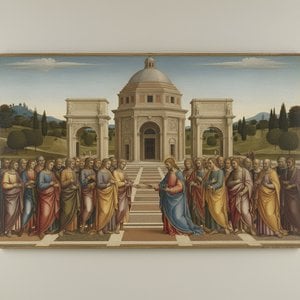
Verla’s output is characterized by a devotion to religious themes, often manifesting in structured, multi-paneled compositions. A significant group of three predella panels, dating from about 1510, illustrates his ability to handle complex theological narratives. These works, which include La Résurrection, L'Ascension, and L'Adoration des Mages, were once part of a single ensemble. They survived through various collections, including the Marquis Campana in Rome, before finding their way to the Musée du Petit Palais in Avignon.
His later years saw the production of works that continued to reflect his stylistic influences. An Enthroned Madonna and Child with Saints Joseph and Francis, attributed to the artist and dated 1520, demonstrates his command of the devotional imagery prevalent in Northern Italy during the Renaissance. Beyond large-scale panel paintings, his hand is seen in more intimate studies, such as a drawing of the Baptism of Christ held at the Morgan Library and Museum in New York.
Where to See His Works Today
The physical remnants of Verla’s career are scattered across several significant collections, reflecting the itinerant nature of his life. In Italy, his presence is felt in Milan, where the Pinacoteca di Brera holds an Enthroned Madonna and Child with Saints Joseph and Francis. This work remains a key point of reference for those studying his place within the Renaissance landscape.
A significant concentration of his output can be found in Avignon. The Musée du Petit Palais houses a group of three predella panels that once formed a single cohesive unit. These include La Résurrection, L'Ascension, and L'Adoration des Mages. These pieces, which were once part of the Marquis Campana collection in Rome, offer a rare opportunity to observe his handling of religious subjects in a single location.
Beyond the European continent, his reach extends to the United States. The Morgan Library and Museum in New York preserves a drawing of the Baptism of Christ, providing a glimpse into his preparatory studies and the more intimate side of his technical practice.