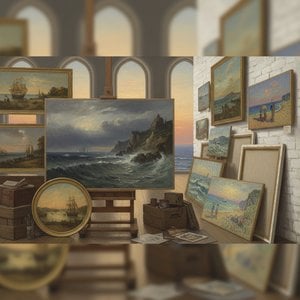
Ffiona Lewis: A Quiet Observer of the British Coast
Ffiona Lewis, born in London in 1964, is a quietly compelling artist whose work has steadily gained recognition for its evocative depictions of the British coast and interior landscapes. Initially trained as an architect – a discipline that undoubtedly informed her meticulous attention to detail and spatial awareness – she transitioned into painting after encountering the vibrant art scene of St Ives in Cornwall. This shift wasn’t merely a career change; it represented a profound embrace of observation, translating architectural precision into a sensitive rendering of light, texture, and atmosphere.
Lewis's artistic journey began with a deliberate rejection of grand narratives or overt emotional displays. Instead, she focuses on the subtle evidence of human presence – a forgotten picnic basket, a weathered fishing boat, a solitary figure against a vast expanse of sky and sea. Her paintings aren’t about telling stories; they are invitations to contemplate the quiet beauty of everyday moments, imbued with a sense of melancholy and timelessness. This approach is deeply rooted in her architectural background, where she learned to see beyond the surface, analyzing structure and form to understand the underlying principles of design.
Early Influences and Artistic Development
Lewis’s formative years spent in Devon undoubtedly shaped her artistic sensibility. The rugged coastline, steeped in maritime history and folklore, provided a constant source of inspiration. However, it was her time in St Ives that proved pivotal. Surrounded by the luminaries of the Cornish art world – Patrick Heron, Terry Frost, and Janet Leach – she absorbed their innovative approaches to color, form, and texture. This exposure broadened her artistic horizons, moving beyond purely representational painting towards a more expressive and layered style.
Crucially, Lewis’s transition from architecture to painting wasn't abrupt. She continued to draw upon the analytical skills honed during her architectural training, applying them to her new medium. Her meticulous layering techniques – utilizing gesso, primers, grounds, and textured mediums on timber panels – create a rich surface that invites close scrutiny. This process mirrors the careful planning and execution characteristic of architectural design, resulting in paintings that possess both a tactile quality and a remarkable sense of depth.
A Palette of Restraint and Observation
Lewis’s artistic palette is remarkably restrained, consisting primarily of muted earth tones – ochres, browns, blues, and greens. This deliberate limitation allows her subjects to emerge from the background, emphasizing their subtle details and creating a sense of quiet intimacy. She avoids bright colors or dramatic contrasts, instead relying on variations in tone and texture to convey mood and atmosphere. As Andrew Lambirth noted, “Lewis has tended to paint the evidence that people leave behind, or their trace in the landscape rather than the people themselves.”
Her technique is characterized by a loose, gestural approach, often employing a palette knife to apply thick layers of paint and create dynamic textures. This method contrasts sharply with the smooth, polished surfaces favored by some contemporary artists, lending her paintings a raw, almost tactile quality. The scars and indentations left by the palette knife are not merely accidental marks; they are integral to the painting’s expressive power, suggesting a process of constant revision and refinement.
Recognition and Legacy
Throughout her career, Lewis has exhibited extensively in both Britain and abroad, gaining recognition from prestigious institutions such as the Royal Academy and the Redfern Gallery. Her work has been included in numerous collections, including those of the Houses of Parliament and various museums and galleries across the UK and Europe. Her paintings are not simply decorative objects; they are thoughtful meditations on the relationship between humans and the natural world, offering a poignant reminder of our fleeting presence within a vast and enduring landscape.
Lewis’s legacy lies in her ability to capture the essence of place – the subtle shifts in light and weather, the textures of the coastline, the quiet dignity of abandoned objects. Her paintings invite viewers to slow down, observe carefully, and appreciate the beauty of the everyday, a testament to the power of understated observation and meticulous craftsmanship.