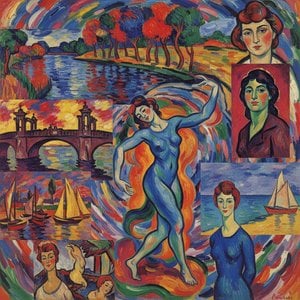
The Parisian Roots and Quebecois Transition
Paris, 1930. The air of the city holds the beginnings of a creative life that will eventually find its gravity in Quebec. Born on August 8, 1930, Denys Morisset moves from the French capital to Quebec City, where his formative years take shape. By 1951, he holds a Bachelor of Arts from Université Laval, a foundation that supports a career spanning painting, sculpture, and photography. His hands are never idle; he moves between the precision of photography and the tactile nature of sculpture, all while navigating the commercial demands of advertising and communication.
The work is prolific. Over a thousand pieces emerge from his studio, ranging from drawings and copper enamels to caricatures. He is a maker of many things, a versatility that defines his output from the mid-century onward.
The Shift in Medium and Form
A quiet revolution occurs in 1975. The traditional tools of the painter—the oil and the brush—are set aside. In their place, Morisset adopts acrylic, applying the pigment with rollers. This technical pivot marks a definitive era in his expression, a method he maintains until his death in 1990. This period sees the emergence of works like Manitoba (1976), where the texture of the application becomes part of the visual language.
His exhibitions trace a path through major cultural hubs. From 1948, his presence is felt in Quebec, Montreal, and Mexico City. Specific moments in his career highlight his evolving focus:
- 1969: The exhibition Morisset rides again at Galerie Jolliet, featuring large-scale paintings of nude women with arms outstretched in a cross-like position.
- 1972: Morisset's bazaar at the Musée du Québec, a multidisciplinary exhibition that broke traditional boundaries.
- 1984: Les Joyaux des collections privées de la Ville de Québec, a collaborative exhibition with Pierre Bernier for the inauguration of the new Palais de justice de Québec.
A Legacy in Collections
The physical traces of his life remain in the Musée national des beaux-arts du Québec. His compositions vary from the structured to the abstract, such as the 1988 acrylic Fille de la rue Saint-Paul or the 1987 crayon manner work Wolfie's Don Giovanni. Whether working in oil on panel or acrylic on canvas, the artist’s output remains a constant, documented through decades of shifting techniques and evolving perspectives on the human form and the landscape.