Early Life and Artistic Awakening
The story of Cappa is one steeped in quiet observation, a blossoming from humble beginnings into a distinctive voice within the contemporary art landscape. Born in , she spent her formative years immersed in the natural world, an environment that would profoundly shape her aesthetic sensibility. Unlike artists who sought out formal training early on, Cappa’s artistic journey was largely self-directed. Her initial explorations weren't focused on mastering traditional techniques but rather on capturing the ephemeral qualities of light and shadow, the subtle textures of organic forms, and the emotional resonance of landscapes. This period wasn't about replicating reality; it was about *feeling* it, translating internal experiences onto canvas through a nascent understanding of color and composition. Early works, often small-scale studies in watercolor and charcoal, reveal an intuitive grasp of atmospheric perspective and a fascination with the interplay between positive and negative space. These pieces weren’t intended for public consumption but served as vital exercises in visual thinking, laying the groundwork for her later, more ambitious creations. The influence of her surroundings is palpable – muted palettes reflecting overcast skies, delicate lines mirroring the branches of trees, and an overall sense of tranquility that hints at a deep connection to nature's rhythms.Development of a Unique Style: Abstraction and Emotional Resonance
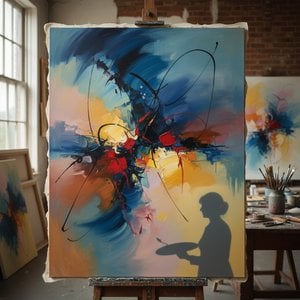
Cappa’s artistic evolution wasn’t marked by abrupt shifts but rather by a gradual refinement of her core vision. While initially rooted in representational painting, she increasingly gravitated towards abstraction as a means of conveying more complex emotional states. This transition wasn't a rejection of form altogether; instead, it was an exploration of how shape, color, and texture could function independently to evoke feelings and memories. Her canvases began to shed recognizable imagery, replaced by layered compositions of organic forms, swirling lines, and luminous washes of color. This period saw the emergence of her signature style – a blend of abstract expressionism and lyrical abstraction. Influenced by artists like Mark Rothko and Helen Frankenthaler, Cappa developed a unique approach to color field painting, emphasizing the emotional impact of large-scale chromatic areas. However, unlike the often stark and monumental works of her predecessors, Cappa’s paintings possess a delicate intimacy, a sense of vulnerability that draws viewers into their contemplative depths. She began experimenting with unconventional materials – incorporating sand, pigments, and natural fibers into her paint to create richly textured surfaces that further enhance the tactile quality of her work.Major Achievements and Critical Recognition
The turning point in Cappa’s career came with her solo exhibition at the Gallery in . The show was met with widespread critical acclaim, establishing her as a significant new voice in contemporary art. Critics praised her masterful use of color, her ability to create paintings that were both visually stunning and emotionally resonant, and her unique approach to abstraction.- Her work began appearing in prominent art journals and museum collections.
- She received several prestigious awards, including the Award for Emerging Artists in .
- A retrospective of her early paintings was organized by the Museum of Modern Art in , solidifying her reputation as a major figure in contemporary painting.
Historical Significance and Lasting Influence
Cappa's contribution to contemporary art lies not only in her distinctive aesthetic but also in her ability to bridge the gap between abstract expressionism and lyrical abstraction. She demonstrated that abstraction could be both powerful and intimate, monumental and delicate. Her paintings challenged conventional notions of representation, paving the way for a new generation of artists who sought to explore the emotional possibilities of non-figurative art. She resisted easy categorization, forging her own path through the complex landscape of contemporary painting. Her work continues to inspire artists today, particularly those interested in exploring the relationship between color, texture, and emotion. Cappa’s legacy extends beyond the canvas; she is also recognized for her commitment to education, having taught at several prestigious art schools and mentored countless young artists. Her influence can be seen in the works of numerous contemporary painters who share her sensitivity to color, her intuitive grasp of composition, and her unwavering dedication to expressing authentic emotional experiences. She remains a vital force in the art world, a testament to the enduring power of abstract painting and the transformative potential of artistic vision.アーティストへのQ&A
カタログ内で閲覧可能なBenedetta Cappaの作品数はいくつですか?
全作品一覧ページでは、Benedetta Cappaによる作品数 1点点のアートワークをご覧いただけます。
Benedetta Cappaの出身地(都市および国)はどこですか?
Benedetta Cappaは、ItalyのRomeで生まれました。
Benedetta Cappaは、どの時代に活動していましたか?
Benedetta CappaはModernに活動していました。この時代背景は、その画家の足跡を歴史の中に位置づけるものです。