The Enigmatic Master of St Francis
Gregorio Fernández (c. 1478 – Valladolid, Spain, 1536) remains one of the most fascinating figures in Spanish Renaissance art, a painter whose legacy extends far beyond his relatively small oeuvre. Despite scholarly debate surrounding his precise origins and biographical details—he was born in Valladolid, Castile, though some historians suggest Andalusian roots—Fernández’s contribution to the artistic landscape of his time is undeniable, particularly within the context of the fervent religious fervor that gripped Europe during the Reformation. He stands as a pivotal link between Gothic tradition and Early Renaissance innovation, embodying the spirit of his era with unparalleled sensitivity.
Early Life and Artistic Training
Information about Fernández’s formative years is scarce. Born into a family of artisans—his father was a sculptor—he received an initial artistic education in Valladolid, absorbing influences from both Gothic sculpture and burgeoning humanist ideals circulating throughout Spain. While he lacked formal academic training in the manner of Leonardo da Vinci or Michelangelo, Fernández possessed an innate talent honed through diligent practice and observation. His apprenticeship with Juan de Vallejo, a prominent sculptor active in Seville, undoubtedly solidified his technical skills and exposed him to the stylistic trends prevalent in Andalusian art circles. This exposure would prove crucial in shaping his distinctive artistic vision.
The Frescoes of Santa Catalina Monastery
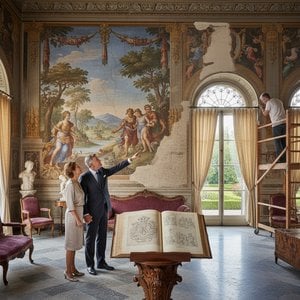
Fernández’s fame rests primarily on his monumental frescoes adorning the Convent of Santa Catalina in Valladolid—a commission undertaken between 1507 and 1513. These paintings represent arguably the most significant achievement of Fernández's career, establishing him as a leading fresco artist of his generation. The cycle depicts scenes from the Life of St Francis of Assisi, meticulously rendered with astonishing realism and imbued with profound spiritual symbolism. Unlike many contemporary artists who favored idealized representations, Fernández captured the physicality of Franciscan monks—their gestures, expressions, and clothing—creating figures that possess an immediacy and emotional depth rarely seen in religious art of the period. The frescoes’ masterful use of color palettes—dominated by earthy hues—and their meticulous attention to detail exemplify the stylistic principles championed by Gregorio Sánchez de Toledo, Fernández's mentor and a key figure in Valladolid’s artistic milieu. He skillfully incorporated elements of linear perspective and chiaroscuro, techniques pioneered by artists like Masaccio and Piero della Francesca, demonstrating his mastery of disegno—the Italian term for drawing—a cornerstone of Renaissance artistic training. Furthermore, he employed innovative pigment preparation methods, utilizing finely ground minerals to achieve luminous colors that rivaled those produced by Florentine masters.
Style and Technique: Gothic Echoes and Renaissance Innovation
Fernández’s style is characterized by a remarkable synthesis of Gothic and Early Renaissance influences. While he adhered to the conventions of Byzantine iconography—particularly in his depiction of Christ Pantocrator—he skillfully incorporated elements of linear perspective and chiaroscuro, techniques pioneered by artists like Masaccio and Piero della Francesca. This blending of traditions reflects the broader artistic currents shaping Spain during the transitional period between the Gothic and Renaissance eras. Fernández’s meticulous preparatory sketches demonstrate a profound understanding of anatomical structure and spatial illusion, showcasing his mastery of disegno—the Italian term for drawing—a cornerstone of Renaissance artistic training. His work profoundly impacted subsequent generations of artists, establishing Valladolid as a center for artistic excellence and contributing significantly to the development of Spanish Renaissance art.
Legacy and Historical Significance
Fernández’s frescoes at Santa Catalina continue to inspire awe and admiration among art historians and viewers alike. They stand as a testament to the enduring power of religious iconography and represent one of the finest examples of Gothic-influenced fresco painting in Spain. His contribution solidified Valladolid's reputation for artistic innovation, marking him as a truly exceptional artist whose legacy persists to this day. He is remembered not merely as a painter but as a visionary who captured the essence of faith and humanity within the confines of monumental fresco paintings—a singular achievement that secures his place among the titans of Spanish Renaissance art.