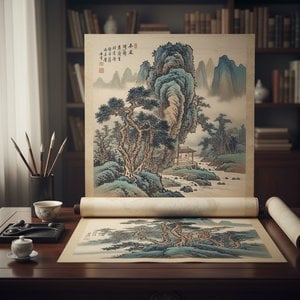
A Nocturnal Vision of Tradition and Insight
Liu Yong, born in February 1949, stands as a singular figure in contemporary Taiwanese art—a writer and painter whose oeuvre delves into the profound beauty of nocturnal landscapes and explores themes of human experience with remarkable sensitivity. Born in Taipei amidst the backdrop of post-war Taiwan’s evolving cultural landscape, Yong's artistic journey began early, shaped by formative experiences that instilled within him an enduring appreciation for resilience and observation. The loss of his father at a young age and a devastating house fire during his childhood irrevocably altered his trajectory, yet these shadows of the past became the very elements that would later inform his fascination with light emerging from darkness.
His academic pursuits provided the intellectual rigor necessary to bridge traditional Eastern aesthetics with a global perspective. After graduating from Cheng Kung Senior High School, he attended National Taiwan Normal University, earning a Bachelor of Fine Arts in 1972. His scholarly journey continued at St. John's University in New York and culminated with a PhD from Columbia University. This unique blend of deep-rooted Eastern training and Western academic excellence allowed him to approach the canvas with both technical precision and a philosophical depth that transcends borders.
The Artistry of Shadow and Light
Yong’s artistic style is characterized by an arresting preoccupation with darkness—a deliberate choice that reflects a fascination with the quiet contemplation afforded by nighttime vistas. He employs meticulous brushwork and delicate ink washes, capturing subtle gradations of color and texture to convey a sense of serenity and introspection. His landscapes are rarely grand or dramatic; instead, they depict tranquil scenes bathed in moonlight, inviting viewers into moments of stillness. Through his use of ink wash techniques, he masterfully navigates the space between what is seen and what is felt, creating atmospheres where the boundary between reality and dream becomes beautifully blurred.
Beyond his landscapes, Yong is a master of calligraphy, particularly in the running script. His calligraphic works, such as his stunning horizontal scrolls on yellow paper, demonstrate an elegant command over black ink, where every stroke carries the weight of tradition and the fluidity of personal emotion. This mastery of the brush allows him to communicate not just through imagery, but through the rhythmic energy of the written word, making him a true polymath of the arts.
A Legacy of Education and Philanthropy
The significance of Liu Yong extends far beyond the confines of the art gallery. As an educator, novelist, and philanthropist, his impact on society is as profound as his impact on the canvas. He founded the Shui Yun Zhai Cultural Enterprise and has demonstrated a remarkable commitment to social welfare, notably funding the construction of over 40 schools in rural China to support the next generation of learners. His literary contributions are equally widespread; his books have been translated into numerous languages, including English, Korean, Vietnamese, and Thai, and are frequently utilized in school textbooks across mainland China and Taiwan.
His career has been marked by a rare versatility that saw him serving as the host for “Seconds Count Down,” Taiwan's first television quiz show, and working as a journalist for China Television. This ability to engage with the public through media, literature, and education has cemented his presence within the cultural fabric of Asia. Ultimately, Liu Yong’s work represents a harmonious intersection of tradition and modernity, where the quietude of a moonlit landscape meets the enduring strength of the human spirit.
Domande e risposte
Dove si possono trovare le opere di Liu Yong raggruppate per palette?
La pagina Per palette di colori raggruppa le opere di Liu Yong in base alle loro palette di colori.
Come posso trovare tutte le opere di Liu Yong suddivise per tecnica?
La pagina Per tecnica raggruppa le opere di Liu Yong per tecnica.
Posso ordinare le opere di Liu Yong per colore?
La pagina Indice dei colori organizza le opere di Liu Yong per colore.