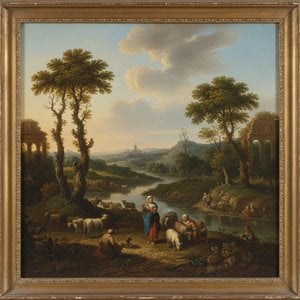
Johannes van Haensbergen (1642 – 1705): A Master of Serene Landscapes and Elegant Portraits
Johannes van Haensbergen, born in Gorinchem around 1642, stands as a pivotal figure within the Dutch Golden Age—a period characterized by unparalleled artistic innovation and cultural flourishing. His career unfolded amidst the vibrant intellectual currents of Utrecht and The Hague, where he established himself as a respected painter and art dealer, leaving an indelible mark on the visual landscape of his time.Early Influences and Artistic Training
Van Haensbergen’s formative years were shaped by the tutelage of Cornelius van Poelenburgh, a celebrated landscape artist whose distinctive style profoundly impacted the young painter's artistic sensibilities. Imitating Poelenburgh’s masterful technique—particularly his ability to convey atmospheric depth and luminous beauty—became a cornerstone of Van Haensbergen’s oeuvre. This dedication to observation and meticulous rendering would prove crucial in defining his subsequent artistic endeavors.The Shift Towards Portraiture: A Pragmatic Decision
Despite the initial fascination with landscape painting, Van Haensbergen swiftly transitioned towards portraiture—a genre that offered considerable commercial viability and allowed him to hone his skills in capturing the essence of his subjects. Recognizing the potential for success within this field, he skillfully employed techniques honed by Poelenburgh to create portraits that prioritized skin complexion, aiming for an idealized representation that flattered the sitter while conveying a sense of dignified composure. This strategic choice cemented his reputation as one of the era’s foremost portraitists.Notable Works and Artistic Legacy
Among Van Haensbergen's most enduring achievements are “Nymphs Bathing” and “Portrait of Maria duyst van Voorhout.” The former exemplifies his mastery of idyllic landscapes—infused with Poelenburgh’s influence—capturing a tranquil scene bathed in soft light. Conversely, the latter showcases his exceptional portraiture abilities, skillfully portraying Maria duyst van Voorhout with remarkable sensitivity and capturing her likeness with exquisite precision. His work continues to inspire admiration for its harmonious blend of observation and artistic finesse.Commercial Ventures and Collaborative Partnerships
Beyond his artistic pursuits, Van Haensbergen played an active role in the Utrecht Guild of St. Luke—serving as a headman alongside Jan Both—a connection documented by Houbraken. This association facilitated his foray into art dealing, where he partnered with “de jode,” bolstering his financial stability and expanding his professional network. Such collaborations underscored the interconnectedness of artistic creativity and economic enterprise during the Golden Age.Concluding Reflections
Johannes van Haensbergen’s legacy extends beyond his individual masterpieces; it resides in his contribution to the broader artistic landscape of the Dutch Baroque—a style characterized by dramatic contrasts of light and shadow, imbued with a humanist spirit. His son, Willem Johan van Haensbergen, served as his pupil, ensuring that Van Haensbergen's artistic principles persisted through generations. Today, his paintings are housed in prestigious museums like The Mauritshuis, where they stand as testament to the brilliance of Dutch Baroque art and the enduring power of a painter who elevated portraiture to an art form of unparalleled elegance and psychological insight.Domande e risposte
Posso studiare l'uso del colore di Jan van Haensbergen in tutte le sue opere?
Il profilo cromatico delle opere di Jan van Haensbergen è consultabile nella pagina Profilo Cromatico dell'Artista dell'artista.
Come si è evoluta l'arte di Jan van Haensbergen nel tempo?
La Cronologia artistica di Jan van Haensbergen è una linea temporale interattiva che presenta le opere dell'artista in ordine cronologico, suddivise in capitoli corrispondenti ai diversi periodi della sua carriera.
In quale città e in quale paese è nato/a Jan van Haensbergen?
Jan van Haensbergen è nato a Gorinchem, in Paesi Bassi.