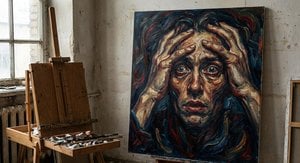
António Teixeira Carneiro Júnior: A Soul Captured in Color
António Teixeira Carneiro Júnior (1872 – 1930) stands as a cornerstone of Portuguese Expressionism, an artist whose life narrative intertwines tragedy and triumph—a poignant reflection of the artistic spirit he embodied. Born into humble circumstances in Amarante, Portugal, his early years were marked by profound hardship: orphaned at seven due to his father’s abandonment and subsequently placed in the Barão da Nova Sintra Asylum, Carneiro experienced firsthand the vulnerabilities inherent in existence. Yet, amidst these difficulties, a remarkable talent emerged—a fascination with religious illustrations that would propel him toward formal artistic training under the guidance of João Marques de Oliveira at the Escola Superior de Belas-Artes do Porto (1884–90). This formative period instilled within him not merely technical skills but also an unwavering dedication to observation and emotional resonance—qualities that would characterize his entire artistic career.Parisian Awakening: Symbolism and Artistic Innovation
The pivotal moment in Carneiro’s artistic evolution arrived with his relocation to Paris in 1897, fueled by a scholarship awarded by António Borges, Marquês da Praia e Monforte. Embracing the intellectual ferment of the fin-de siècle, he enrolled at the Académie Julien under Jean-Paul Laurens and Benjamin Constant—encountering artists who championed Symbolist aesthetics and challenged prevailing artistic conventions. This immersion in Parisian culture profoundly impacted his worldview and artistic sensibilities, fostering a rejection of naturalism and propelling him toward explorations of spirituality, melancholy, and psychological introspection. It was during this period that he began to hone his distinctive Expressionist style, prioritizing emotional intensity over mere representation—a stylistic choice that would define his oeuvre for decades to come. The Universal Exhibition of 1900 served as a catalyst for recognition, securing him a Silver Medal for his monumental triptych *A Vida* (Life)—a work lauded by critics and historians alike as an emblem of Portuguese artistic innovation.Landscape and Portraiture: Two Sides of a Singular Vision
Carneiro’s artistic practice centered primarily on two genres—landscape painting and portraiture—each meticulously crafted to convey profound psychological insights. Unlike many of his contemporaries who sought to depict the external world objectively, Carneiro imbued his landscapes with mood and atmosphere, transforming natural vistas into reflections of human emotion. His canvases pulsated with color and texture, capturing not just visual details but also intangible sensations—a testament to his belief that art should aspire to capture the essence of experience. Simultaneously, he excelled in portraiture, delving beneath superficial appearances to reveal the inner workings of his subjects’ minds. He possessed an uncanny ability to portray individuals with sensitivity and nuance, conveying their personalities through subtle gestures and expressions—a skill honed by years of meticulous observation and artistic experimentation.A Legacy Etched in Color: Recognition and Artistic Influence
Throughout his life, Carneiro received considerable acclaim for his work, garnering awards both domestically and internationally. His paintings were exhibited extensively, securing prominent positions within national museum collections and establishing him as a celebrated figure among Portuguese artists. Notably, the Museu Nacional Soares dos Reis houses a significant collection of his canvases—a testament to their enduring artistic merit and historical significance. Furthermore, Carneiro’s influence extended beyond his own lifetime, shaping the artistic landscape of Portugal in the decades following his death. His pioneering Expressionist style inspired subsequent generations of painters—artists who embraced psychological depth and emotional intensity as core tenets of their creative endeavors. António Teixeira Carneiro Júnior remains a beacon of Portuguese modern art—a testament to the transformative power of art to illuminate the human condition and capture the sublime beauty of existence.Domande e risposte
In quali periodi è suddivisa la carriera di António Teixeira Carneiro Júnior?
La carriera di António Teixeira Carneiro Júnior si svela periodo dopo periodo nella pagina Cronologia: una linea temporale orizzontale delle opere, raggruppate in capitoli relativi ai vari periodi della sua carriera.
Dove posso vedere le opere di António Teixeira Carneiro Júnior suddivise per atmosfera?
Le opere di António Teixeira Carneiro Júnior possono essere esplorate per emozione nella pagina Stanze d'atmosfera dell'artista, che organizza le opere d'arte in base alle emozioni che trasmettono.
Posso sfogliare le opere di António Teixeira Carneiro Júnior in base alla palette di colori?
Le opere di António Teixeira Carneiro Júnior possono essere consultate per palette cromatica nella pagina Per palette dell'artista.