A Parisian Legacy Forged in Revolution and Royalty
Born in the vibrant heart of Paris in 1774, Anthelme-François Lagrenée was destined to inhabit the upper echelons of the European art world. As the son of the esteemed Louis-Jean-François Lagrenée, his very existence was steeped in the traditions of French academic excellence. This prestigious lineage provided him with an unparalleled foundation, yet his path was far from a predictable ascent through the salons of Paris. His early training took place within the atelier of Vincent, where he mastered a meticulous realism and a classical discipline that would become the bedrock of his technical prowess. However, the winds of history were shifting; the tumultuous onset of the French Revolution forced a sudden departure from the studio to the battlefield. Serving in the military in 1793, Lagrenée experienced a period of profound upheaval that likely tempered his artistic gaze, infusing his later portraiture with a certain reserved elegance and a depth of character born from witnessing the fragility of social order.
The true metamorphosis of Lagrenée’s artistry occurred not in the streets of France, but amidst the glittering splendor of the Russian Empire. Arriving in Russia in 1817, he found a landscape ripe with opportunity and a court hungry for the refined touch of French sophistication. This sojourn proved to be the defining chapter of his life, as he transitioned from a student of classical tradition to a master of imperial narrative. In the presence of Tsar Alexander I, Lagrenée’s style began to breathe with a new vitality, shedding the rigid constraints of purely academic French portraiture in favor of a more nuanced, expressive approach that mirrored the theatricality and vibrant energy of the Russian aristocracy.
The Art of Detail and the Splendor of the Imperial Court
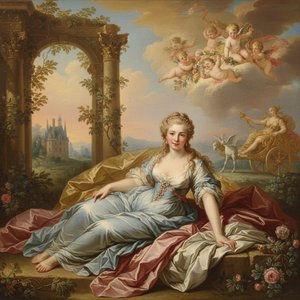
Lagrenée’s work during his Russian period is celebrated for its remarkable sensitivity to the tactile world. He possessed an extraordinary ability to translate the opulence of the era onto canvas, focusing intensely on the intricate textures of silk, velvet, and lace. His portraits were more than mere likenesses; they were immersive studies in status and luxury. Through his brush, the elaborate wardrobes of the Russian elite became central protagonists in his compositions, lending a sense of weight and historical permanence to his subjects.
His mastery extended even to the most miniature of scales, as seen in his exquisite work on snuff boxes. These delicate objects, featuring portraits of figures such as Empress Maria Feodorovna, her son Grand Duke Michael Pavlovich, and Elena Pavlovna, demonstrate a level of precision that is nothing short of breathtaking. In these small-scale masterpieces, Lagrenée achieved a monumental impact, capturing the essence of royalty within a frame no larger than a palm. This ability to command attention across different mediums—from large-scale imperial commissions to intimate decorative arts—solidified his reputation as a versatile and indispensable artist of his age.
The historical significance of Lagrenée’s oeuvre lies in its role as a cultural bridge. His art serves as a visual record of the intersection between French aesthetic refinement and Russian imperial grandeur. To study his work is to witness:
- The evolution of portraiture from the strictures of 18th-century classicism to a more emotive, atmospheric style.
- A window into the Russian Imperial Court, capturing the fashion, hierarchy, and splendor of the era under Tsar Alexander I.
- The technical intersection of fine art and decorative craft, particularly through his celebrated miniature paintings on snuff boxes.
Ultimately, Anthelme-François Lagrenée remains a figure of profound artistic importance. He did not merely document the faces of his time; he captured the very spirit of an era defined by transition, blending the disciplined heritage of Paris with the opulent, dramatic soul of Russia.