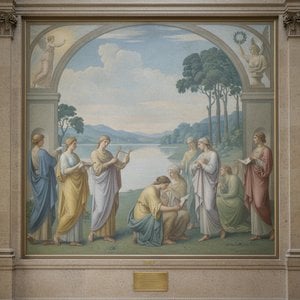
A Life Dedicated to Monumental Visions
Pierre Cécile Puvis de Chavannes, a name often simply rendered as Puvis de Chavannes, occupies a unique and pivotal position in 19th-century French art. Born in Lyon in 1824, he rose to become known as “the painter for France,” a testament to his profound impact on public art during the early years of the Third Republic. His legacy extends far beyond mere decoration; Puvis de Chavannes crafted visual narratives that embodied national ideals and resonated with a generation grappling with political and social transformation. He wasn’t merely illustrating history, but actively shaping its visual memory for the future. His influence on subsequent artists, particularly those aligned with Symbolism and Art Nouveau, is undeniable, and his collaborative spirit extended to working alongside medallists, offering designs and insightful suggestions.From Engineering Aspirations to Artistic Devotion
The early life of Pierre-Cécile Puvis was marked by a trajectory that initially diverged from the world of art. Born into a family of modest means – his father an engineer descended from Burgundy nobility – he received an education at Amiens College and Lycée Henri IV in Paris, preparing him for a career following in his father’s footsteps. However, a serious illness proved to be a turning point, forcing a period of convalescence that allowed space for introspection and the burgeoning of artistic inclinations. A transformative journey to Italy ignited within him a passion for painting, prompting a decisive shift away from engineering and towards a life dedicated to creative expression. He embraced his ancestral heritage by incorporating “de Chavannes” into his name, a subtle assertion of identity and lineage. His formal training included brief mentorships under luminaries like Eugène Delacroix, Henri Scheffer, and Thomas Couture, yet he ultimately favored independent study, establishing a spacious studio near the Gare de Lyon that became a hub for artistic exploration. He diligently honed his understanding of anatomy through classes at the Académie des Beaux Arts, laying a solid foundation for his later monumental works.The Genesis of a Symbolist Style
Puvis de Chavannes’s artistic style is generally categorized as Symbolist, though it evolved from roots in Romanticism. His work is instantly recognizable by its simplified forms, rhythmic linear compositions, and a distinctive, muted palette reminiscent of fresco painting. He wasn't interested in photographic realism; instead, he sought to distill essence, to capture the underlying spirit of his subjects. He frequently drew inspiration from classical antiquity and idealized landscapes, weaving allegorical themes into grand narratives. His early commissions, beginning in the 1860s at the Musée de Picardie in Amiens – including *Concordia*, *Bellum*, *Le Travail* (Work), and *Le Repos* (Rest) – established his reputation for large-scale mural paintings. These weren’t simply decorative elements; they were carefully considered statements about civic virtue, labor, and the pursuit of harmony. Later, a significant series of murals commissioned for the Museum of Fine Arts in Lyon further cemented his position as a leading figure in public art. Notable works like *The Woodcutters* (1873), currently housed at the San Antonio Museum of Art, demonstrate his ability to imbue everyday scenes with symbolic weight and poetic grace. Paintings such as *Massilia, Greek Colony*, and *Sacred Grove* exemplify his characteristic style and thematic interests, showcasing nude figures within evocative landscapes that invite contemplation.Collaborations and Artistic Circles
Puvis de Chavannes’s artistic practice was characterized by a remarkable openness to collaboration and engagement with the broader artistic community. He wasn't an isolated genius; rather, he actively sought out opportunities to work alongside other artists, medallists, and designers. His studio became a gathering place for young talents, including Émile Bernard and Maurice Utrillo, who benefited from his guidance and mentorship. He collaborated extensively with medallists, providing designs and insightful suggestions that enriched their work. Notably, he maintained a close relationship with the sculptor Robert Genin, exchanging ideas and influencing each other’s artistic development. Puvis de Chavannes was also deeply involved in the Parisian art scene, attending exhibitions and engaging in intellectual discussions with prominent figures such as Émile Zola and Théodore de Banville. His connections to Symbolist circles were particularly significant, fostering a vibrant exchange of ideas and contributing to the movement's evolution.Monumental Murals and Lasting Impact
The most enduring legacy of Puvis de Chavannes lies in his monumental murals, which adorn public buildings throughout France. These works – including those at the Panthéon in Paris, the Sorbonne University, and the Hôtel de Ville – are not merely decorative paintings; they are carefully crafted visual narratives that embody national ideals and reflect the spirit of their respective institutions. His commission for the Pantheon’s murals depicting the life of Saint Geneviève is particularly noteworthy, showcasing his ability to combine classical forms with Symbolist sensibilities. The scale and ambition of these projects demanded a unique approach to painting – one that prioritized atmosphere, mood, and symbolic meaning over precise detail or realistic representation. Puvis de Chavannes's murals served as powerful symbols of civic pride and cultural identity, shaping the visual landscape of Paris and inspiring generations of artists. His work continues to be studied and admired for its artistic merit and historical significance, solidifying his place as one of the most important figures in French art history.Gyakran Ismételt Kérdések
Hol találhatók Puvis de Chavannes művei technika szerint csoportosítva?
A Összes médium oldalon Puvis de Chavannes művei technikák szerint vannak csoportosítva.
Hogyan tekinthetném meg minden Puvis de Chavannes által készített művet?
Puvis de Chavannes minden alkotása a ez a weboldal oldalán megtekinthető az alkotó Összes műalkotás oldalán.
Hogyan találhatom meg Puvis de Chavannes műveit egy adott színpalettában?
Puvis de Chavannes művei színek szerinti csoportosítással is böngészhetők a művész Színpaletták szerint oldalán.