A Venetian Visionary: The Life and Art of Paolo Veronese
Paolo Caliari, known to the world as Paolo Veronese, emerged from the vibrant artistic landscape of 16th-century Venice as a master of color, composition, and opulent spectacle. Born in Verona in 1528, the son of a stonecutter, his early life was steeped in the visual richness of his surroundings – the classical architecture, sculpted forms, and burgeoning humanist ideals that characterized the region. His initial training under Antonio Badile and Giovanni Francesco Caroto laid a foundation in traditional techniques, but it was his move to Venice in the 1550s that truly ignited his artistic genius. The city itself became his muse, its bustling marketplaces, grand palazzi, and shimmering waterways informing the scale and drama of his work. He quickly absorbed the influences of established Venetian masters like Titian, whose mastery of color profoundly impacted Veronese’s palette, yet he forged a distinct style characterized by an unparalleled sense of theatricality and grandeur.The Painter of Feasts and Grand Narratives
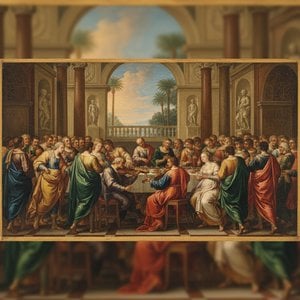
Veronese's reputation rests upon his monumental paintings, particularly those depicting lavish feasts and biblical scenes transformed into dazzling displays of Venetian life. The Wedding at Cana, completed in 1563 for the Benedictine monastery of San Giorgio Maggiore, stands as a testament to his skill. This colossal canvas isn’t merely an illustration of the miracle; it's a vibrant panorama of 16th-century society, teeming with elegantly dressed figures, musicians, and architectural details rendered with breathtaking precision. The painting is not just about what happened at Cana but *how* it would have looked if it had occurred in Venice during Veronese’s time. He meticulously recreated the city's architecture, its canals, and its inhabitants, creating a believable and immersive scene that transports the viewer to another era. Similarly, The Feast in the House of Levi, originally titled The Last Supper, caused controversy with the Inquisition due to its inclusion of contemporary figures and a seemingly irreverent atmosphere. Veronese defended his artistic license, asserting that painters were entitled to the same creative freedom as poets and jesters – a bold statement reflecting his belief in art’s power to interpret and reimagine sacred narratives. These works weren't simply religious depictions; they were celebrations of life, wealth, and the splendor of Venice itself. He wasn’t interested in austere spirituality but rather in capturing the joy and abundance of existence. The figures are not idealized saints but recognizable members of Venetian society, adding a layer of realism and social commentary to the scene.Influences and Artistic Development
While Titian’s influence on Veronese’s colorism is undeniable, his artistic development was a complex interplay of various influences. The architectural precision he brought to his compositions owes much to the classical tradition prevalent in Verona during his formative years, particularly the work of architects like Michele Sanmicheli. He also absorbed elements from Central Italian masters such as Raphael and Parmigianino, evident in the graceful lines and harmonious arrangements within his paintings. However, Veronese didn’t simply imitate these influences; he synthesized them into a uniquely Venetian style characterized by its dramatic use of light, vibrant color palettes, and meticulous attention to detail. He excelled at creating illusions of space and depth, employing perspective techniques to draw viewers into the heart of his elaborate scenes. His mastery of oil painting allowed him to achieve an unparalleled luminosity and richness of texture. He also ran a large workshop, with contributions from his brother Benedetto and sons Gabriele and Carlo, ensuring that his style continued to flourish even after his death in 1588.Major Achievements and Notable Works
Veronese’s career was marked by numerous significant commissions and masterpieces. Beyond the monumental Wedding at Cana and Feast in the House of Levi, he created a series of altarpieces for Venetian churches, including works for the Scuola Grande di San Rocco and the Chiesa di Santa Maria Gloriosa dei Frari. His decoration of the library of S. Marco is considered one of his finest achievements, showcasing his mastery of illusionistic painting and architectural design. The Feast in the House of Levi, with its inclusion of contemporary figures and a playful depiction of the Last Supper, remains a particularly intriguing example of his artistic vision. His ability to seamlessly blend religious themes with secular elements—to portray biblical events within the context of Venetian life—established him as a truly unique and influential artist.- The Wedding at Cana (1563) – Louvre Museum
- Feast in the House of Levi (1573) – Accademia Gallery, Venice
- Decorations for the Library of S. Marco (1556–57) – Venice
Historical Significance and Legacy
Paolo Veronese’s impact extends far beyond the realm of Renaissance art. His work has resonated through centuries, inspiring artists across various disciplines. His dramatic compositions and vibrant color schemes have been cited as influences on everything from Baroque painting to modern cinema—even finding echoes in the visual aesthetics of Spaghetti Westerns. He was part of the “great trio” of Venetian painters—alongside Titian and Tintoretto—each contributing uniquely to the city’s artistic legacy, yet Veronese often stands apart for his sheer exuberance and celebration of earthly pleasures. His paintings continue to captivate audiences with their grandeur and spectacle, offering a glimpse into the opulent world of 16th-century Venice. Veronese's legacy is a testament to his artistic genius, his ability to capture the essence of an era, and his enduring contribution to the history of art.Gyakran Ismételt Kérdések
Hol és melyik országban született Paolo Veronese?
Paolo Veronese Verona városban, Olaszország országban született.
Hány Paolo Veronese alkotása tekinthető meg a katalógusban?
A 426 műalkotás darab alkotást Paolo Veronese részéről a Összes műalkotás oldalon tekintheti meg.
Paolo Veronese műveit műkor movements szerint böngészhetem?
Paolo Veronese művei a művész Összes irányzat oldalán, stílusirányzat szerinti csoportosításban tekinthetők meg.
Milyen színeket használt leggyakrabban Paolo Veronese?
Paolo Veronese Paletta Genom egy olyan oldal, amely bemutatja a művész életművének színes profilját.
Hol és 어느 해 született Paolo Veronese?
Paolo Veronese Verona városban született, 1528 évben.
Honnan származik Paolo Veronese?
Paolo Veronese Olaszország-ban született.
Hogyan találhatom meg Paolo Veronese alkotásainak összes darabját egy adott médiumban?
A Összes médium oldalon Paolo Veronese művei technikák szerint vannak csoportosítva.