The Riga Roots and the Pallas Years
Riga, 1907. The beginnings of Nigul Espe are rooted in this city before his trajectory shifts toward the academic rigor of the Pallas school. Between 1926 and 1932, the focus remains on the dual mastery of painting and furniture art. Under the guidance of Ado Vabbe, the technical foundation takes shape. The transition from student to professional arrives with a sudden, overwhelming display of talent. At his graduation exhibition, Espe bypasses the standard quota of twenty works, presenting fifty instead. This surge of productivity marks the arrival of a freelance artist in Tartu, a man who would soon become a fixture of the local cultural scene.
A Life of Color and Industry
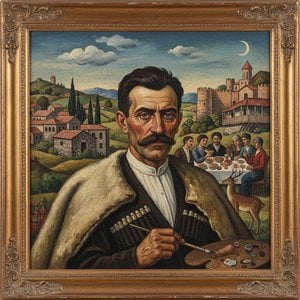
The 1930s find Espe operating at the intersection of art and social life. He manages the "Ko-Ko-Ko" cultural cafe, a space where his own designs and paintings define the atmosphere. His brush moves between the quietude of landscapes populated by staffage and the structured geometry of cityscapes. By the late 1940s, the subject matter shifts toward the grit of the Kiviõli mine and the oil industry. Following field visits in 1947 and 1949, the canvas begins to reflect the heavy themes of oil shale and industrial interiors.
- Landscapes featuring staffage
- Cityscapes and urban views
- Industrial themes and oil shale subjects
- Interior scenes
His technique oscillates between meticulous detail and a more painterly, free application of pigment. There is a specific quality to his color selection; he identifies combinations that transform a scene into something more atmospheric. The palette remains bright, often carrying a joyful undertone even when depicting heavy industrial landscapes.
The Final Chapter in Tallinn
The exhibition history of Espe stretches far beyond the borders of Estonia, reaching as far as Rome and Budapest. His work travels, carrying the specific light and color of his vision to international audiences. He remains a figure of significant activity until his death in Tallinn in 1970. His legacy is found in the tension between the decorative precision of his furniture training and the expressive freedom of his oil paintings.