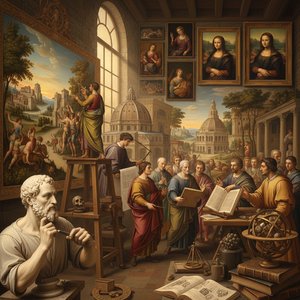
Masaccio (1401-1428): The Dawn of Renaissance Realism
Tommaso di Ser Giovanni di Simone Cassai, better known as Masaccio (meaning "clumsy Tom"), was a pivotal figure in the Early Italian Renaissance. Born on December 21, 1401, in San Giovanni Valdarno, Italy, and dying tragically young in 1428, his brief career revolutionized painting with groundbreaking realism, perspective, and chiaroscuro (the use of strong contrasts between light and dark). Despite his short life, Masaccio’s impact on subsequent generations of artists was profound, establishing a new standard for naturalism and influencing the course of Western art.Early Life and Training
Masaccio's origins were humble; he descended from Ser Giovanni di Mone Cassai, a notary, and Jacopa di Martinozzo di Dino. His family name, Cassai, reflected his paternal grandfather’s trade as a cabinet maker – a craft that instilled in him an appreciation for meticulous detail and craftsmanship. Orphaned at age five when his father succumbed to illness, Masaccio was cared for by his brother Giovanni (Lo Scheggia), who also pursued artistic endeavors. The specifics of Masaccio's formative years remain shrouded in obscurity—a rarity amongst Renaissance artists—underscoring the mystery surrounding his rapid ascent to mastery and his innovative techniques. Scholars believe he began his artistic education around 12, though definitive evidence of a particular teacher has yet to emerge. This lack of documented training contributes to the enduring fascination with Masaccio’s artistic journey. He joined the painters’ guild (Arte de’ Medici e Speziali) in Florence on January 7, 1422, marking his emergence as an independent artist and signaling his commitment to upholding established artistic traditions while simultaneously pushing boundaries.Artistic Development and Major Works
Masaccio's artistic vision was profoundly shaped by Giotto di Bondone, a predecessor who championed naturalism in painting—a stylistic approach that prioritized accurate representation of human anatomy and emotion. However, Masaccio swiftly surpassed Giotto’s achievements in mastering perspective and anatomical precision. He drew inspiration from Filippo Brunelleschi’s groundbreaking rediscovery of linear perspective – a technique that revolutionized artistic space by creating the illusion of depth on a flat surface—and diligently studied Brunelleschi's architectural models to refine his understanding of spatial relationships. Masaccio pioneered several transformative techniques:- Linear Perspective: He meticulously employed vanishing points and mathematical calculations to generate convincing illusions of depth, fundamentally altering how artists depicted reality.
- Chiaroscuro: Masaccio skillfully utilized dramatic contrasts between light and shadow—a technique known as chiaroscuro—to sculpt forms with remarkable realism, conveying mood and emotion through nuanced shading.
Historical Significance and Legacy
Masaccio’s influence extended far beyond his immediate contemporaries; he served as a catalyst for artistic innovation throughout Europe, inspiring artists who would shape the trajectory of the High Renaissance. Giorgio Vasari, a prominent art historian of the 16th century, recognized Masaccio's unparalleled skill in imitating nature—a characteristic that distinguished him from other painters of his time—and lauded him as “the best painter of his generation.” His unwavering dedication to anatomical accuracy and emotional expression established new standards for artistic representation, fundamentally altering how artists conveyed human experience. Despite his untimely demise at the age of 26 – a tragic loss mourned by fellow artists like Filippo Brunelleschi – Masaccio’s legacy persists as one of the most significant achievements in art history. He remains an emblem of artistic brilliance and innovation, forever enshrined as a cornerstone of Western artistic tradition.Kérdések és válaszok
Hol találhatók Masaccio művei művészeti stílusok szerint csoportosítva?
Masaccio alkotásainak különböző stílusirányzatai a művész Összes művészeti irányzat oldalán tekinthetők meg, ahol a műalkotások stílus szerint csoportosítva láthatóak.
Mely történelmi korszakban alkotott Masaccio?
Masaccio a Reneszánsz korszakban alkotott. Ez az időszak a művész tevékenységét a történelembe helyezi.
Hol és 어느 해 született Masaccio?
Masaccio San Giovanni Valdarno városban született, 1401 évben.