The Visionary of the Enlightenment: The Life and Legacy of Louis Gabriel Blanchet
Born in the vibrant heart of Paris in 1705, Louis Gabriel Blanchet emerged as a transformative force within the French artistic landscape, bridging the gap between the theatrical grandeur of the Baroque era and the disciplined elegance of Neoclassicism. His life and career mirrored the profound intellectual shifts of the Enlightenment, as he navigated the transition from an age of emotional intensity to one of classical restraint and reason. While biographical records of his earliest years remain somewhat elusive, Blanchet’s artistic identity was forged through a rigorous foundation in the sculptural arts, a discipline that would forever inform the structural integrity and tactile richness of his later paintings.
The seeds of Blanchet's mastery were sown during his apprenticeship under the esteemed sculptor Jean-Baptiste Simeon Lefèvre. This formative period provided him with much more than mere technical instruction in the carving of marble and bronze; it instilled in him a profound reverence for classical principles and the pursuit of beauty as an expression of divine order. Through Lefèvre, Blanchet learned to appreciate the weight, volume, and anatomical precision required to breathe life into stone—qualities that would later permeate his canvases. This sculptural sensibility allowed him to approach painting not merely as a play of light, but as a construction of form, where every figure possessed a monumental presence and a palpable sense of physical reality.
A Mastery of Style: From Baroque Drama to Neoclassical Grace
Blanchet’s early creative output was deeply steeped in the Baroque tradition, characterized by a fascination with dramatic narratives and emotional depth. Drawing inspiration from masters such as Nicolas Frémiet and François Girardon, his early works often utilized dynamic compositions and vibrant, expressive brushstrokes to evoke visceral responses from the viewer. In pieces like “Saint George and the Dragon,” one can witness the artist's ability to capture theatrical grandeur, using light and shadow to heighten the tension of the struggle and the heroism of the subject.
As the cultural tides of Europe shifted toward the Enlightenment, so too did Blanchet’s aesthetic. He seamlessly transitioned into the Neoclassical style, a movement that favored clarity, symmetry, and a return to the idealized forms of antiquity. This evolution is perhaps most strikingly realized in his 1765 masterpiece, “The Borghese Warrior in a Niche.” In this work, the artist demonstrates a sophisticated command of chiaroscuro, using rich contrasts to define a powerfully rendered nude figure set within an architectural framework. The painting serves as a testament to his ability to marry the dramatic lighting of his Baroque roots with the structured, disciplined composition of the Neoclassical era.
Portraiture and the Documentation of an Era
Beyond his historical and mythological endeavors, Blanchet gained significant renown as a portraitist capable of capturing the very essence of the 18th-century elite. His portraits were not merely likenesses but carefully constructed narratives of social status and personal character. He possessed a remarkable ability to utilize soft colors and delicate lines to convey the refinement of his subjects, often employing subtle details in attire and accessories to communicate their intellect and standing.
His notable achievements include:
- Portraits of Royalty: His skill in capturing the dignity of prominent figures, such as Prince Charles Edward Stuart and his brother Henry Stuart, solidified his position within the upper echelons of French society.
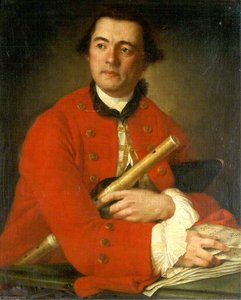
- Character Studies: In works like “James Grant of Lettock” (1760), Blanchet moved beyond mere formal portraiture to present subjects as cultured individuals, using elements like musical notation to highlight their personal accomplishments and intellectual pursuits.
- Multidisciplinary Impact: His rare ability to move between the realms of painting, sculpture, and architectural design allowed him to contribute to a cohesive aesthetic vision that defined much of Parisian culture during his lifetime.
Ultimately, the historical significance of Louis Gabriel Blanchet lies in his role as an artistic bridge. He stood at the crossroads of two centuries, absorbing the passion of the old world and refining it through the intellectual rigor of the new. His enduring legacy is found in the strength of his compositions and a technical precision that continues to captivate art historians and enthusiasts alike, marking him as a true visionary of the Enlightenment.