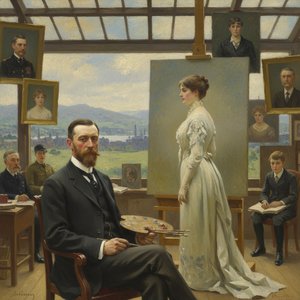
John Collier: A Pre-Raphaelite Master of Portraiture
John Maler Collier, a name perhaps less familiar today than some of his contemporaries, nevertheless occupies a significant place in the annals of Victorian art. Born in London in 1850 and passing away in 1934, he dedicated his life to capturing the essence of British society through the medium of portraiture, imbuing each canvas with a Pre-Raphaelite sensibility that emphasized meticulous detail, vibrant color, and a subtle narrative depth. His legacy extends beyond mere likeness; Collier sought to reveal character, status, and even a hint of the sitter’s inner world within the confines of his carefully constructed compositions.
A Privileged Upbringing and Artistic Formation
Collier's journey began in an environment steeped in privilege and intellectual pursuit. His family boasted a distinguished lineage – a Quaker merchant grandfather who served as Member of Parliament, and a father who ascended to the roles of Attorney General and judge in the Privy Council. This advantageous background provided him with access to quality education at Eton College, laying the groundwork for his later artistic endeavors. Formal training commenced at the Munich Academy, where he honed his skills under established masters, absorbing the principles of classical technique. Further enriching his artistic palette was a period of study in Paris, working alongside Jean-Paul Laurens, whose influence is subtly discernible in Collier’s approach to composition and dramatic lighting. These formative experiences shaped him into an artist poised to embrace the Pre-Raphaelite aesthetic.
The Pre-Raphaelite Vision: Portraits with Narrative Depth
Collier's artistic style is inextricably linked to the Pre-Raphaelite Brotherhood, a movement that championed a return to the detailed realism and vibrant colors of medieval art. Unlike some of his contemporaries who embraced more abstract or impressionistic approaches, Collier remained steadfast in his commitment to meticulous observation and faithful representation. However, he transcended mere replication; his portraits are not simply likenesses but carefully constructed narratives. He masterfully employed symbolism and subtle gestures to convey deeper meanings about his subjects – their social standing, intellectual pursuits, or even their personal histories. The rich color palettes characteristic of the Pre-Raphaelites are evident in Collier’s work, lending a luminous quality to his portraits that draws the viewer into the world he created.
Capturing the Faces of an Era: Notable Sittings and Royal Commissions
Collier's reputation as a leading portrait painter rested on his ability to secure commissions from some of the most prominent figures of his time. His studio doors welcomed luminaries from across British society, including Charles Darwin, whose thoughtful gaze he immortalized with remarkable accuracy; Thomas Henry Huxley, his father-in-law and a towering figure in Victorian science; Rudyard Kipling, the celebrated author; and even Sir Lawrence Alma-Tadema, another esteemed artist. He also received significant royal patronage, undertaking portraits of the Duke of York (later King George V) as Master of Trinity House, and the Prince of Wales (later Edward VIII), a portrait that was prominently displayed at the Durbar Hall in Jodhpur, Rajputana – a testament to his artistic standing on the world stage. These commissions solidified his position among the elite portraitists of the era.
A Lasting Legacy: Beyond Likeness and into Character
While Collier’s work experienced fluctuations in critical reception throughout his career—some finding his style overly solemn, others praising his vibrant color sense—his contribution to Victorian art remains undeniable. His meticulous record-keeping, documented in the “Sitters Book” now housed at the National Portrait Gallery, provides invaluable insight into his artistic process and the individuals he portrayed. The fact that sixteen of his paintings reside within the National Portrait Gallery’s collection, alongside two held by the Tate Gallery, speaks to the enduring appeal and historical significance of his work. John Collier's portraits offer a captivating glimpse into the lives and personalities of those who shaped Victorian Britain, ensuring his place as a master of portraiture whose legacy continues to resonate today.
Kérdések és válaszok
Hol találhatók John Collier művei technika szerint csoportosítva?
A Minden médium oldalon John Collier művei technikák szerint vannak csoportosítva.
Hol tekinthetők meg John Collier műveit témakör szerint csoportosítva?
A Témakörök katalógusa oldalon John Collier művei témánként bö phậníthetők be.
Hogyan találhatok John Collier műveit egy adott témában?
John Collier Kulcsszavak szerint oldala a művész alkotásait kulcsszavak alapján csoportosítja.