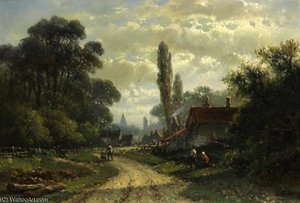
Early Life and Training
Abraham Hulk Senior, a towering figure in Anglo-Dutch marine painting, was born on May 1, 1813, in London—a son of Hendrik Hulk, a prosperous textile merchant, and Mary Burroughs. His artistic journey began not within the confines of formal academies but amidst the vibrant cultural landscape of his upbringing. Initially apprenticed to Jean Augustin Daiwaille (1786–1850), a celebrated portraitist, Hulk honed his skills in capturing human likeness before embarking on a more ambitious pursuit: mastering the art of depicting the sea—a passion that would define his entire career. He excelled at the Rijksacademie in Amsterdam, absorbing the stylistic precepts of luminism and embracing the Romantic spirit prevalent during his formative years.Artistic Career and Notable Works
A pivotal moment arrived in 1833 when Hulk embarked on a transatlantic voyage to America—a trip that profoundly impacted his artistic sensibilities. Visiting New York and Boston, he immersed himself in the burgeoning American art scene, absorbing influences from Hudson River School painters like Frederic Church. Upon returning to Amsterdam, Hulk swiftly established himself as a champion of marine painting, earning the moniker “patriarch” among a lineage of Anglo-Dutch artists—a testament to his enduring legacy. His oeuvre boasts masterpieces such as "Study of Pine Trees," an exquisite demonstration of meticulous observation and tonal subtlety; "Sea Battle at La Hogue," circa 1701 (though not solely his own), which embodies the grandeur and drama characteristic of Baroque maritime art; and “Self-Portrait with Gray Felt Hat,” a rare glimpse into Hulk’s artistic introspection—a piece that transcends mere representation to convey emotion and psychological depth.Exhibitions and Legacy
Hulk's dedication to his craft was recognized through numerous exhibitions, most notably at the Royal Academy in London from 1876 to 1890, where two of his Dutch seascapes captivated audiences. He also graced galleries in Suffolk Street and Leeuwarden and The Hague with his artistic presence between 1843 and 1868. His influence extended beyond the confines of individual artworks; Hulk’s stylistic innovations—particularly his masterful use of atmospheric perspective and luminous color palettes—established a benchmark for subsequent generations of marine painters. He is remembered not merely as a painter but as a pivotal figure in shaping the aesthetic sensibilities of Victorian Britain.Family and Later Life
Abraham Hulk Senior married Maria Wilhelmina van der Meulen, forging a familial bond that mirrored his artistic pursuits. Together they raised two daughters and three sons—all of whom embraced the art world to varying degrees—continuing Hulk’s family tradition of creative excellence. His brother Johannes Frederik Hulk Senior (1829–1911), who also pursued painting as a vocation, further solidified Hulk's place in artistic history. The legacy of Abraham Hulk Senior persists today, inspiring artists and scholars alike to revisit his groundbreaking contributions to maritime art and to appreciate the enduring power of Romantic idealism.Gyakran Ismételt Kérdések
Hulk Ábrahám műveit témák szerint is felfedezhetem?
Hulk Ábrahám Témakör-atlasz oldala olyan felület, amely a művész alkotásait témák szerint rendszerezi.
Hol tekinthetném meg Hulk Ábrahám munkásságának színprofilját?
Hulk Ábrahám színek használata a ez a weboldal oldalon található műveiben a művész Paletta Genom oldalán tanulmányozható.
Hol találhatók Hulk Ábrahám művei szín szerinti csoportosítással?
Hulk Ábrahám Színspektrum index oldala olyan felület, amely a művész alkotásait színek szerint csoportosítja.
Mely történelmi korszakban alkotott Hulk Ábrahám?
Hulk Ábrahám a 19. század korszakban alkotott. Ez az időszak a művész tevékenységét a történelembe helyezi.
Létezik-e egy időrendi áttekintés Hulk Ábrahám műveiről?
Megக் exists egy időrendi áttekintés Hulk Ábrahám műveiről: a művész Műalkotások időrendje oldala a alkotások létrehozásának dátuma szerint rendszerezi a műveket.
Létezik-e teljes lista Hulk Ábrahám műពី listája?
Hulk Ábrahám minden alkotása a ez a weboldal oldalán megtekinthető az alkotó Összes műalkotás oldalán.
Hol és melyik országban született Hulk Ábrahám?
Hulk Ábrahám Amsterdam városban, Holland országban született.
Mely művészeti irányzatokban dolgozott Hulk Ábrahám?
Hulk Ábrahám művész alkotásainak különböző irányzatait a művész Összes irányzat oldalán tekintheti meg, ahol a műalkotások stílusirányzat szerinti csoportosításban láthatóak.