A Life Rooted in the American Landscape
Asher Brown Durand, born August 21, 1796, in Maplewood, New Jersey, wasn’t initially destined for a life immersed in paint and canvas. His early years were shaped by the practical world of his father, a watchmaker and silversmith – a profession that instilled in him an extraordinary attention to detail, a meticulousness that would later become fundamental to his artistic approach. This grounding in craftsmanship led him down an unexpected path: an apprenticeship with the engraver Peter Maverick in 1812. Initially, Durand seemed destined for a career within the precise lines of engraving, and he quickly proved himself exceptionally skilled, rising through the ranks of the firm and establishing its New York City branch. His reputation as an engraver soared dramatically after completing the intricate reproduction of John Trumbull’s *The Declaration of Independence* in 1823 – a monumental undertaking that firmly cemented his standing within the artistic community. However, beneath the surface of this exacting craft lay a burgeoning passion for capturing the raw beauty and grandeur of the natural world, a calling that would ultimately transform him into one of America's most celebrated landscape painters.From Engraving to Embracing Nature’s Palette
The transition from meticulous engraver to a painter dedicated to capturing the essence of nature wasn’t immediate or straightforward. Durand continued his engraving work while simultaneously exploring painting, initially focusing on portraiture and genre scenes – works that showcased his technical skill but didn't fully satisfy his artistic aspirations. A pivotal moment arrived in the 1830s through the patronage of Luman Reed, a wealthy merchant who recognized Durand’s potential and provided him with the financial support to dedicate himself more fully to painting. Reed’s encouragement, coupled with a transformative sketching expedition with his close friend, Thomas Cole, in the Adirondacks during the summer of 1837, proved to be a catalyst for change. This journey into the untamed wilderness – a vast expanse of mountains, lakes, and forests – fundamentally altered Durand's artistic perspective. He discovered a profound connection to the American landscape, an overwhelming sense of awe and wonder that compelled him to translate these experiences onto canvas. He began spending his summers immersed in nature, meticulously documenting the Catskills, Adirondacks, and White Mountains through countless drawings and oil sketches; each stroke was deliberate, informed by a deep understanding of light, shadow, and texture. These preliminary studies weren’t merely preparatory exercises; they were integral to his artistic process, informing the composition, color palette, and overall mood of his finished paintings.A Founding Voice of the Hudson River School
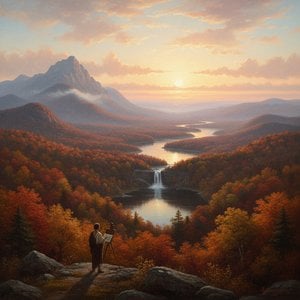
Durand's dedication to landscape painting aligned him with a burgeoning group of artists who shared a similar vision – a movement that would soon be recognized as the Hudson River School. This school wasn’t simply about depicting picturesque scenery; it was about imbuing landscapes with emotional resonance, spiritual significance, and a profound connection to the divine. Durand became one of its founding members, alongside Cole, and played a crucial role in establishing the school's distinctive aesthetic. The Hudson River School painters sought to capture not just the appearance of nature but also its essence – its power, beauty, and majesty. Durand’s work embodies this philosophy, characterized by an extraordinary level of realism combined with a romantic sensibility. He believed in observing nature with unwavering accuracy, meticulously rendering every detail from the texture of bark to the play of light on water. Yet, he also recognized that landscapes could evoke powerful emotions – feelings of awe, reverence, and even spiritual transcendence. His paintings weren’t merely representations of places; they were expressions of his deep connection to the American wilderness and a celebration of God's creation.Major Achievements and Artistic Style
Durand’s artistic style evolved significantly throughout his career, reflecting his deepening understanding of landscape painting. Initially influenced by the precision of engraving, he gradually developed a looser, more expressive brushstroke – a technique that allowed him to capture the fleeting effects of light and atmosphere. His paintings are renowned for their meticulous detail, vibrant colors, and atmospheric perspective. He was particularly adept at depicting trees, capturing their complex forms and textures with remarkable accuracy. His most celebrated works include *The Solitary Oak* (1846), a powerful depiction of an ancient tree standing alone in a vast landscape; *Sketch in the Woods* (1838), which captures the dappled light filtering through the trees; and *Kindred Spirits* (1849), a monumental painting that depicts Cole and poet William Cullen Bryant amidst a serene woodland scene – a testament to their shared appreciation for nature. Durand’s influence extended beyond his own artistic output, as he served as president of the National Academy of Design from 1845 to 1861, using his position to champion American art and nurture emerging talent.Legacy and Enduring Influence
Asher Brown Durand's legacy extends far beyond his individual paintings. He was a pivotal figure in shaping the course of American landscape painting, establishing new standards for realism and artistic expression. His “Letters on Landscape Painting,” published in *The Crayon* in 1855, articulated his artistic principles and advocated for direct observation from nature – a philosophy that continues to resonate with artists today. Durand’s commitment to capturing the beauty and spiritual significance of the American wilderness cemented his place as one of the most important figures in the Hudson River School and a lasting influence on generations of landscape painters. His paintings, now housed in major museums across the country, offer viewers a glimpse into 19th-century America – a nation grappling with its identity while simultaneously discovering the profound beauty and spiritual power of its natural landscapes.Kérdések és válaszok
Asher Brown Durand műveit műkorok szerint is böngészhetem?
Asher Brown Durand művei stílusirányzat szerinti csoportosításban tekinthetők meg a művész Összes művészeti irányzat oldalán.
Hogyan fejlődött Asher Brown Durand művészete az idő múlásával?
Asher Brown Durand pályafutása időszakosan nyílik meg a művész Krónika oldalán: egy horizontális időrendi vonal a műalkotásokról, amelyek a karrier szakaszaira oszlanak.
Látogathatom Asher Brown Durand műveinek virtuális múzeumát?
Asher Brown Durand művei megtekinthetők a művész virtuális, 3D-s galériájában, a 3D Galéria oldalon.