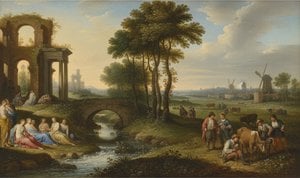
A Life Woven in Landscape: The World of Denijs van Alsloot
Denijs van Alsloot, a name resonating softly through the annals of Flemish art, occupies a fascinating transitional space between the established traditions of the 16th century and the burgeoning Baroque dynamism of the 17th. Born around 1570 in either Mechelen or Brussels, Belgium, his origins were steeped in the craft of tapestry – his father’s profession providing an early immersion into design and visual composition. Though details surrounding his formal artistic training remain elusive, it's clear that this familial connection to textile arts laid a foundational aesthetic sensibility for the young Alsloot. He entered the Brussels Guild of St Luke in 1599 as a tapestry designer, initially focusing on this craft before gradually shifting towards painting, taking on his first pupil the same year and continuing to mentor apprentices until 1625. This period suggests a deliberate evolution, a honing of skills that would eventually blossom into a distinctive landscape style.Early Life and Artistic Beginnings
Information about Denijs van Alsloot’s formative years is scarce, reflecting the limitations of archival records from the period. He was born in Mechelen or Brussels—precise documentation remains elusive—and his father practiced tapestry weaving, an occupation that instilled within him a profound understanding of pattern, color, and compositional balance – elements crucial to both textile design and subsequent painting endeavors. Unlike many artists of his time who benefited from privileged educations, Alsloot’s artistic development appears to have been largely self-directed, fueled by observation and experimentation. His entry into the Brussels Guild of St Luke in 1599 marks a pivotal moment, establishing him within the framework of Flemish artistic practice and signaling his commitment to mastering established techniques. Simultaneously, he took on his first pupil that same year, demonstrating an early inclination for mentorship and fostering the transmission of artistic knowledge—a characteristic that would define his career trajectory.Court Painter and Patronage
A transformative juncture arrived around 1606 when Denijs van Alsloot ascended to the role of court painter to Albert VII., Archduke of Austria, and Isabella Clara Eugenia, the Habsburg ruler of the Spanish Netherlands. This prestigious appointment wasn’t merely a matter of prestige; it constituted a significant catalyst for his artistic advancement, securing him access to influential patrons—nobles and dignitaries—who commissioned elaborate landscapes and genre scenes reflecting the grandeur and daily life of their courts. He excelled at capturing ceremonial processions, festive celebrations, and architectural vistas—images that served as visual records of Habsburg rule in Brussels and its environs. Notably, Isabella herself entrusted him with the monumental task of depicting eight panels commemorating the Ommegang procession of 1615—a commission that yielded one of his most celebrated works now housed in London’s Victoria and Albert Museum. This undertaking underscored the Archduchess’s appreciation for Alsloot's artistic prowess and cemented his reputation as a master of historical painting, skillfully blending topographical accuracy with dramatic narrative elements.The Sonian Forest School: Style and Technique
Denijs van Alsloot is considered to be a cornerstone figure within the Sonian Forest school of landscape painters—a movement characterized by its preference for depicting scenes from the expansive woodlands surrounding Brussels. This stylistic inclination wasn’t merely dictated by geographical proximity; it reflected a shared aesthetic sensibility rooted in meticulous observation and an unwavering commitment to capturing atmospheric conditions—misty mornings, dappled sunlight, and autumnal hues—with remarkable realism. His landscapes frequently employed techniques reminiscent of earlier masters, notably Gillis van Coninxloo, yet Alsloot's work distinguishes itself through a calmer palette, greater compositional restraint, and heightened attention to detail—a stylistic hallmark that positioned him between the expressive fervor of Coninxloo and the monumental grandeur of Jan Brueghel the Elder. He skillfully utilized *dolci*, or soft brushstrokes, creating luminous surfaces and subtly modulating tonal values—techniques that conveyed a profound sense of depth and spatial illusion.Legacy and Artistic Influence
Despite his untimely demise around 1626—likely preceding 1628—Denijs van Alsloot’s artistic legacy persists as evidenced by the enduring presence of his paintings in prominent museums across Europe, including the Museo Nacional del Prado in Madrid and the Victoria and Albert Museum in London. He is remembered not only for his technical virtuosity—his mastery of perspective, color theory, and topographical representation—but also for his contribution to documenting 17th-century Brussels society through evocative landscapes and genre scenes. His depictions of festivals, processions, and architectural vistas offer invaluable insights into the cultural milieu of Habsburg rule—a testament to his enduring influence on Flemish art history. As a pivotal representative of the Sonian Forest school and a transitional figure bridging earlier landscape traditions with the burgeoning Baroque style, Van Alsloot remains a subject of scholarly fascination—a symbol of artistic innovation and a conduit for conveying the spirit of an era.Gyakran Ismételt Kérdések
Hol találhatók Denis Van Alsloot művei kulcsszavakra csoportosítva?
Denis Van Alsloot Kulcsszavak alapján oldala a művész alkotásait kulcsszavak alapján csoportosítja.
Van-e kronológiai ismertetés Denis Van Alsloot életművének?
Denis Van Alsloot munkásságának időrendi áttekintése a művész Krónika oldalán érhető el, ahol az alkotások fejezetről fejezetre, a készítés sorrendjében követhetők egymást.
Hol és melyik országban született Denis Van Alsloot?
Denis Van Alsloot Mechelen városban, Belgium országban született.