

Sacred Narratives on Canvas: Exploring Devotional Imagery Across Art History

Tartalomjegyzék
The Roots of Sacred Art: From Ancient Rituals to Early Christian Symbolism
Religious art is a visual representation of religious ideologies and their relationship with humans. Sacred art directly relates to religious art in the sense that its purpose is for worship and religious practices. According to one set of definition...
Long before the Renaissance brushstrokes that define so much of our understanding of religious art, humanity sought to visualize the divine. The impulse wasn’t merely aesthetic; it was fundamentally devotional. From the cave paintings of prehistoric times – often interpreted as sympathetic magic intended to ensure successful hunts, but also hinting at a reverence for the animal world and its spirits – to the elaborate funerary rituals of ancient Egypt, art served as a conduit between the earthly and the spiritual realms. The Egyptians, with their meticulously detailed depictions of gods, pharaohs, and the afterlife, established conventions of iconography that would resonate through millennia. Their vibrant murals weren’t simply decoration; they were believed to actively participate in the journey of the soul. Similarly, Mesopotamian votive figures, small sculptures left as offerings to deities, demonstrate an early desire to create a physical representation of faith. These nascent forms laid the groundwork for more complex systems of religious imagery that blossomed with the rise of organized religions.
The transition from polytheistic beliefs to monotheism presented unique challenges and opportunities for artistic expression. Early Christian art, emerging in the Roman catacombs, initially shied away from direct representation of Christ or biblical scenes due to lingering associations with pagan idolatry. Instead, artists employed symbolism – a fish (ichthys) representing Jesus, the lamb symbolizing sacrifice, the anchor signifying hope – to convey their beliefs discreetly. These early symbols weren’t arbitrary; they were coded messages understood by initiates within the community. As Christianity gained acceptance, however, so too did its visual language evolve. The mosaics of Ravenna, shimmering with gold and depicting Christ as a powerful shepherd or triumphant ruler, marked a shift towards more overt displays of faith and a growing confidence in representing the divine figure.
Medieval Devotion: Icons, Frescoes, and Illuminations as Vessels of Faith
 Saint Stephen
Explore Giotto’s ‘Saint Stephen’! A masterpiece of Proto-Renaissance painting featuring lifelike figures & innovative perspective. Discover this iconic artwork's beauty and historical significance.
The Medieval period witnessed an explosion of religious art fueled by unwavering belief and the patronage of powerful institutions like the Church. Icons, particularly prevalent in Eastern Orthodox traditions, weren’t merely paintings; they were considered windows into heaven, imbued with a sacred presence. Created according to strict canons – precise rules governing composition, color, and technique – icons aimed not at realistic representation but at conveying spiritual truth. The stylized figures, elongated limbs, and golden backgrounds served to distance the image from the earthly realm, emphasizing its otherworldly nature. Frescoes, adorning the walls of churches and cathedrals across Europe, functioned as visual sermons, narrating biblical stories for a largely illiterate population. Giotto di Bondone’s frescoes in the Scrovegni Chapel in Padua represent a pivotal moment in this evolution; his figures, though still stylized, possess a newfound sense of volume and emotional depth, foreshadowing the Renaissance emphasis on realism.
Illuminated manuscripts, painstakingly crafted by monks in scriptoria, were another vital form of devotional art. These lavishly decorated books weren’t simply repositories of religious texts; they were objects of beauty intended to inspire reverence and facilitate contemplation. The intricate details, vibrant colors, and delicate gold leaf work transformed the act of reading into a spiritual experience. The Book of Kells, with its complex interlace patterns and stunning depictions of biblical scenes, stands as a testament to the artistry and devotion of medieval scribes.
Renaissance Transformations: Humanism, Realism, and the Depiction of Religious Narratives
 Madonna and Child with an Angel
Experience Sandro Botticelli’s ‘Madonna & Child’! A serene Renaissance masterpiece of grace & devotion. Admire its rich colors & elegant composition – perfect for art lovers.
The Renaissance marked a profound shift in artistic priorities. Fueled by a renewed interest in classical antiquity and the burgeoning humanist philosophy, artists began to explore the human form with unprecedented accuracy and emotional nuance. While religious themes remained dominant, they were now approached through a distinctly humanistic lens. Artists like Sandro Botticelli, in his serene “Madonna & Child,” imbued their subjects with grace, beauty, and a sense of earthly tenderness. The focus shifted from purely symbolic representation to portraying the humanity of Christ, Mary, and the saints.
This emphasis on realism wasn’t simply about technical skill; it was driven by a desire to connect with the divine on a more personal level. The use of perspective, pioneered by artists like Masaccio, created a sense of depth and immersion, drawing viewers into the scene. The study of anatomy allowed artists to depict the human body with greater accuracy and expressiveness. This period also saw the rise of altarpieces – elaborate multi-paneled paintings that served as focal points for worship. Artists such as Zanobi Machiavelli excelled in these devotional works, creating detailed depictions of saints and biblical figures designed to inspire piety.
Symbolism Unveiled: Decoding Common Motifs in Religious Painting
A halo (from Ancient Greek ἅλως, hálōs, 'threshing floor, disk'), also called a nimbus, aureole, glory or gloriole (Latin: gloriola, lit. 'little glory'), is a crown of light rays, circle or disk of light that surrounds a person in works of art. Th...
Throughout the history of religious art, certain motifs have recurred with remarkable consistency, each carrying layers of symbolic meaning. The halo, originating in ancient traditions as a representation of divine radiance, became universally associated with saints and holy figures. Its color – gold signifying spiritual purity, red representing martyrdom – further refined its significance. The use of light and shadow was also deeply symbolic; light often represented God’s grace or divine knowledge, while darkness symbolized evil or ignorance.
Flowers, too, held specific meanings: lilies representing purity, roses symbolizing love and sacrifice, and irises signifying sorrow. Animals were frequently employed as symbols – the dove representing the Holy Spirit, the lamb embodying Christ’s innocence, and the peacock associated with resurrection. Understanding these symbolic codes is crucial to fully appreciating the depth and complexity of religious paintings. For example, the positioning of figures within a composition often conveyed hierarchical importance; Christ typically occupies the central position, surrounded by his apostles or saints. The garments worn by figures also held significance – blue representing Mary’s purity, red symbolizing Christ’s sacrifice.
Global Expressions of Sacred Art: Exploring Traditions Beyond Europe
 Garcia Fernandes
Discover garcia fernandes, a renowned Portuguese Renaissance painter known for his exquisite altarpieces, religious themes, and masterpieces in Lisbon, Coimbra, and Portuguese India. Explore his artistic legacy today.
While European religious art often dominates our understanding of the genre, devotional imagery flourished in diverse cultures around the world. In India, Hindu and Buddhist painting traditions developed unique styles and symbolism. Mandalas, intricate geometric diagrams representing the cosmos, served as aids to meditation and visual representations of enlightenment. Tanjore paintings, characterized by their vibrant colors, gold leaf embellishments, and depictions of deities, were created for temple worship and personal devotion.
In Tibet, Thangka paintings – elaborate silk scrolls depicting Buddhist saints and deities – played a central role in religious practice. These meticulously crafted artworks weren’t simply decorative; they were considered sacred objects imbued with spiritual power. Similarly, Islamic art, while often eschewing direct representation of figures due to theological constraints, developed sophisticated geometric patterns and calligraphy that served as expressions of faith. Garcia Fernandes, a Portuguese Renaissance painter who worked extensively in India, exemplifies the cross-cultural exchange of artistic ideas during this period.
The Enduring Legacy: How Devotional Art Continues to Inspire Today
Despite evolving cultural landscapes and shifting religious beliefs, devotional art continues to resonate with audiences today. The masterpieces of the past – from the icons of Byzantium to the frescoes of Giotto and the paintings of Botticelli – remain powerful expressions of faith, beauty, and human emotion. The enduring appeal lies not only in their artistic merit but also in their ability to connect us to something larger than ourselves.
At ArtsDot.com, we are committed to making these timeless works accessible to everyone. Through our handmade oil paintings and museum-quality prints, we strive to preserve the legacy of these artistic traditions and inspire a new generation of art lovers. Whether you’re seeking a stunning reproduction for your home or simply wish to explore the rich history of devotional art, we invite you to discover the beauty and meaning that lies within these sacred canvases.
Kapcsolódó cikkek
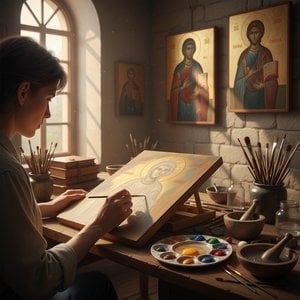
Illuminating Surfaces: A Comprehensive Exploration of Tempera on Panel Painting Techniques & Historical Significance
Explore the rich history & techniques of tempera painting! Discover Renaissance masters like Botticelli & Fra Angelico, conservation insights, and the enduring legacy of this captivating art form. Learn more now!


A művészettörténet 10 legikonikusabb tempera festménye – ArtsDot
Fedezze fel a művészettörténet 10 legjelentősebb tempera festményét! Giotto, Botticelli és más mesterek alkotásainak története – technikák, színek, inspiráció. Múzeumminőségű reprodukciók otthonába a ArtsDot-on. Explore the full collection online!

Filippo Lippi: Bridging Renaissance Devotion & Artistic Innovation
Explore the life & revolutionary art of Filippo Lippi, a pivotal Renaissance painter. Discover his masterpieces, influence on Botticelli, and investment potential. Expert analysis at ArtsDot.

Portrayals of Power & Perception: A Historical Survey of Women in Art
Explore the rich history of women in art – from iconic muses to groundbreaking artists. Discover feminist movements & reclaim female narratives with ArtsDot. Expert insights for discerning collectors.

Devotion Embodied: Exploring Representations of Piety in Western Art History
Explore the rich history of piety in Western art! Discover iconic Renaissance masterpieces, Baroque symbolism & El Greco's spiritual intensity. Expert analysis for collectors and enthusiasts.

