Richard Alexandrovich Bergholz: A Painter of Russian Light and Landscape
Born in St. Petersburg in 1865, Richard Alexandrovich Bergholz emerged as a significant figure in late 19th and early 20th-century Russian landscape painting. His work, characterized by a luminous quality and an intimate understanding of the Russian countryside, reflects both the influence of the Hudson River School and a distinctly European sensibility – particularly evident in his time spent studying in Naples and Paris. Bergholz’s legacy lies not just in the beauty of his paintings but also in his contribution to establishing a recognizable style within the evolving landscape tradition of Russia.
Early influences shaped Bergholz's artistic trajectory. His formal training began in St. Petersburg, providing him with a foundational knowledge of Russian art history and technique. However, it was his relocation to Italy in 1887 that proved pivotal. The vibrant light and dramatic landscapes of the Italian south ignited within him a passion for capturing atmospheric effects – a core element of what would become his signature style. This period fostered an appreciation for color and light, qualities he later expertly translated onto canvas.
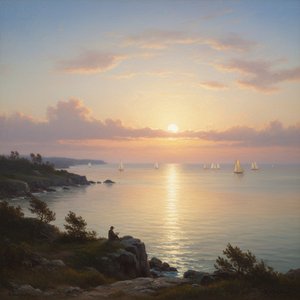
Returning to Russia, Bergholz continued to refine his artistic vision. He embraced the tenets of Luminism, a movement emphasizing the subtle interplay of light and shadow to evoke mood and atmosphere. Unlike the more grandiose scenes often depicted by his contemporaries, Bergholz focused on smaller, more intimate landscapes – often featuring lakes, forests, and glimpses of rural life. His subjects weren’t heroic or dramatic; instead, he sought to capture the quiet beauty of everyday moments in nature. His paintings frequently depict Murano Lagoons, A Hut, and scenes of Russian countryside.
The Influence of European Art and Techniques
Bergholz's artistic development was profoundly shaped by his exposure to European art movements. His time in Paris introduced him to Impressionism and Post-Impressionism, particularly the work of artists like Monet and Pissarro. He adopted their techniques for capturing fleeting moments of light and color, translating them into a distinctly Russian context. The influence is subtle – not a direct imitation but rather an absorption of principles that informed his approach to landscape painting. His use of broken brushstrokes and vibrant hues demonstrates this assimilation.
Furthermore, the artistic traditions of Italy played a crucial role. Studying under F. Peluso in Naples provided him with invaluable experience in watercolor techniques – a medium he mastered with remarkable skill. Watercolor allowed him to achieve delicate gradations of color and capture the ephemeral qualities of light with unparalleled subtlety. This mastery is evident in his many luminous landscapes, where colors seem to shimmer and dance on the canvas.
Key Works and Artistic Style
Bergholz’s oeuvre comprises a substantial body of work, primarily watercolors and oils depicting Russian landscapes. Notable works include “Murano Lagoons,” “A Hut,” and numerous scenes capturing the beauty of the Russian countryside. These paintings are characterized by their atmospheric quality, delicate color palettes, and meticulous attention to detail. He was particularly adept at portraying the effects of light on water surfaces – a skill that earned him considerable acclaim.
His style can be described as a synthesis of Russian realism and European Impressionism. He retained a strong sense of observation and fidelity to nature but infused his paintings with an emotional depth and sensitivity that resonated deeply with viewers. The compositions are often carefully constructed, guiding the eye through the scene and creating a sense of spatial harmony.
Recognition and Legacy
Richard Alexandrovich Bergholz’s artistic achievements were recognized during his lifetime. He was awarded the title of academician in 1912, a significant honor that reflected his standing within the Russian art community. His works are now held in prominent museums throughout Russia, including the State Tretyakov Gallery and the State Russian Museum, ensuring their continued appreciation by future generations.
Despite the turbulent events of the early 20th century, Bergholz’s legacy endures as a master of Russian landscape painting. His paintings continue to captivate viewers with their luminous beauty and evocative power – a testament to his artistic skill and profound understanding of the natural world. His work remains an important example of Luminism in Russia, bridging European influences with uniquely Russian sensibilities.