Early Life, Family and Training
Léon Auguste César Hodebert entered the world on June 27, 1851, in the quiet surroundings of Saint-Michel-sur-Loire, France. He was born into a family of modest means, the son of Auguste César Haudebert, a merchant, and Léonie Marie, who was born into the Trochu family. His early years in the department of Indre-et-Loire provided a foundation far removed from the bustling studios of the capital, yet the seeds of his future vocation were already present in the lineage of his parents.
The young man’s path eventually led him toward the rigorous discipline of formal instruction. He sought out the guidance of established masters to refine his hand and eye. He became a student of the painter Louis Marie Charles de Bodin de Galembert, a mentorship that would shape his understanding of form and composition. Beyond the lessons of Galembert, his training was further enriched by the influence of Achille and Eugene Deveria, whose presence in his education helped mold his developing skill as a painter and lithographer.
Career and Professional Activity
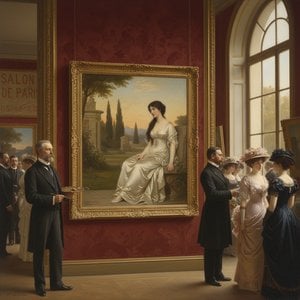
His emergence into the professional art circles of France began in earnest during the late 1870s. He first presented his work to the public at the Salon de Paris in 1877, returning to those same halls in 1879. This early exposure paved the way for a long and steady presence within the prestigious Salon des artistes français, where his paintings were exhibited consistently from 1880 until 1909. His standing within the artistic community grew as the years passed, culminating in his election as a member of the Société des Artistes Français in 1889.
The artist's life was marked by a series of movements across the French landscape. During the early years of the new century, specifically in 1902 and 1903, he spent his time navigating between Beauvais, Mont-Saint-Aignan near Rouen, and the bustling streets of Paris. These transitions reflected a life in motion, seeking new environments for his practice. Eventually, he found a permanent home in Lille. It was there that he transitioned from a solitary creator to a mentor, dedicating his later years to teaching at the local art school and shaping the hands of the next generation of painters.
Artistic Style and Subject Matter
A master of the human figure, Hodebert dedicated much of his creative life to the traditions of French Academic Classical painting. He possessed a particular talent for capturing the grace of the female form, often rendering female nudes in a disciplined academic style that emphasized anatomical precision and classical poise. His hands were as skilled at capturing the likeness of a sitter as they were at composing a scene, as he moved with ease between the intimate requirements of portraiture and the broader narratives of genre scenes. While he found success in these human-centered subjects, he also turned his gaze toward the natural world to produce various landscapes.
His versatility extended beyond the canvas and into the realm of printmaking, where he practiced as a lithographer. This technical dexterity allowed him to translate his visual ideas into different mediums, proving his adaptability within the artistic circles of his time. His ability to shape form was not limited to paint or ink; in 1902, he applied his sense of composition to the creation of a bronze medal for the city of Lille, demonstrating a capacity for sculptural design that complemented his painterly pursuits.
Notable Commissions and Works
The artist found opportunities to decorate the grand spaces of his era, often working in close connection with the architects of the day. For the architect Charles Touzet, he produced four paintings intended to adorn the walls of the Villa La Cuola in La Turbie during the 1890s. These works allowed his hand to grace the private elegance of such a residence. His reach extended to the public splendor of the Monte-Carlo Casino, where his painting Jeunes Femmes jouant avec des cygnes was chosen to contribute to the establishment's decor.
His studio practice also yielded intimate studies of the human form and classical themes. In 1906, he produced Nymph Who Weeps, a work that reflects his command over the academic tradition. Another significant piece from his repertoire is The artist's model, a work that remains undated but captures a quiet moment of preparation. Through these various commissions and personal endeavors, he left behind a body of work that moved between the private villas of the coast and the grand halls of public life.