The Tension of Form and Reality
Jan Oeltjen did not merely paint; he dissected the visual world through the lenses of Expressionism and New Objectivity. His work avoids the easy sentimentality often found in early twentieth-century art, opting instead for a rigorous engagement with structure and substance. Whether working in oil, watercolor, or the sharp, graphic language of woodcut and lithography, Oeltjen maintained a focus on the essential weight of his subjects. His technical versatility was not a pursuit of variety for its own sake, but a means to capture different facets of reality, from the heavy presence of an altarpiece to the stark, rhythmic cuts of a woodcut.
His development was shaped by a restless movement through the major European centers of the era. From his architectural studies in Hannover to his formal training in Berlin under Franz Lippisch, and later in Munich and Paris, Oeltjen absorbed the shifting currents of modernism. This was not a passive absorption. His travels through Rome, Scandinavia, Bosnia and Herzegovina, and Dalmatia provided a diverse visual vocabulary that he eventually distilled into a distinct, assertive style. He was a painter of substance, grounded in the physical reality of the landscapes and people he encountered.
A Life Divided by Borders
Oeltjen’s biography is a map of European upheaval. Born in Jaderberg, Oldenburg, his life was marked by the movement between Germany and Yugoslavia. His marriage to Elsa Oeltjen-Kasimir in 1911 anchored him to a life that would eventually find its permanent center in Ptuj. The war years, spent on the Russian and French fronts, left an indelible mark on his perspective, stripping away any inclination toward the decorative. This period of conflict and subsequent relocation between Oldenburg and Ptuj defined his dual identity as a German-born artist who became a significant figure in the Slovenian art scene.
His presence in Ptuj was not merely as a resident, but as a vital part of the local cultural fabric. He worked as a restorer at the Ptuj Museum, a role that required a technical precision mirroring his own artistic discipline. His connection to the landscape of Haloz became a central theme, where he found a specific, rugged subject matter that suited his direct approach. He did not look for the picturesque; he looked for the structural truth of the terrain and its inhabitants.
The Graphic and the Grand
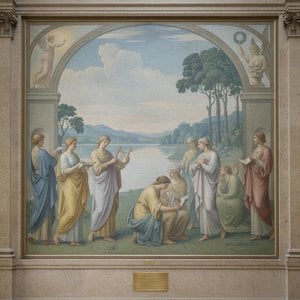
The breadth of Oeltjen’s output is best understood through his command of scale and medium. He was capable of the monumental, as seen in his 1926 altarpiece, "Auferstehung Christi", and the large-scale mural for the Landtag building in Oldenburg. Yet, he was equally effective in the intimate, controlled environment of graphic arts. His woodcuts, such as "Eisstoss" from 1923, demonstrate a mastery of high-contrast tension and spatial organization. These works are not mere illustrations; they are forceful statements of form.
His legacy is preserved in collections across Europe, from the museums in Berlin, Munich, and Hamburg to the galleries in Maribor and Ptuj. He remains a figure of consequence for those studying the intersection of German and Central European modernism. His work does not ask for affection; it demands recognition for its clarity and its refusal to compromise on the weight of the subject.