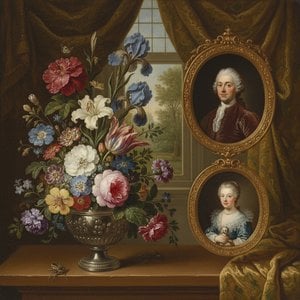
1695 - 1743

Kratki pregled

  • Typical colors:
    • espresso
    • gray
  • Born: 1695, Prague, Czech Republic
  • Museums on this site:
    • Narodní galerie Praha
    • Bavarske državne slikopisne zbirke
    • Regionalna galerija u Libericu
  • Art period: Early Modern
  • Color intensity: monochromatic
  • Nationality: Czech Republic
  • Died: 1743

The Quiet Presence of Jan Kašpar Hirschely

Born in Praha, Jan Kašpar Hirschely lived a life that left behind a specific, focused mark on the art of the early eighteenth century. His existence, spanning from 1695 to 1743, was rooted in the Czech lands, moving through the streets of Praha until his death in the same city. He worked during a period when the weight of mortality was a frequent subject for those who held a brush, and his own hand found its way to the small, intimate surface of copper.

His work often dealt with the heavy themes of existence. In 1727, he produced The scene with death´s head, Vanitas, a piece that uses the stillness of objects to speak of what remains when life departs. This work, currently held in the Regional Gallery in Liberec, is painted in oil on copper, a choice of material that demands a certain precision and a steady hand.

Technique and Symbolism

When looking closely at his compositions, one sees a deliberate arrangement of shapes. He did not rely on chaotic movement, but rather on a careful balance of the organic and the static. In his 1727 work, the soft, curving lines of flowers and trees meet the hard, unmoving presence of a skull and a vase. This intersection of the living and the inanimate creates a tension that requires little explanation.

The physical scale of his output suggests a private, contemplative experience. His paintings are small, measuring approximately 22,8 x 17,3 CM. Such dimensions invite a viewer to lean in, to observe the fine details of the overlapping lines and the way light settles on a surface. It is a way of working that favors the quiet observation of detail over the grand scale of public spectacle.

Brzi kviz

Svako pitanje ima samo jedan točan odgovor.

Pitanje 1:
What was Jan Kašpar Hirschely's nationality?
Pitanje 2:
In which city was Jan Kašpar Hirschely born?
Pitanje 3:
In what year was the artwork 'The scene with death´s head, Vanitas' created?
Pitanje 4:
What medium was used for the painting 'The scene with death´s head, Vanitas'?
Pitanje 5:
Where is the collection of 'The scene with death´s head, Vanitas' located?

Pitanja i odgovori

Mogu li istražiti djela umjetnika Jan Kašpar Hirschely prema spektru boja?

Spektar boja umjetnika Jan Kašpar Hirschely stranica je koja organizira njegova djela prema bojama.

Gdje je i kada je rođen/a Jan Kašpar Hirschely?

Jan Kašpar Hirschely rođen/a je u gradu Prague 1695. godine.

Gdje mogu vidjeti profil boja u radovima umjetnika Jan Kašpar Hirschely?

Genom palete umjetnika Jan Kašpar Hirschely stranica je koja predstavlja profil boja u cjelokupnom umjetničkom stvaralaštvu tog autora.

Mogu li posjetiti virtualni muzej djela umjetnika Jan Kašpar Hirschely?

3D galerija umjetnika Jan Kašpar Hirschely stranica je koja prikazuje umjetnikova djela u virtualnoj trodimenzionalnoj galeriji.

U kojem je povijesnom razdoblju stvarala/radio Jan Kašpar Hirschely?

Jan Kašpar Hirschely je stvarala u razdoblju Early Modern. To razdoblje smješta umjetnikov rad u povijesni kontekst.

Mogu li istražiti djela umjetnika Jan Kašpar Hirschely prema tematici?

Djela umjetnika Jan Kašpar Hirschely možete istražiti prema tematici na njegovoj stranici Atlas tema.

Po kojim drugim imenima je Jan Kašpar Hirschely poznat/a?

Jan Kašpar Hirschely poznat/a je i pod drugim imenima: Caspar Hirschely, Johann Kaspar Hirscheli, Caspar Hirscheli, J. C. Hirschely, Gaspar Hirscheli.

Koliko je umjetničkih djela autora Jan Kašpar Hirschely dostupno u katalogu?

Možete pregledati 16 umjetnina djela autora Jan Kašpar Hirschely na stranici Sva umjetnička djela.

Mogu li pregledavati djela umjetnika Jan Kašpar Hirschely prema umjetničkom pravcu?

Umjetnički pokreti u kojima je Jan Kašpar Hirschely stvarao možete vidjeti na stranici Svi umjetnički pravci, koja grupirira djela prema umjetničkom pokretu.