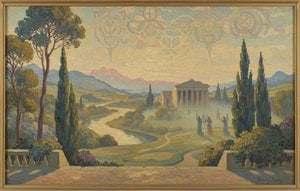
A Parisian Vision: The Life and Art of Gustave Loiseau
Gustave Loiseau, a name perhaps less immediately recognized than some of his Post-Impressionist contemporaries, nevertheless occupies a significant place in the story of French painting at the turn of the 20th century. Born in Paris on October 3rd, 1865, and passing away there on October 10th, 1935, Loiseau’s life was deeply intertwined with the evolving artistic landscape of his city and the broader currents of modernism. His journey began not within the hallowed halls of an art academy—though he briefly attended the École des arts décoratifs—but amidst the practical world of his parents' butcher shop. This early exposure to everyday Parisian life, coupled with a subsequent apprenticeship with a family friend who was a decorator, would profoundly shape his artistic sensibilities. It instilled in him a keen observation of the city’s rhythms and textures, a fascination that would become central to his oeuvre. A modest inheritance from his grandmother proved pivotal, allowing Loiseau to dedicate himself fully to painting in 1887, though his formal training was cut short by a disagreement with a teacher—a testament to his independent spirit.Early Influences and Artistic Beginnings
Loiseau’s formative years were marked by a desire for intellectual stimulation beyond the confines of his family business. He devoured literature and philosophy, absorbing the ideas of thinkers such as Nietzsche and Schopenhauer – influences that would subtly permeate his artistic vision. Recognizing the limitations of academic painting—its rigid conventions and preoccupation with idealized forms—Loiseau sought alternatives rooted in observation and emotion. His initial explorations into Pointillism, championed by Georges Seurat and Paul Signac, revealed the potential for capturing light and color through a systematic approach, yet Loiseau quickly abandoned this technique deeming it too restrictive for his artistic impulses. Instead, he turned to Brittany—the region of his parents’ birth—where he encountered a burgeoning artist colony led by Paul Gauguin and Émile Bernard. This encounter proved transformative, exposing him to new perspectives on color, form, and the expressive power of landscape. It was here that Loiseau began experimenting with *en treillis*, or cross-hatching – a technique that would become his signature style.The Discovery of ‘En Treillis’ and Its Unique Aesthetic
Loiseau's breakthrough came during his first visit to Pont-Aven in 1890, where he encountered the vibrant artistic spirit of the Breton colony. He was captivated by Gauguin’s bold use of color and Bernard’s expressive brushstrokes—artists who challenged the prevailing aesthetic norms of their time. However, Loiseau didn't simply emulate their styles; rather, he embarked on his own distinctive path – developing *en treillis*, or cross-hatching. Unlike Impressionism’s fleeting impressions of light and color, Loiseau employed a network of fine, interwoven lines to build up form and capture the nuances of atmosphere. This created a remarkable textural quality in his paintings—almost a shimmering effect—that set him apart from many of his contemporaries. It was a technique born not from theoretical contemplation but from an intuitive understanding of how to translate visual perceptions onto canvas. The resulting images possessed a palpable sense of depth and materiality, reflecting Loiseau’s profound engagement with the physical world.Parisian Landscapes and Artistic Recognition
Loiseau's artistic output consistently focused on two recurring themes: the bustling streets of Paris and the serene landscapes of France—primarily Brittany. His Parisian scenes—such as *Rue de Clignancourt* and *Avenue de Fiedland*—were not grand panoramas but intimate glimpses into everyday life, meticulously rendered with remarkable sensitivity to detail. He captured the energy of the city—the movement of carriages, the flow of pedestrians, the interplay of light on buildings—with a profound awareness of its rhythms and textures. Simultaneously, Loiseau developed a series of landscapes that revisited familiar motifs – orchards, gardens, fields – at different times of year and under varying weather conditions. These paintings echoed Monet’s exploration of atmospheric effects but Loiseau's *en treillis* technique imbued them with a unique character—a textural richness that conveyed his emotional response to the scene. He wasn’t merely recording what he saw; he was communicating its inherent beauty and tranquility.Legacy and Enduring Influence
Throughout his career, Loiseau exhibited regularly at prestigious venues such as the Salon des Indépendants and the Salon de la Société Nationale—garnering recognition from both critics and collectors. He benefited from the patronage of Paul Durand-Ruel, a prominent art dealer who championed many of the leading Impressionist and Post-Impressionist artists. While Loiseau never achieved the widespread fame enjoyed by figures like Monet or Cézanne, his work gained considerable esteem within artistic circles—finding its way into important museum collections across France. Today, Gustave Loiseau’s paintings are appreciated for their distinctive style—their evocative atmosphere—and their insightful portrayal of French life during a period of significant social and cultural transformation. He stands as a testament to the power of individual vision—an artist who remained true to his own aesthetic principles while engaging with the artistic currents of his time, leaving an indelible mark on the history of Post-Impressionism.Pitanja i odgovori
U kojem je gradu i državi rođen/a Gustav Loiseau?
Gustav Loiseau rođen/a je u gradu Pariz, u državi Francuska.
Odakle dolazi Gustav Loiseau?
Gustav Loiseau je rođen/a u Francuska.
Mogu li proučiti način na koji Gustav Loiseau koristi boju u svim svojim djelima?
Genom palete umjetnika Gustav Loiseau stranica je koja predstavlja profil boja u cjelokupnom umjetničkom stvaralaštvu tog autora.
U kojem je povijesnom razdoblju stvarala/radio Gustav Loiseau?
Gustav Loiseau je stvarala u razdoblju 19. stoljeće. To razdoblje smješta umjetnikov rad u povijesni kontekst.
Kako mogu pronaći sva djela umjetnika Gustav Loiseau u određenom mediju?
Stranica Svi mediji grupirana je prema tehnici izrade djela umjetnika Gustav Loiseau.
Gdje je i kada je rođen/a Gustav Loiseau?
Gustav Loiseau je rođen/a u gradu Pariz 1865. godine.
Gdje se mogu pronaći djela umjetnika Gustav Loiseau grupirana prema paleti boja?
Stranica Prema paletama boja grupirala je djela umjetnika Gustav Loiseau prema njihovim paletama boja.