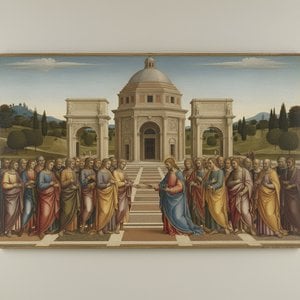
The Bridge Between Two Worlds
In the vibrant, salt-aired atmosphere of the early sixteenth century, a unique artistic voice emerged from the intersection of Greek tradition and Venetian innovation. Giovanni Permeniate, also known by his Greek name Ioannis Permeniates, stands as a fascinating figure of the Renaissance—a painter who navigated the delicate boundary between the spiritual austerity of Byzantine iconography and the burgeoning humanism of the Italian mainland. Likely born in Crete, a renowned hub for icon painters, Permeniate migrated to Venice, bringing with him the profound, meditative depth of the Cretan school while simultaneously absorbing the light and spatial complexities of the Venetian Renaissance.
His life and work represent a pivotal moment of cultural synthesis. As a member of the Greek community in Venice, he occupied a space where the maniera greca—the traditional Greek style characterized by its symbolic, two-dimensional elegance—began to encounter the revolutionary techniques of Western masters. Permeniate was not merely a preserver of old traditions; rather, he was an artist who sought to transcend them. He worked with a deliberate intention to escape the rigid simplicity found in the works of earlier masters like Duccio or Cimabue, instead introducing a sense of atmospheric depth and structural volume that breathed new life into his sacred subjects.
A Synthesis of Style and Spirit
The mastery of Permeniate lies in his ability to harmonize two seemingly disparate aesthetic languages. His icons possess the unmistakable spiritual gravity of the East, yet they are infused with a distinctly Venetian sense of space and naturalism. This stylistic duality is most evident in his treatment of light and form, where the flat, decorative qualities of traditional iconography give way to a more sculptural solidity. In his hands, the divine figures do not merely exist as symbols on a surface; they inhabit a world that feels tangible and resonant.
His notable works serve as windows into this transitional era:
- The Virgin and Child Enthroned: Perhaps his most celebrated achievement, this piece—often accompanied by St. John the Baptist and St. Augustine—showcases his ability to blend the solemnity of an icon with the sophisticated spatial logic of the Italian Renaissance.
- Christ in the Garden of Gethsemane: A profound exploration of emotion and shadow, demonstrating his command over the more dramatic, emotive elements of the period.
- The Adoration of the Magi: A work that highlights his engagement with the evolving Venetian style, showcasing a richer palette and a more complex arrangement of figures.
Through these compositions, Permeniate achieved a refined version of the maniera greca, one that respected the sanctity of the icon while embracing the burgeoning interest in human emotion and physical presence. His ability to integrate the meticulous detail of the Cretan tradition with the luminous, airy qualities of Venetian art allowed him to create works that were both deeply devotional and aesthetically modern for his time.
Legacy of a Transcultural Master
Though much of the biographical detail surrounding Giovanni Permeniate remains shrouded in the mists of history, his impact on the evolution of religious art is undeniable. He was a painter of the threshold, standing at the gateway between the medieval and the modern. By bridging the gap between the Greek East and the Latin West, he contributed to a broader European movement toward a more unified, human-centric visual language.
His presence in the Venetian archives and his surviving masterpieces in institutions such as the Museo Civico Correr in Venice and various collections in Vicenza ensure that his contribution to the Renaissance dialogue remains preserved. Permeniate’s legacy is found in every brushstroke that sought to find more space, more light, and more humanity within the sacred frame. He remains a testament to the power of migration and cultural exchange, proving that when two worlds meet through the medium of art, the result can be something entirely transcendent.