A Satirical Vision of Louisiana and Beyond
Caroline Wogan Durieux (1896–1989) stands as a singular figure in American printmaking, recognized for her unflinching depictions of human folly interwoven with profound spiritual contemplation. Born in New and Orleans into a Creole family—a heritage that profoundly shaped her worldview—Durieux possessed an innate artistic talent nurtured from childhood and honed through rigorous academic training. Her legacy resides not merely in the aesthetic beauty of her prints but also in their biting critique of societal norms and beliefs, cementing her place as one of Louisiana’s most distinctive artistic voices.
From the age of four, Durieux demonstrated an exceptional aptitude for drawing, initially guided by her grandmother who instilled in her a love for observation and meticulous detail. Her formal art education began at Newcomb College under Mary Williams Butler, a respected faculty member who championed realism and encouraged students to explore diverse subjects—from Louisiana landscapes to portraits of prominent figures. This formative experience solidified Durieux’s commitment to mastering traditional printmaking techniques, particularly lithography, which she pursued with unwavering dedication at the Pennsylvania Academy of the Fine Arts under Henry Bainbridge McCarter. McCarter instilled in her a belief that art is not merely decoration, but an expression of thought. Her early works, including evocative depictions of the Ursuline Convent and the French Market, demonstrate this foundational influence, capturing Louisiana’s cultural heritage with remarkable accuracy.
The Art of Social Commentary and Global Influence
Durieux’s artistic career blossomed in Mexico during the 1920s where she befriended Diego Rivera and Frida Kahlo, aligning herself with their leftist convictions and embracing a shared passion for social justice. This encounter profoundly impacted her perspective, as she began to weave political and social awareness into her compositions. Upon returning to New Orleans, she lived within an enclave of literati and artists in the French Quarter, alongside figures like William Faulkner, which served to further sharpen her satirical eye. She became a master at observing the behaviors of bourgeois circles across the United and Mexico and France, translating the quirky, conspicuous behaviors she observed into poignant visual narratives.
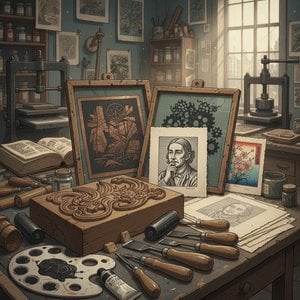
Her work often explored the concept of "conspicuous consumption," a term coined by Thorstein Veblen, using her medium to dissect the patterns of leisure and excess that united the upper classes globally. Whether through the lens of spiritual themes or biting humor, her prints captured the essence of human character. Her technical repertoire was as diverse as her subject matter, ranging from traditional lithography to more experimental methods:
- Lithography: Used to create striking, high-contrast images that emphasized social satire and dramatic lighting.
- Cliché-verre: A technique she revived to achieve unique textures and patterns in her compositions.
- Electron Printmaking: An innovative approach where she researched the use of radioactive inks to push the boundaries of print media.
Legacy and Academic Contribution
Beyond her personal creative output, Durieux was a dedicated educator who left an indelible mark on the American art landscape. She served as a Professor Emeritus at both Louisiana State University, where she worked from 1943 to 1964, and Newcomb College of Tulane University. Her tenure at LSU was particularly significant, as it allowed her to mentor new generations of artists while continuing her own experimental research into printmaking processes. Her ability to blend academic rigor with avant-garde experimentation ensured that her influence extended far beyond the borders of Louisiana.
Today, the historical significance of Caroline Wogan Durieux is preserved in major institutions such as the National Gallery of Art and the LSU Museum of Art, which holds nearly 300 of her works. Her ability to navigate the complexities of identity, class, and spirituality through a satirical lens remains a testament to her profound intellect. She remains a celebrated figure whose work continues to challenge viewers to look closely at the masks worn by society, finding both the humor and the tragedy in the human condition.
प्रश्न और उत्तर
Caroline Wogan Durieux का जन्म किस शहर और देश में हुआ था?
Caroline Wogan Durieux का जन्म New Orleans, United States of America में हुआ था।
मैं Caroline Wogan Durieux के कार्यों की कलर प्रोफाइल कहाँ देख सकता हूँ?
इस वेबसाइट पर पर सूचीबद्ध कृतियों में Caroline Wogan Durieux द्वारा रंगों का उपयोग कलाकार के पलेट जीनोम पेज पर देखा जा सकता है।
क्या Caroline Wogan Durieux का कोई कालानुक्रमिक विवरण उपलब्ध है?
Caroline Wogan Durieux का जीवन यात्रा एक स्क्रॉल-संचालित टाइमलाइन है, जो कलाकार की कृतियों को उनके करियर के विभिन्न चरणों में विभाजित कर कालानुक्रमिक क्रम में प्रस्तुत करता है।