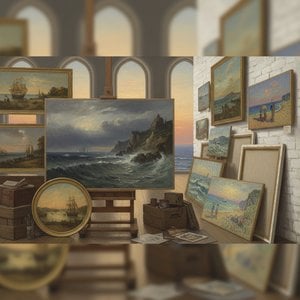
The Maritime Legacy of Aleksei Vasilievich Hanzen
Born amidst the salt spray and maritime grandeur of Odessa on February 2, 1876, Aleksei Vasilievich Hanzen was destined to become a master of the sea. His connection to the ocean was not merely professional but deeply ancestral; as the grandson of the legendary Ivan Konstantinovich Aivazovsky, Hanzen spent his formative years wandering the workshops of his grandfather along the Black Sea shore. This early immersion in the rhythms of the tides and the dramatic interplay of light on water laid the foundation for a career defined by an extraordinary ability to capture the ephemeral beauty of the maritime world. While his lineage provided him with a profound connection to the sea, Hanzen’s artistic identity was forged through a rigorous, pan-European education that saw him studying at the Imperial Academy of Arts in St. Petersburg, and later refining his technique at the prestigious academies of Berlin, Dresden, and Munich.
Hanzen's artistic evolution was a journey across the great cultural hubs of Europe, allowing him to weave together diverse influences into a singular, evocative style. His work reflects a sophisticated blend of Russian Landscape Painting and the luminous principles of Impressionism. As he traveled through France, Italy, Holland, and Sweden, he absorbed the ability to capture fleeting moments—the way sunlight shimmers upon a cresting wave or how mist softens the horizon of a distant coastline. His time in Paris was particularly transformative, where his participation in the Salon d'Automne and the Salon of French Painters allowed him to engage with the vanguard of modern light-centric art. This exposure enabled him to move beyond mere documentation, infusing his seascapes with a romantic touch that remained anchored by an almost scientific accuracy in depicting naval vessels and turbulent waters.
Mastery of Light and the Adriatic Spirit
The true heart of Hanzen’s oeuvre lies in his breathtaking watercolor series documenting the Dalmatian Coast. In works focusing on the historic vistas of Dubrovnik and Split, Hanzen achieved a level of atmospheric perspective that transports the viewer directly to the Adriatic shore. His mastery of the watercolor medium allowed for a delicate translucency, essential for rendering the crystalline waters and the sun-drenched stone architecture of Croatia. He possessed a rare talent for balancing the monumental with the minute; one might find himself captivated by the sheer power of a storm-tossed sea in The Storm, only to be moved by the quiet, shimmering reflections in his more tranquil coastal scenes. His brushstrokes, though precise enough to document historical naval details, remained fluid and expressive, prioritizing the emotional resonance of light and color.
Beyond the serene coastlines, Hanzen’s work also captured the tension and drama of maritime history. As an official artist for the Naval Ministry starting in 1909, he produced compelling depictions of warships and naval engagements. These pieces, such as Warships, demonstrate his ability to render the heavy, grey mass of a battleship amidst the chaotic, white foam of a turbulent sea, blending historical gravity with artistic movement. This duality—the ability to be both a romantic dreamer and a meticulous observer—is what defines his historical significance. His life, which eventually led him to settle in the Kingdom of Yugoslavia, saw him acting as a bridge between the classical traditions of his grandfather and the burgeoning modernism of the early 20th century.
A Life of Artistic Exploration
The breadth of Hanzen's impact extends far beyond the canvas, reaching into the very cultural fabric of his homeland. His passion for the arts was not limited to creation; in 1910, he took the visionary initiative to establish the first art museum in Odessa, a testament to his dedication to preserving the heritage he so dearly loved. His career was marked by a relentless pursuit of excellence and a nomadic spirit that brought his works to the most prestigious galleries in London, America, Paris, and beyond. Though his life came to an end in Dubrovnik in 1937, his legacy remains etched in the luminous textures of his paintings.
To reflect on the essence of Hanzen's contribution, one might consider these defining elements of his career:
- Ancestral Inspiration: The profound influence of his grandfather, Ivan Aivazovsky, and the maritime atmosphere of Odessa.
- Academic Versatility: A training lineage spanning St. Petersburg, Germany, and France, blending classical precision with Impressionist light.
- Geographic Focus: An unparalleled documentation of the Croatian coast, specifically the beauty of the Dalmatian region.
- Technical Brilliance: The masterful use of watercolor to achieve atmospheric perspective and the delicate interplay of sunlight and water.
- Cultural Stewardship: His role as a founder of the first art museum in Odessa and his service as an official naval artist.