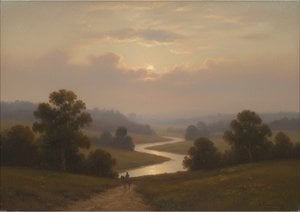
The Essence of Tonalism: Understanding the Mood of Muted Landscapes
 Jean-Baptiste-Camille Corot
. French Realist of atmospheric landscapes and soft vegetation, using thin washes and loosely dabbed strokes to capture the play of light.
Entering a room decorated with intention often feels like stepping into a different state of mind. It is a shift in pace, a departure from the frantic rhythm of modern life that demands constant attention. Tonalism, an artistic movement that flourished between 1880 and 1920, offers a visual language for this very transition. Rather than relying on the sharp, scientific precision of light found in Impressionism, Tonalist painters sought to capture a specific, often fleeting, emotional atmosphere. They focused on the overall tone of a landscape, using a palette of grays, blues, greens, and purples to create a sense of mist or twilight. This approach does not ask you to look at a specific object, but rather to feel the weight of the air and the stillness of the moment.
This pursuit of mood finds its roots in the French Barbizon school of the mid-19th century. Artists like Jean-Baptiste-Camille Corot moved away from the rigid, idealized landscapes of the past, choosing instead to emphasize shadow and the subtle interplay of light. Corot’s Souvenir de Mortefontaine (1864) serves as a quiet precursor to the Tonalist sensibility, prioritizing a harmonious integration of light and shadow over dramatic narrative. Just as the Barbizon painters sought a direct connection to the natural world, Tonalism uses the landscape as a vessel for contemplation, inviting the viewer to find a poetic sense of nature within the soft-edged forms and diffused light of the canvas.
In a contemporary home, this translates to an atmosphere of grounding. A Tonalist landscape does not compete with your furniture or the architecture of your room; it supports the space, providing a sense of calm that feels both lived-in and profoundly quiet.
A Legacy of Light: From the Barbizon School to Modern Interiors
 James McNeill Whistler
. American Tonalist known for musical arrangements of color and atmospheric river nocturnes, from the Peacock Room to his famous portraits.
The history of landscape painting is often told through revolutions of color, yet some of the most profound shifts occurred in the quiet spaces between the hues. Tonalism emerged as a reaction to the bright, often jarring energy of Impressionism, seeking instead a more introspective connection to the earth. This movement was not a singular event but a global resonance, appearing in the 1890s in Canada through the influence of James McNeill Whistler, and later in Melbourne during the 1910s. It was a way for artists to express a post-Civil War introspection, a desire for spiritual connection in a rapidly changing world.
We see this historical echo in the way we curate our modern sanctuaries. Just as the St Ives artists in Britain used landscape to explore the nuances of light and shadow, we often look to art to provide a sense of place and belonging. A painting of a misty shoreline or a twilight meadow acts as a window, offering a reprieve from the digital noise of the present. The movement’s focus on subjectivity—the idea that art should reflect an inner experience rather than a literal depiction—mirrors our own modern desire for homes that serve as restorative retreats rather than mere displays of status.
By bringing these historical sensibilities into a living room or study, we do more than decorate; we participate in a long-standing human tradition of using art to find a moment of respite within the frame.
The Color of Calm: How Low-Key Palettes Shape Emotional Space
 Nocturne in Black and Gold: The Falling Rocket
, James McNeill Whistler
Color has a profound ability to dictate the temperature of a room. While bright, high-contrast colors can energize a space, they can also create a sense of restlessness if not balanced. Tonalism relies on a low-key palette—earth tones, muted blues, and soft grays—to achieve a sense of tonal harmony. This harmony is achieved when colors share similar values, creating subtle gradations that allow the eye to rest. It is a method of painting that favors the suggestion of a scene over its precise delineation, allowing the viewer's imagination to fill in the soft-focus details.
This preference for subtlety can be traced back to the Aesthetic Movement, particularly through the work of James McNeill Whistler. His Nocturne in Black and Gold: The Falling Rocket (1875) moved away from literal representation toward a focus on harmonious color arrangements. Whistler’s "art for art's sake" philosophy prioritized the aesthetic arrangement of tones, a concept that Tonalists adopted to evoke a sense of mystery and twilight. The use of dark, neutral hues was not meant to be somber, but rather to create a sense of depth and quietude that invites a meditative state.
In an interior design context, these muted palettes are exceptionally versatile. A serene, blue-toned landscape in a bedroom can encourage rest, while a landscape with soft greens and browns in a study can provide a grounding presence, helping to stabilize the energy of the room.
Soft Edges and Stillness: The Visual Mechanics of Serenity
 Entry to the Park at St. Cloud
, Jean-Victor Bertin
The technical execution of Tonalist art is what truly facilitates its calming effect. Unlike the sharp, defined lines of Neoclassicism, such as those seen in Jean-Victor Bertin’s Entry to the Park at St. Cloud, Tonalist works utilize broad brushwork and soft-edged forms. These blurred boundaries allow shapes to dissolve into the surrounding atmosphere, creating a misty, ethereal quality. This lack of rigid precision prevents the eye from getting "stuck" on a single detail, instead encouraging a fluid, sweeping movement across the canvas that mimics the way we experience nature in a dreamlike or hazy state.
This technique finds a parallel in the Pictorialist photography of the late 19th and early 20th centuries. Artists like Alfred Stieglitz used soft-focus techniques to elevate photography to a fine art, mirroring the atmospheric compositions of Tonalist painters. Both mediums sought to move beyond the mere documentation of reality, aiming instead to capture a personal sentiment or a "feeling" of a place. The soft focus creates a sense of distance and nostalgia, making the subject matter feel as though it is being viewed through a veil of memory.
When you choose an artwork with these soft, painterly qualities, you are choosing a piece that works quietly. It does not demand attention through noise or high-contrast drama; instead, it invites a quiet contemplation of the relationship between the viewer and the natural world.
Curating Quietude: Selecting Art for Restorative Living Spaces
 Astley Cheetham Art Gallery
Discover British landscape & portraiture at the Astley Cheetham Art Gallery in Stalybridge! Free admission to a unique collection within Tameside Museums. Plan your visit today!
Selecting art for a home is often a balance between personal taste and the functional needs of a space. Many collectors find that they are drawn to works that "feel right" rather than those that are simply fashionable. This is particularly true when seeking to create a restorative environment. A piece that is too busy or visually loud can clash with the intended purpose of a room, such as a bedroom meant for sleep or a hallway meant for transition. Tonalism, with its inherent focus on harmony and mood, is uniquely suited for creating these intentional atmospheres.
This careful selection process echoes the way museums like the Astley Cheetham Art Gallery curate their collections to offer a sense of intimacy and tranquility. Unlike large national institutions that may feel overwhelming, smaller, more intimate spaces allow for a more contemplative experience. They recognize that art is not just something to be viewed, but something to be lived with. The goal is to find pieces that resonate emotionally, providing a sense of ease and clarity.
Whether it is a large-scale landscape that opens up a room or a smaller, intimate study of a twilight scene, the key is to consider how the artwork will interact with the light and the energy of your specific space. Art chosen with this level of care tends to age well, remaining a supportive presence long after trends have passed.
Texture and Depth: The Tactile Difference in Atmospheric Art
The physical presence of an artwork—the way the paint sits upon the surface—adds a layer of meaning that a flat print cannot replicate. In a hand-painted oil reproduction, the visible brushstrokes and the texture of the impasto create a sense of depth and life. This tactile quality is essential for Tonalist works, where the subtle gradations of color and the movement of the brush are what convey the feeling of mist, light, or shadow. The physical depth of the paint allows the light in your room to catch the ridges of the brushwork, changing the appearance of the piece as the time of day shifts.
This emphasis on the physical nature of the medium is a return to the fundamental principles of fine art. Throughout history, the materiality of the work has been as important as the subject matter itself. From the heavy, textured surfaces of the Impressionists to the delicate, layered glazes used to create the ethereal figures of Thomas Wilmer Dewing, the texture of the paint is a vital component of the emotional resonance. It provides a sense of permanence and craftsmanship that distinguishes a true work of art from a mere image.
For those looking to bring this level of depth into their homes, understanding the difference between a digital print and a hand-painted oil is crucial. A hand-painted piece offers a unique, sensory experience, turning a simple image into a tangible piece of history that brings a sense of soul and atmosphere to your living space. To explore these textures and find the perfect piece for your home, visit ArtsDot.com.