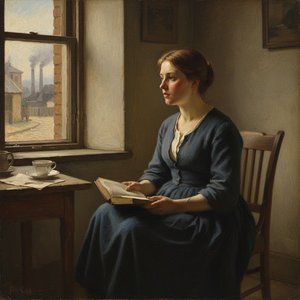
Le Maître Discret du Réalisme : La Vie et l'Héritage de Théodule Auguste Ribot
Théodule Auguste Ribot s'érige comme un témoignage de l'éclat feutré de la peinture réaliste française durant la seconde moitié du XIXe siècle. Souvent éclipsé par des contemporains plus impétueux tels que Courbet, l'observation méticuleuse de la vie quotidienne par Ribot et sa manipulation magistrale du clair-obscur lui ont assuré une place respectée dans le paysage artistique de son époque. Son héritage prend racine dans une profonde admiration pour les maîtres baroques et se caractérise par un engagement indéchifrable à capturer la nuance psychologique à travers le prisme de la vérité. Né en 1823 à Saint-Nicolas-de-Azé, en France, les années de formation de Ribot furent marquées par l'acquisition de compétences pratiques développées parallèlement à ses inclinations artistiques. Il commença sa formation formelle à l'École des Arts et Métiers de Châlons, ce qui lui permit d'acquérir des connaissances fondamentales avant son installation à Paris en 1845. Conscient de la nécessité d'une stabilité financière, il trouva un emploi à décorer des cadres dorés pour un fabricant de miroirs — un rôle qui lui assura simultanément un revenu et favorisa une compréhension aiguë de l'esthétique visuelle. Cet apprentissage précoce instilla en lui un œil attentif au détail et à l'harmonie des couleurs, des éléments qui allaient plus tard imprégner ses toiles les plus célèbres.Une Vision Forgée par la Lumière et le Travail
Le voyage artistique de Ribot ne fut pas propulsé par de grandes ambitions ou une ferveur révolutionnaire ; il émergea plutôt, de manière organique, d'un engagement profond envers le monde naturel et la condition humaine. Ses voyages en Algérie vers 1848 impactèrent profondément sa sensibilité, favorisant une appréciation des paysages dramatiques et orientant ses choix stylistiques concernant l'ombre et la lumière. À son retour à Paris en 1851, il poursuivit son métier d'artisan tout en s'adonnant avec diligence à la peinture comme vocation — une double quête qui lui permit de subvenir à ses besoins financiers tout en nourrissant une vision centrée sur la dignité de l'homme ordinaire. Son œuvre se définit par une exploration poignante du labeur et des moments de silence de l'existence. Contra-irement aux grands récits historiques privilégiés par beaucoup de ses contemporains, Ribot trouva la beauté dans le banal et le monumental dans l'ordinaire. Ses peintures présentent souvent :- La Dignité du Travail : Des représentations magistrales de paysans et d'ouvriers, comme dans 'Les Déterreurs de pommes de terre' et 'Les Vendangeurs', qui offrent un aperçu empreint d'âme de la vie française du XIXe siècle.
- La Maîtrise du Clair-Obscur : Un usage sophistiqué de l'ombre et de la lumière, rappelant la tradition baroque, pour créer de la profondeur et un poids émotionnel.
- L'Empathie Narrative : Des œuvres telles que 'Le Bon Samaritain' démontrent sa capacité à tisser des récits moraux et psychologiques profonds au sein de scènes simples et réalistes.
Importance Historique et Impact Artistique
En tant que figure de proue du mouvement réaliste, la contribution de Ribot réside dans sa capacité à élever le quotidien au rang de grand art sans jamais recourir au sentimentalisme. Il évita le piège de romantiser la pauvreté, choisissant plutôt de présenter les textures de la vie — le grain de la terre, le poids des outils et les expressions lassées mais résilientes de ses sujets — avec une honnêteté sans faille. Cet engagement envers la vérité lui permit de capturer un moment historique spécifique en France avec un niveau d'intimité que peu d'autres pouvaient atteindre. Bien qu'il n'ait peut-être pas recherché la reconnaissance bruyante de l'avant-garde, l'influence de Ribot persiste à travers la résonance émotionnelle durable de son travail. Il demeure un lien vital entre les techniques d'éclairage dramatiques du passé et la conscience sociale du réalisme moderne. Aujourd'hui, ses peintures servent de fenêtres évocatrices sur un monde disparu, nous rappelant qu'une beauté profonde peut être trouvée dans les expériences humaines les plus humbles.Questions et réponses
Comment puis-je trouver toutes les œuvres de Théodule Augustin Ribot dans une technique donnée ?
La page Tous les médiums regroupe les œuvres de Théodule Augustin Ribot par technique.
Dans quelle ville et quel pays Théodule Augustin Ribot est-il/elle né(e) ?
Théodule Augustin Ribot est né à Saint-Nicolas-de-Azé, en France.
Puis-je parcourir les œuvres de Théodule Augustin Ribot par ambiance ?
La page L'ambiance par émotion de l'artiste présente les œuvres de Théodule Augustin Ribot classées par atmosphère.