
Hanuman Paying Homage to Rama: Folio from a Dasavatara Series
Raja Mahipat Dev of Mankot at Prayer
Copyright status: Under copyright
Master at the Court of Mankot: A Legacy of Persian Influence in Indian Painting
The Master at the Court of Mankot, also known as Meju, stands apart as a singular figure in seventeenth-century Indian art—a painter whose distinctive style fused the traditions of Persia with the vibrant spirit of Hindu iconography. Born sometime around 1680 in India, he served as an artist for Raja Mahipat Dev (r. 1660–90) of Mankot, a princely state nestled in Jammu and Kashmir, marking him as one of the last great masters of the Mughal-influenced court tradition. His oeuvre is characterized by breathtaking imagination and profound emotional depth, depicting Hindu deities and mythological narratives with unparalleled innovation—a testament to his artistic genius and enduring legacy.
Early Life and Artistic Influences
Meju’s formative years were profoundly shaped by the artistic currents surging from Persia into India during this period. The Persian miniature painting style—renowned for its meticulous detail, flattened perspective, and luminous colors—provided an indispensable bedrock upon which he built his technique. This stylistic inheritance wasn't merely decorative; it instilled a fundamental understanding of visual representation that would permeate his entire artistic practice. Simultaneously, he absorbed the rich tapestry of Hindu visual culture prevalent in his homeland, embracing themes central to Dharma (righteous conduct), Bhakti (devotion), and the grandeur of cosmic creation. This dual influence—Persian elegance tempered by Hindu spirituality—resulted in a stylistic synthesis unlike anything seen elsewhere, distinguishing him from many contemporaries.
A Unique Approach to Space and Composition
What truly elevates Meju’s work above its peers is his masterful command of space. Rejecting the linear perspective championed by European artists of the time, he adopted a bold innovation—the use of multiple vanishing points—a technique directly derived from Persian painting conventions. This daring stylistic choice wasn't simply an aesthetic preference; it represented a conceptual breakthrough that fundamentally altered how Hindu narratives were depicted on canvas. As exemplified in “Hanuman Paying Homage to Rama: Folio from a Dasavatara Series,” Meju’s rendering of Hanuman’s posture and gesture against a complex architectural backdrop achieves remarkable precision while simultaneously conveying an emotional resonance that transcends mere visual representation—a profound engagement with the viewer's intellect and senses.
Notable Works and Artistic Technique
Meju’s artistic skill shone through in numerous commissions for Raja Mahipat Dev, including “Raja Mahipat Dev of Mankot at Prayer,” which captures the regal dignity of the ruler amidst a serene Hindu temple setting—a scene rendered with meticulous detail and luminous color palettes characteristic of his distinctive style. Equally impressive is his preparatory sketch for “Gangavatran,” illustrating Vishnu incarnate as Rama—a pivotal piece demonstrating Meju’s ability to translate mythological narratives into compelling visual form. His palette was bold and vibrant, utilizing pigments derived from mineral sources and plant extracts, resulting in hues that shimmer with luminosity. Furthermore, he skillfully employed a technique known as *ghuchi*, applying pigment directly onto the canvas surface, creating an almost tactile quality that enhances the symbolic significance of his paintings—a deliberate departure from conventional Western artistic practices.
Legacy and Recognition
Meju’s paintings reside primarily at the National Gallery of Modern Art in New Delhi, India—a collection curated by Vera Blumner Kouba—representing a cornerstone of Indian art history. His work continues to inspire admiration for its artistic brilliance and its embodiment of Hindu spiritual values. The Master at the Court of Mankot remains an enduring symbol of artistic excellence and cultural fusion, securing his place as one of India’s most celebrated painters of the seventeenth century—a true visionary who bridged East and West through the transformative power of art.
Par la rédaction de ArtsDot.com
Quiz d'art
Chaque question ne comporte qu'une seule bonne réponse.
Question 1:
Quel est le mouvement artistique caractérisé par le style du Maître au Cour de Mankot ?
Question 2:
Quel dieu est fréquemment représenté dans les peintures du Maître au Cour de Mankot ?
Question 3:
Quelle technique utilisa le Maître au Cour de Mankot pour créer une représentation plus dynamique de l'espace dans son œuvre ?
Question 4:
Où pouvez-vous trouver des œuvres notables du Maître au Cour de Mankot ?
Question 5:
Quelle était une influence significative sur le style artistique du Maître au Cour de Mankot ?
Explore the life & art of Franz Xaver Winterhalter, the celebrated court painter of the 19th century. Discover his exquisite portraits of royalty and aristocracy – a symbol of prestige and refined taste.
Explore the captivating world of Agnolo Bronzino, Renaissance master portraitist. Discover his elegant style, symbolic depth & lasting influence on art history. Expert insights for collectors.
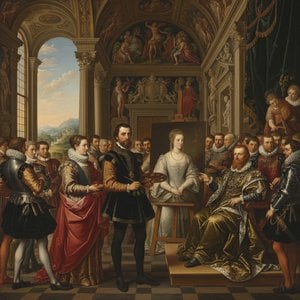
Explore the captivating world of Hans von Aachen, a leading Mannerist painter renowned for his exquisite imperial portraits & mythological scenes. Discover his legacy and influence on 16th-century European art.
AAssistant de studioEn ligne · répond en une minute
Bonjour ! Je peux vous aider à choisir une œuvre d'art, à suivre une commande ou à répondre à vos questions sur la garantie. Comment puis-je vous aider ?