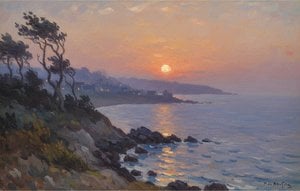
Maxime Emile Louis Maufra : Un Peintre de la Lumière et de l'Atmosphère
Maxime Emile Louis Maufra (1861 – 1918) s'impose comme une figure emblématique de la peinture de paysage française, particulièrement renommé pour sa maîtrise magistrale des panoramas côtiers bretons et des scènes marines. Né à Nantes le 17 mai, il entreprit un voyage artistique largement autodidacte, nourri par les encouragements de ses confrères nantais — Charles Leduc et Alfred Leduc — et influencé par le style expressif de Charles Le Roux. Ses années de formation lui ont inculqué un profond amour pour l'observation et le détail méticuleux, façonnant son approche distinctive pour capturer l'essence même de la nature.- Jeunesse et Formation : Les premières inclinations artistiques de Maufra s'épanouirent durant son adolescence, portées par une curiosité innée pour la représentation visuelle. Bien que dépourvu d'une formation académique formelle, il perfectionna ses compétences par l'expérimentation indépendante et son immersion dans le milieu artistique vibrant de Nantes.
- Influences et Style Artistique : La sensibilité esthétique de Maufra fut profondément marquée par l'Impressionnisme et le Symbolisme. Il admira tout particulièrement la technique pointilliste prônée par Georges Seurat et Camille Pissarro, adoptant leur méthode pour obtenir des effets lumineux et des nuances texturales subtiles. De plus, il puisa son inspiration dans les palettes de couleurs audacieuses et les coups de pinceau dynamiques de l'École de Pont-Aven, s'imposant ainsi comme un contributeur clé de ce mouvement influent.
Le Paysage Breton : Un Sanctuaire pour la Vision Artistique
L'orientation artistique de Maufra se cristallisa en 1890 lorsqu'il s'installa à Pont-Aven, en Bretagne — une région qui allait devenir indissociable de son œuvre. Cette décision charnière coïncida avec l'arrivée d'autres artistes tels que Paul Gauguin et Paul Sérusier au Bateau-Lavoir, favorisant un environnement collaboratif propice à l'expérimentation et à l'innovation. Le littoral accidenté de la Bretagne servit de source d'inspiration inépuisable pour les toiles de Maufra — études de ciels dramatiques, paysages marins turbulents et ports sereins — chacun étant imprégné d'une émotion palpable et d'une profondeur atmosphérique. Ses œuvres notables incluent « La Houle à Donant Belle Ile en Mer » (1896) et « La Grande Houle à Donant (Belle île) » (1898), qui illustrent parfaitement sa capacité à transmettre la grandeur sublime du monde naturel.Technique et Innovation : Le Pointillisme et au-delà
La technique artistique de Maufra se caractérisait par un engagement délibéré à capturer la lumière et la couleur avec une précision inégalée. Il adopta la méthode pointilliste — développée par Seurat et Sisley — employant de minuscules points de pigment pour construire des variations tonales et créer des surfaces scintillantes. Cette approche exigeait une attention minutieuse aux détails, mais produisait des résultats époustouflants — témoignage du dévouement inébranlable de Maufra à la maîtrise de son art. Au-delà du pointillisme, il utilisa avec talent des techniques de glacis et des coups de pinceau expressifs pour imprégner ses peintures d'un dynamisme et d'une résonance émotionnelle.Réalisations Majeures et Héritage
Tout au long de sa carrière prolifique, Maufra produisit un corpus impressionnant — plus de 300 peintures — qui continue de captiver le public du monde entier. Ses paysages sont célébrés pour leur beauté évocatrice et leur rendu magistral des conditions atmosphériques, consolidant sa place parmi les plus grands peintres de la fin du XIXe siècle. « Étude pour le ciel rouge de Pont-Aven (Ancien titre : L) » demeure une pierre angulaire de l'histoire de l'art breton, conservée au Musée de Pont-Aven — un rappel poignant de la contribution durable de Maufra à l'esthétique impressionniste et symboliste. Son héritage s'étend bien au-delà de sa production artistique ; il a défendu le Bateau-Lavoir comme un refuge pour les artistes et a favorisé un esprit de collaboration créative qui a façonné le paysage culturel de Montmartre. L'art de Maxime Emile Louis Maufra continue d'inspirer l'admiration par sa beauté lumineuse et sa connexion profonde avec le monde naturel.Questions et réponses
À quelle période historique Maxime Maufra a-t-il exercé ?
Maxime Maufra a œuvré durant la période XIXe siècle. Cette période situe l'activité de l'artiste dans l'histoire.
Où puis-je admirer les œuvres de Maxime Maufra dans une galerie en 3D ?
La Musée 3D de Maxime Maufra est une page qui présente les œuvres de l'artiste dans une galerie virtuelle en trois dimensions.
Existe-t-il une liste complète des œuvres de Maxime Maufra ?
Chaque œuvre de Maxime Maufra sur ce site web peut être consultée depuis la page Toutes les œuvres de l'artiste.