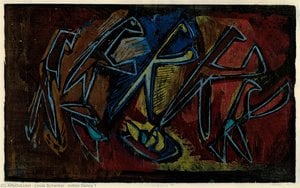
Louis Schanker: Pioneer of Color and Form in American Abstract Art
Louis Schanker (1903-1981) stands as a significant figure within the burgeoning landscape of American abstract art during the 1930s, recognized primarily for his distinctive approach to color-patch compositions and his impactful contributions to the Works Progress Administration (WPA). Born in the Bronx, New York, Schanker’s formative years were steeped in Orthodox Jewish tradition, shaping his worldview and fostering a lifelong appreciation for artistic expression rooted in observation of the natural world. His parents, Sam and Fannie Schanker, immigrants from Romania, instilled in him values of craftsmanship and intellectual curiosity—traits that would prove invaluable throughout his life's journey. Early exposure to both art and music fueled Schanker’s creative inclinations. He pursued formal training at Cooper Union, the Educational Alliance, and the Art Students League with influential mentors like Barnett Newman, Mark Rothko, and Milton Avery, absorbing techniques and philosophies that would profoundly influence his artistic development. Notably, he shared a studio space with the Soyers brothers—Chaim Gross and Adolph Gottlieb—creating an environment conducive to experimentation and collaborative dialogue. This formative period cemented his connection to the avant-garde movement of its time. A restless spirit propelled Schanker across the United States in 1920, embarking on a nomadic existence characterized by participation in circus troupes and manual labor – experiences that would later find expression in evocative imagery within his artwork. The murals he created for the Neponset Beach Children’s Hospital and “Man Cutting Wheat,” a striking print depicting agricultural labor, serve as tangible reminders of these formative years and demonstrate Schanker's ability to translate lived experience into artistic representation. These works exemplify a profound engagement with social realities—a characteristic that distinguishes him from many of his contemporaries who focused primarily on formal experimentation. The mid-1920s witnessed Schanker’s return to New York City where he secured another studio space and rekindled friendships with fellow artists—Rothko and Avery among them—continuing his artistic pursuits amidst the evolving cultural climate of the era. His involvement in the Federal Art Project during the Great Depression solidified his commitment to socially conscious artmaking, collaborating with a cohort of talented individuals on ambitious mural projects and graphic arts commissions. This period was marked by considerable debate within the artistic community regarding stylistic choices and political messaging—a reflection of the broader anxieties surrounding economic hardship and social upheaval. Schanker’s engagement with the WPA yielded particularly noteworthy results, notably his contribution to the New York City Division where he worked alongside luminaries like Jackson Pollock, Lee Krasner, Burgoyne Diller, Byron Browne, Milton Avery, and Stuart Davis. These collaborations reflected the spirit of experimentation and innovation that defined the era, pushing boundaries of artistic expression—a testament to Schanker’s intellectual breadth and artistic versatility. His distinctive style blended Cubist influences with Expressionist sensibilities—a synthesis that underscores his profound understanding of both visual language and emotional resonance. Schanker imbued his prints, paintings, and sculpture with an animated expressionism that aims at a fundamental emotional structure. Sculptures such as *Owl,*carved in 1937, adroitly convey not only the bird’s physical appearance, but the quality of mystery that has made it a symbol of wisdom and secrecy.*Three Men,*exhibited in the American Abstract Artists' first annual exhibition in 1937, exemplifies the expressive, angular animation for which Schanker's work was frequently praised in press reviews of the 1930s. He pursued formal training at Cooper Union, the Educational Alliance, and the Art Students League with influential mentors like Barnett Newman, Mark Rothko, and Milton Avery, absorbing techniques and philosophies that would profoundly influence his artistic development. Notably, he shared a studio space with the Soyers brothers—Chaim Gross and Adolph Gottlieb—creating an environment conducive to experimentation and collaborative dialogue. This formative period cemented his connection to the avant-garde movement of its time. Schanker’s exploration of natural forms—particularly landscapes and animals—served as a cornerstone of his artistic vision. He sought to capture not merely visual appearances but also underlying rhythms and emotional qualities—a characteristic that distinguishes him from many of his contemporaries who prioritized purely geometric abstraction. His prints, in particular, demonstrate a masterful command of woodblock printing techniques—a medium he embraced with unwavering dedication throughout his career. Schanker’s legacy extends beyond his individual artworks; he played an instrumental role in shaping the trajectory of American abstract art by fostering dialogue between artists and advocating for artistic freedom—values that resonated deeply within the intellectual milieu of his time. His influence can be discerned in the work of subsequent generations of artists who adopted similar approaches to color, form, and subject matter—a testament to Schanker’s enduring contribution to the visual arts.Questions et réponses
Où les œuvres de Louis Schanker sont-elles regroupées par mots-clés ?
Les œuvres de Louis Schanker peuvent être explorées par mot-clé sur la page Par mots-clés de l'artiste. Chaque mot-clé regroupe les œuvres associées.
Puis-je étudier l'utilisation de la couleur par Louis Schanker à travers l'ensemble de ses œuvres ?
La Génome de la palette de Louis Schanker est une page qui présente le profil chromatique de l'ensemble de l'œuvre de l'artiste.
Comment puis-je trouver toutes les œuvres de Louis Schanker dans une technique donnée ?
Les œuvres de Louis Schanker peuvent être consultées par technique sur la page Tous les médiums de l'artiste.