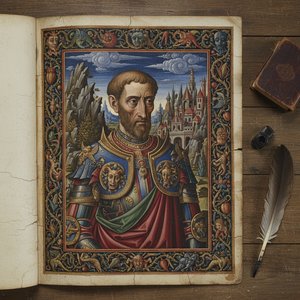
Le Peintre du Mythe et de la Foi : La Vie de Lorenzo Costa
Lorenzo Costa (1460–1535) s'impose comme une figure emblématique du paysage artistique florissant de la Renaissance italienne, incarnant le dynamisme intellectuel des écoles de Ferrare et de Bologne. Né dans la vibrante cité de Ferrare, Costa a émergé à une époque où les frontières entre dévotion spirituelle et quête humaniste s'estompaient avec une beauté singulière. Son œuvre se caractérise par un mélange distinctif d'élégance stylistique et de contemplation profonde, une qualité qui lui permit de répondre aux exigences complexes tant des institutions religieuses que des cours séculières les plus sophistiquées de son temps. Sous son pinceau, la lumière éthérée du divin rencontrait la grâce structurée de la mythologie classique, créant un langage visuel qui résonnait profondément avec l'esprit de la Renaissance.Années de Formation et Maîtrise de la Lumière
Bien que les archives concernant les premières années de Costa demeurent quelque peu évasives, son ADN artistique fut clairement forgé dans les ateliers de l'Italie du Nord. Il est largement reconnu qu'il suivit une formation rigoureuse sous la direction du maître Francesco Francia à Bologne. Cet apprentissage fut transformateur, lui inculquant une attention méticuleuse aux détails et une fascination précoce pour la technique du sfumato—ce mélange subtil et vaporeux des tons popularisé par Léonard de Vinci. De Francia, Costa hérita d'une compréhension profonde de la perspective et d'un usage dramatique du clair-obscur, ce qui lui permit de sculpter les figures à même l'ombre et d'insuffler à ses compositions une sensation de profondeur et un poids émotionnel sans précédent. Ce socle technique lui permit de dépasser la simple représentation pour chercher, au contraire, à capturer l'atmosphère même entourant ses sujets.La Splendeur de la Cour Mantouane
L'apogée de la carrière de Costa fut inextricablement liée à sa prestigieuse nomination en tant que peintre de cour d'Isabella d'Este, la marquise de Mantoue. En tant que l'une des mécènes les plus redoutables et exigeantes de l'histoire européenne, Isabella d'Este réclamait un art qui soit à la fois un triomphe esthétique et une énigme intellectuelle. Sous son regard attentif, le travail de Costa évolua pour embrasser des allégories mythologiques complexes et des idéaux humanistes. Ses peintures devinrent bien plus que de simples icônes religieuses ; elles se transformèrent en récits sophistiqués conçus pour un public d'érudits et d'aristocrates. Cette période de sa vie fut marquée par :- L'intégration des mythes grecs et romains classiques dans la peinture italienne contemporaine.
- Une attention accrue à la signification symbolique, où chaque geste et chaque détail botanique revêtait une importance capitale.
- Le raffinement d'un style doux et atmosphérique capable de transmettre la grâce délicate exigée par le goût de la cour.
Héritage et Importance Historique
À mesure que la Renaissance progressait, l'influence de Costa se propagea à travers les communautés artistiques de Ferrare et de Bologne, laissant une empreinte indélébile sur le développement de l'école italienne. Sa capacité à harmoniser les traditions rugueuses et émotives des maîtres ferrarais avec le style plus lyrique et poli des peintres bolognais créa un pont stylistique unique. Même lorsque de nouveaux mouvements commencèrent à émerger, le dévouement de Costa à l'équilibre entre beauté et narration demeura une référence pour ses successeurs. Aujourd'hui, il est commémoré non pas seulement comme un artisan habile, mais comme un visionnaire qui a capturé l'âme d'une époque—un artiste capable de rendre les mythes anciens aussi immédiats et vivants que les figures sacrées de la foi chrétienne.Questions et réponses
Dans quelle ville et quel pays Lorenzo Costa est-il/elle né(e) ?
Lorenzo Costa est né à Ferrara, en Italie.
D'où vient Lorenzo Costa ?
Lorenzo Costa est né(e) en Italie.
Existe-t-il une liste complète des œuvres de Lorenzo Costa ?
Chaque œuvre de Lorenzo Costa sur ce site web peut être consultée depuis la page Toutes les œuvres de l'artiste.
Puis-je parcourir les œuvres de Lorenzo Costa par mouvement ?
Les mouvements dans lesquels Lorenzo Costa a travaillé sont consultables sur la page Tous les mouvements de l'artiste, qui regroupe les œuvres par mouvement.
Où et en quelle année Lorenzo Costa est-il né ?
Lorenzo Costa est né à Ferrara en 1460.
Puis-je explorer les œuvres de Lorenzo Costa par mot-clé ?
Pour trouver des œuvres de Lorenzo Costa sur un thème spécifique, utilisez la page Par mots-clés de l'artiste, qui regroupe les œuvres par mot-clé.
Comment puis-je suivre l'évolution de l'œuvre de Lorenzo Costa année après année ?
La page Chronologie des œuvres de l'artiste présente les œuvres de Lorenzo Costa classées par date, année par année.