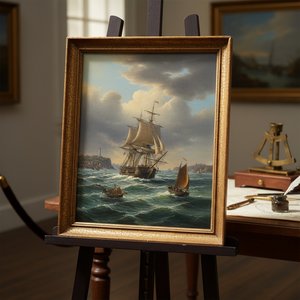
John Charlton (1849–1917): Pioneer of Maritime Gothic
John Charlton (1849–1917) stands as a singular figure in British art history, recognized primarily for his breathtaking depictions of naval battles and maritime landscapes—a style he christened “Maritime Gothic.” Born in Liverpool, England, Charlton’s artistic journey began amidst the burgeoning Victorian fascination with Romanticism and its exploration of sublime grandeur and emotional intensity.
Early Life and Artistic Influences
Charlton's formative years were steeped in the intellectual currents of his time. Educated at Shrewsbury School and subsequently at Lincoln’s Inn, he pursued legal studies before abandoning them to dedicate himself wholeheartedly to painting. His artistic sensibilities were profoundly shaped by Caspar David Friedrich’s landscapes—particularly “Wanderer Above the Sea of Fog”—which instilled within him a deep appreciation for solitude, contemplation, and confronting the immensity of nature.
The Birth of Maritime Gothic
Charlton's breakthrough came with his ambitious series of paintings commemorating the Crimean War (1853–1856). Unlike conventional military art of the era, which often prioritized heroic narratives, Charlton sought to convey not merely victory but also the psychological toll endured by soldiers amidst chaos and suffering. This approach—characterized by dramatic lighting, muted color palettes, and a palpable sense of unease—became the cornerstone of Maritime Gothic.
- Charlton’s meticulous attention to detail captured the textures of weathered ships, turbulent seas, and tormented faces with remarkable accuracy.
- He eschewed idealized representations in favor of portraying scenes imbued with emotional depth and psychological realism.
Notable Works and Legacy
Among Charlton’s most celebrated paintings are “The Mariner’s Dream,” a haunting portrayal of a sailor grappling with existential anxieties, and “The Battle of Trafalgar,” which powerfully conveys the terror and heroism of Britain's naval triumph. These works exemplify Maritime Gothic’s distinctive aesthetic—a fusion of Romantic grandeur and Gothic gloom—and cemented Charlton’s reputation as one of the foremost artists of his generation.
Charlton continued to produce artwork until his death in 1917, leaving behind a legacy that extends beyond his individual masterpieces. His pioneering approach to naval art profoundly influenced subsequent generations of painters and solidified Maritime Gothic's place within British artistic canon as an enduring symbol of Romanticism’s exploration of human emotion and the sublime.