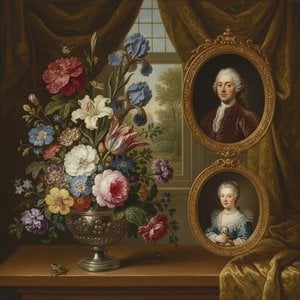
Jan van Huysum (1682–1749): A Master of Floral Illusion
Jan van Huysum, a name synonymous with the exquisite flower paintings of the Dutch Golden Age, was born in Amsterdam on April 15, 1682. He wasn’t simply a painter of blooms; he was a master of illusion, capable of rendering petals and droplets with such breathtaking realism that viewers felt they could almost inhale their fragrance. Born into an artistic family—his father, Justus van Huysum the Elder, was also a respected flower painter, and his brothers Jacob and Michiel followed suit—Jan’s path seemed predetermined. However, he wasn't immediately drawn to floral subjects. Early in his career, he experimented with landscapes, described as “conventional and arcadian,” but it was within the delicate world of still life that his true genius blossomed. The foundation of Van Huysum’s artistic education was laid by his father, a formative experience that instilled in him not only technical skill but also an understanding of the art market. Amsterdam during this period thrived as a center for commerce and culture, fostering a demand for luxurious and decorative paintings like those depicting lavish floral arrangements. This environment shaped Van Huysum’s approach; he wasn't merely replicating nature, but crafting idealized visions of beauty intended to delight and impress. His earliest dated work is completed in 1717 and now residing in the Louvre, already revealing a remarkable maturity and attention to detail, hinting at the mastery that was to come.The Art of Detail: Technique and Style
What truly sets Van Huysum apart is his unparalleled technique. He employed smooth, glossy brushstrokes, building up layers of paint to create an almost enamel-like surface that enhanced the richness and vibrancy of his colors. But it wasn’t just about color; it was about light—the way it played across petals, illuminated water droplets clinging to leaves, and created a sense of depth and volume. He possessed an extraordinary eye for detail, meticulously capturing the textures of every flower, fruit, and leaf with astonishing precision. Stories circulated that he could paint details like ants and dew drops so realistically they were visible without magnification—a testament to his dedication and skill. His compositions are characterized by a refined elegance and balance. Unlike some of his contemporaries who favored crowded, overflowing arrangements, he consistently avoided imbalance or over-composition. His later works became more elaborate, certainly, but always maintained a sense of harmony and grace. He often incorporated elements of fantasy into his work, particularly in his landscapes which featured imaginary scenes with classical architectural details and motionless trees. These weren’t attempts at topographical accuracy, but rather evocative settings designed to showcase the beauty of the flowers they contained.Influences and Artistic Development
Van Huysum’s artistic development was profoundly shaped by his father’s influence—a legacy that extended beyond mere technical instruction. Justus van Huysum the Elder championed a style rooted in observation and idealized representation, prioritizing clarity and luminous color. Jan absorbed these principles wholeheartedly, honing his skills alongside his brothers and establishing himself as a prominent figure within Amsterdam's artistic community. He studied under Rembrandt’s pupil Hendrick Willem Ter Brugghen, gaining invaluable insight into chiaroscuro—the dramatic interplay of light and shadow—a technique that would become central to Van Huysum’s distinctive aesthetic. Furthermore, he was exposed to the works of Rubens and Van Dyck during his visits to Madrid, broadening his artistic horizons and enriching his stylistic repertoire.Major Achievements and Legacy
Throughout his lifetime, Jan van Huysum enjoyed considerable acclaim and financial success. His paintings were highly sought after by collectors—including royalty—and he commanded high prices for his work. Today, his masterpieces can be found in prestigious museums around the world, including the Louvre in Paris, the National Gallery in London, and collections in Berlin and Amsterdam. Among his most celebrated works are *Terracotta Vase with Flowers and Fruits*, a stunning display of color and texture; *Flowers and Fruits*, showcasing his mastery of composition; and *Bouquet of Flowers in an Urn*, a testament to his ability to capture the ephemeral beauty of nature. His meticulous attention to detail, combined with his masterful use of light and color, cemented his place as one of the foremost floral painters of his era—a true innovator who elevated still life art to new heights of sophistication and elegance. Van Huysum’s legacy continues to inspire artists today, reminding us that beauty can be found in the simplest of forms when rendered with unwavering precision and profound artistic vision.Questions et réponses
Quelles émotions les œuvres de Jan Van Huysum expriment-elles ?
La L'espace des émotions de Jan Van Huysum vous permet de découvrir les œuvres de l'artiste classées par ambiance.
Où trouver les œuvres de Jan Van Huysum regroupées par mots-clés ?
Pour trouver des œuvres de Jan Van Huysum sur un thème spécifique, consultez la page Par mots-clés de l'artiste, qui regroupe les œuvres par mot-clé.
Où trouver les œuvres de Jan Van Huysum classées par couleur ?
L'Par couleur de Jan Van Huysum permet de parcourir les œuvres de l'artiste par couleur.