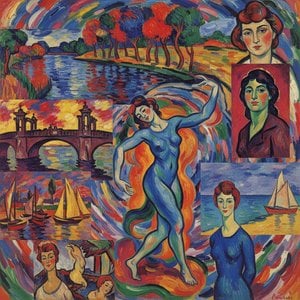
L'Âme Vibrante du Fauvisme Brésilien
Dans la grande tapisserie de l'art moderne, peu de fils brillent avec une intensité chromatique aussi profonde que ceux tissés par Inimá José de Paula. Né le 7 décembre 1918, dans la paisible ville d'Itanhomi, au Minas Gerais, Paula allait devenir un titan du fauvisme brésilien, un mouvement défini par sa libération de la précision représentative au profit d'une couleur brute et émotive. Sa vie fut un voyage en mouvement perpétuel, à l'image des compositions rythmiques que l'on retrouve sur ses toiles. De ses premières années de formation au Brésil jusqu'aux cercles avant-gardistes de Paris, l'existence de Paula fut dédiée à la capture du pouls de la vie à travers un prisme de pigments déchaînés et d'abstraction expressive.
Ses fondations artistiques furent posées avec une discipline rigoureuse, débutant au Núcleo Antônio Parreiras à Juiz de Fora. Cette formation initiale lui a doté du vocabulaire technique qu'il allait plus tard déconstruire et réimaginer. En rejoignant les pôles culturels de Rio de Janeiro pour étudier au Liceu de Artes e Ofícios, il commença à absorber les influences de maîtres tels qu'Argemiro Cunha et les membres du Núcleo Bernardelli. Cependant, c'est sa rencontre avec le modernisme européen qui embrasa véritablement son esprit créatif. L'exposition aux techniques d'André Lhote et de Gino Severini agit comme un catalyseur, l'initiant à la tradition fauve où la couleur n'est pas simplement descriptive, mais sert de vecteur primaire à l'émotion et à l'énergie.
Un Voyage entre Couleur et Continents
La trajectoire de la carrière de Paula fut marquée par des jalons significatifs qui ont jeté un pont entre l'identité brésilienne et le modernisme international. Un moment charnière survint en 1948 avec sa première exposition personnelle à l'Instituto dos Arquitetos do Brasil (IAB/RJ). Ce début ne fut pas seulement un triomphe personnel, mais un véritable couronnement professionnel, puisqu'il reçut le soutien généreux du légendaire Candido Portinari. Un tel parrainage plaça Paula fermement à l'avant-garde de la scène artistique brésilienne, l'établissant comme une étoile montante capable de fusionner les sensibilités locales avec les mouvements mondiaux.
En 1954, cherchant à s'immerger davantage au cœur du monde de l'art, Paula s'installa à Paris. Cette période de résidence lui permit de respirer le même air que les esprits d'avant-garde qui avaient façonné sa jeunesse. Vivant au milieu du ferment intellectuel de la capitale française, son travail commença à évoluer vers un dialogue sophistiqué entre structure et spontanéité. Il rapporta au Brésil une sensibilité raffinée — une manière de voir utilisant des coups de pinceau audacieux et des teintes contrastées pour transformer le banal en extraordinaire. Qu'il s'agisse de paysages urbains ou de formes plus abstraites, son œuvre est restée ancrée dans un profond sentiment de vitalité.
L'Héritage d'un Visionnaire Expressif
L'importance durable d'Inimá José de Paula réside dans sa capacité à évoquer la chaleur, l'esprit et le mouvement de la vie à travers un langage visuel unique. Ses chefs-d'œuvre, tels que Facades with Trees (1979), sont des exemples époustouflants de sa maîtrise. Dans ces œuvres, on découvre une symphonie de couleurs où des wagons bleus et un feuillage verdoyant dansent au sein d'une tapisserie urbaine, brouillant les frontières entre l'architecture, la machinerie et l'humanité. Il ne se contentait pas de peindre des scènes ; il peignait l'énergie qui leur est inhérente.
Tout au long de sa carrière s'étendant sur plusieurs décennies, Paula a reçu des reconnaissances prestigieuses d'institutions telles que la SNBA et la SNAM, consolidant un héritage qui continue d'inspirer collectionneurs et historiens. Sa contribution à l'art peut se résumer par plusieurs piliers essentiels :
- Innovation Chromatique : L'utilisation de palettes intenses et émotives qui définissent l'identité fauve brésilienne.
- Synthèse Culturelle : L'intégration fluide des techniques d'avant-garde européennes avec l'esprit vibrant des paysages et de la vie brésiliens.
- Dynamisme Structurel : Une capacité unique à utiliser des formes simplifiées et des arrangements rythmiques pour créer un sentiment de mouvement perpétuel.
- Mentorat et Connexion Artistique : Son rôle dans le mouvement plus large de l'art moderne brésilien, soutenu par des icônes comme Portinari.
Lorsque nous contemplons les œuvres d'Inimá José de Paula, nous n'observons pas simplement de la peinture sur une toile ; nous sommes témoins d'une célébration de l'existence tout au long d'une vie. Il demeure une figure vitale de l'histoire de l'art du XXe siècle, un peintre qui nous a enseigné que la couleur est le chemin le plus direct vers l'âme humaine.
Questions et réponses
Où puis-je voir les œuvres de Inimá José De Paula par ordre chronologique ?
La page Chronologie des œuvres de l'artiste présente les œuvres de Inimá José De Paula classées par date, année par année.
Dans quel pays Inimá José De Paula est-il né ?
Inimá José De Paula est né(e) en Brésil.
Dans quelle ville et quel pays Inimá José De Paula est-il/elle né(e) ?
Inimá José De Paula est né à Itanhomi, en Brésil.