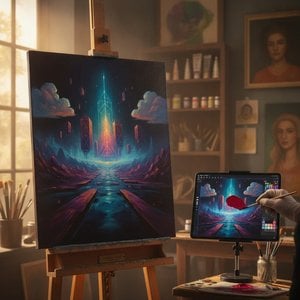
A Tapestry of Light and Shadow: The Artistic Journey of Eva Janina Wieczorek
In the quiet, creative atmosphere of Brühl, Germany, the works of Eva Janina Wieczorek emerge as profound meditations on the duality of existence. Born in Katowice, Poland, on May 23, 1951, Wieczorek carries within her a rich, multicultural heritage that informs her visual language. Her early life was marked by a technical precision, having completed an apprenticeship as a technician in Poland, yet it was the gentle influence of her uncle, a fellow painter, that ignited a lifelong devotion to the fine arts. This foundational period, rooted in discipline and observation, would later become the bedrock upon which she built her mastery of oil on canvas, allowing her to bridge the gap between the tangible world and the ethereal realms of the subconscious.
The evolution of Wieczondere’s style is a testament to her relentless pursuit of new modes of expression. Her formal training under Professor Roman Kalarus at the Academy of Fine Arts in Katowice provided her with the classical tools necessary to manipulate light and shadow with breathtaking intensity. While her early explorations involved the delicate transparency of watercolours and the vibrant immediacy of acrylics, she eventually found her true voice in the rich, layered depths of oil painting. This mastery allows her to achieve a level of realism that feels almost tactile, yet she frequently subverts this accuracy by introducing surrealist motifs—dreamlike imagery that invites the viewer to question the boundaries between reality and fantasy.
The Convergence of Tradition and Innovation
As her career progressed, Wieczorek demonstrated an extraordinary ability to adapt to the changing tides of the art world. A pivotal moment occurred around 2010 when, inspired by the pioneering digital explorations of David Hockney, she embraced the possibilities of digital painting. This transition did not represent a departure from her classical roots but rather an expansion of them. By integrating graphic software into her repertoire, she found new ways to experiment with color-themed series and spontaneous mental imagery. Her digital works often possess the same emotional weight as her oils, characterized by a keen sense of interpersonal relationships and a fascination with the human form, ranging from intimate portraits of women and children to stylized depictions of cultural icons.
Her thematic preoccupations are as diverse as her mediums. In her more recent large-scale works, Wieczorek has utilized her technical prowess to address pressing socio-political narratives. Through series such as "Unsere Welt" (Our World), she juxtaposes contrasting realities—peace and war, wealth and poverty, opportunity and inequality. By utilizing a striking contrast between monochromatic black-and-white elements and soft, pastel hues, she forces a confrontation with the complexities of modern life. This ability to weave heavy, contemporary themes into a visually captivating aesthetic has earned her recognition across Europe, with her works finding homes in collections and exhibitions throughout Germany, Great Britain, Croatia, Poland, and Belgium.
A Legacy of Visual Storytelling
The significance of Eva Janina Wieczorek’s oeuvre lies in its capacity to act as a mirror to both the individual psyche and the global landscape. Whether she is rendering an underwater scene that evokes a sense of profound solitude or a portrait that captures the fleeting essence of fame, her work remains anchored by a powerful implementation of light. Her art does not merely depict subjects; it breathes life into them, using the interplay of luminance and obscurity to tell stories that are often wordless yet deeply resonant.
As she continues to create in Brühl, Wieczorek’s legacy is defined by several key artistic pillars:
- Technical Versatility: A seamless transition between traditional oil painting, sculpture, and modern digital illustration.
- Stylistic Duality: The masterful blending of meticulous realism with the imaginative freedom of surrealism.
- Social Commentary: The use of artistic contrast to highlight the disparities and tensions within contemporary society.
- Emotional Depth: A profound focus on light, shadow, and human connection as tools for psychological exploration.