Une vie ancrée dans le réalisme : l'univers d'Émile Friant
Émile Friant, né dans la petite commune de Dieuze en 1863, s'est imposé comme une figure charnière, jetant un pont entre le réalisme du XIXe siècle et les mouvements artistiques bourgeonnants du début du XXe siècle. Son histoire personnelle est profondément entrelacée avec les bouleversements politiques et sociaux de son époque. La guerre franco-prussienne a projeté une ombre durable sur son enfance ; la fuite de sa famille vers Nancy, suite à l'annexion de Dieuze par la Prusse, a instillé en lui un sentiment de déracinement qui, peut-être, a nourri son dévouement à capturer l'essence de la vie et de l'identité françaises à travers son art. Bien qu'initialement orienté vers une voie scientifique, le talent artistique inné de Friant s'est rapidement affirmé, nourri d'abord par des tuteurs privés, puis sous la direction de Louis-Théodore Devilly à Nancy. L'accent mis par Devilly sur l'observation directe et le détail méticuleux a posé les fondations du style emblématique de Friant — un réalisme imprégné de profondeur émotionnelle et de finesse psychologique. Même un autoportrait de jeunesse, « Le Petit Friant », réalisé à seulement quinze ans, a attiré l'attention et lui a permis de poursuivre des études formelles à Paris, marquant le début de son ascension dans le monde de l'art.Formation parisienne et premiers succès au Salon
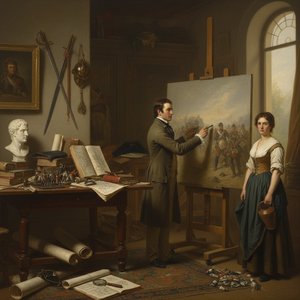
Le paysage artistique parisien s'est révélé à la fois stimulant et désillusionnant pour le jeune Friant. Étudier sous la direction d'Alexandre Cabanel, peintre académique de renom, l'a exposé aux techniques établies, mais l'a finalement laissé avec un sentiment de contrainte face à la rigidité du système des ateliers. Bien qu'il ait pratiqué avec diligence des esquisses à l'huile d'œuvres historiques, Friant aspirait à une approche plus personnelle et authentique. Ce désir le ramena à Nancy, où il continua de perfectionner ses compétences tout en exposant régulièrement dans les salons parisiens et locaux. Ses premières contributions au Salon, notamment « Le Fils prodigue » et « Intérieur d'atelier », ont démontré un talent naissant pour la peinture narrative et une capacité à saisir les nuances de l'émotion humaine. Une deuxième place au prestigieux concours du Prix de Rome a consolidé sa réputation, suivie de distinctions de troisième puis de deuxième classe lors de présentations ultérieures au Salon. De manière cruciale, Friant noua des amitiés durables avec les acteurs Ernest et Benoît Coquelin, ce qui mena à une série de commandes de portraits fascinants qui deviendraient la marque de fabule de son œuvre. Une bourse obtenue lors du Salon de 1886 lui permit de voyager aux Pays-Bas, où il découvrit les œuvres des maîtres hollandais — une expérience qui influença profondément son usage de la lumière et de l'ombre ainsi que son attention portée à la vie quotidienne.Œuvres de maturité : portraits, scènes de genre et influences nord-africaines
L'œuvre mature de Friant se caractérise par des portraits évocateurs et des scènes de genre dépeignant la vie des gens ordinaires à Nancy et au-delà. Il possédait une capacité extraordinaire à capturer non seulement la ressemblance physique, mais aussi le caractère intérieur et l'état psychologique de ses sujets. Ce talent atteignit son apogée avec « La Toussaint », une représentation poignante d'une famille pleurant sur une tombe, qui lui valut une médaille d'or à l'Exposition Universelle de 1889 — témoignage de sa reconnaissance croissante. Au-delà du portrait, Friant trouva l'inspiration en Afrique du Nord, effectuant plusieurs voyages en Algérie et en Tunisie. Ces périples imprégnèrent ses paysages d'une palette vibrante et d'un certain exotisme, tout en offrant des sujets captivants pour des portraits reflétant la diversité culturelle de la région. En 1923, il fut nommé professeur de peinture à l'École des Beaux-Arts de Paris, un poste qui saluait sa réputation établie et son influence dans le monde de l'art. Ses contributions furent également honorées par sa promotion au rang de Commandeur de la Légion d'honneur et son admission à l'Institut de France — les plus hautes distinctions décernées aux artistes en France.Un héritage de réalisme et de précision photographique
L'héritage artistique d'Émile Friant repose fermement sur son engagement envers le réalisme, un style qu'il a embrassé tout en dépassant ses limites. Bien qu'initialement façonné par l'accent mis par Devilly sur l'observation directe et les techniques académiques de Cabanel, Friant a développé une voix distinctive qui s'est affranchie d'une adhésion stricte à l'une ou l'autre approche. Il ne cherchait pas simplement à répliquer la réalité ; il aspirait plutôt à imprégner ses peintures d'une résonance émotionnelle et d'une profondeur psychologique. Son utilisation innovante de la photographie comme outil préparatoire — une pratique de plus en plus courante chez les artistes de l'époque — démontre un engagement envers les technologies émergentes et un désir de précision dans la représentation. Il représente un lien crucial entre le naturalisme du XIXe siècle et les innovations artistiques du début du XXe siècle, contribuant à l'évolution de la peinture française tout en restant fidèle à ses principes fondamentaux. Certains le considèrent comme l'un des derniers grands naturalistes, préservant une tradition d'observation méticuleuse et d'honnêteté émotionnelle à une époque de changements rapides. Sa mort tragique en 1932 — une chute à Paris — mit un terme abrupt à une carrière remarquable, mais ses peintures continuent de captiver le public par leur beauté, leur sensibilité et leur pertinence intemporelle. L'œuvre de Friant sert de puissant rappel de l'importance de capturer l'expérience humaine avec autant de précision que de compassion.Questions et réponses
Sous quels autres noms Émile Friant est-il/elle connu(e) ?
Émile Friant apparaît sous les noms alternatifs Emile Friant.
Puis-je parcourir les œuvres de Émile Friant par technique ?
Pour trouver toutes les œuvres de Émile Friant dans une technique donnée, consultez la page Tous les médiums de l'artiste.
Puis-je explorer les œuvres de Émile Friant par mot-clé ?
Pour trouver des œuvres de Émile Friant sur un thème spécifique, utilisez la page Par mots-clés de l'artiste, qui regroupe les œuvres par mot-clé.