Menu
CONSEIL EN ART OFFERT

David Rijckaert Iii

1612 - 1661

L'essentiel

  • Art period: Époque moderne précoce
  • Also known as:
    • David Ryckaert Iii
    • David Rijckaert Le Jeune
  • Top-ranked work: L
  • Born: 1612, Antwerpen, België
  • Museums on APS: Musée des Beaux-Arts
  • Nationality: België
  • Afficher plus…
  • Died: 1661
  • Top 3 works:
    • L
    • Interior of a Cobbler’s Shop, David Ryckaert (III), c. 1650
  • Works on APS: 2
  • Lifespan: 49 years
  • Copyright status: Public domain

Quiz d'art

Chaque question ne comporte qu'une seule bonne réponse.

Question 1:
Où est né David Ryckaert III ?
Question 2:
Quel guildeau David Ryckaert III a-t-il rejoint à Anvers ?
Question 3:
David Ryckaert III est surtout connu pour ses représentations de :
Question 4:
Qui était le mécène de David Ryckaert III pendant son séjour au palais du gouverneur des Pays-Bas méridocaux ?
Question 5:
Quel musée abrite des œuvres remarquables par David Ryckaert III, notamment « Dulle Griet » ?

David Ryckaert III (1612 - 1661)

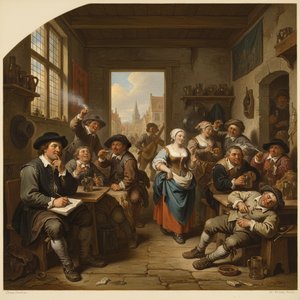
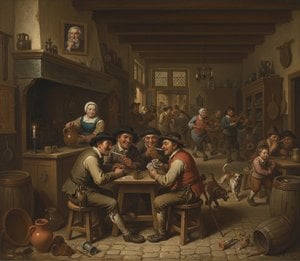
David Ryckaert III, David Rijckaert III or David Rijckaert the Younger (2 December 1612, Antwerp – 11 November 1661, Antwerp) was a Flemish painter known for his contribution to genre painting, in particular through his scenes of merry companies and peasants. He also painted hell scenes and images of alchemists. He enjoyed the patronage of prominent patrons and was a painter to the court of the governor of the Southern Netherlands. David Ryckaert III was born in Antwerp on 2 December 1612 and was baptized in the St. James’ Church on the same date. He was the second of three children of David Rijckaert II and Katelijne de Meere (or Catharina de Merre). As the only son, he was named after his father, following the family's naming tradition. A member of the Ryckaert (or Rijckaert) family of artists, he was the grandson of David Rijckaert I and the nephew of Marten Ryckaert. He had an uncle called Pauwels who was also a painter, but of whom no known works exist. His father was a painter and art dealer. It was earlier believed that his father was a painter of landscapes and genre scenes. This view changed when in 1995 Christie’s auctioned a painting referred to as Still life with shells with a nautilus, vases, glasses and Chinese porcelain, which was signed and dated 'DAVIDT.RYCKAERTS. / .1616.' The art historian Fred Meijer was able to attribute this work to David Rijckaert II. This led to the attribution to David Rijckaert II of more still life works. David Ryckaert III was a pupil of his father. He became master of the Guild of Saint Luke in Antwerp in 1636-37 and was registered as a 'wijnmeester', i.e. the son of a master. He held the position of dean of the Guild in 1652–53. He was one of the many Antwerp artists who were invited to work on the decorations for the Joyous Entry into Antwerp of the new governor of the Habsburg Netherlands Cardinal-Infante Ferdinand in 1635. Rubens was in overall charge of this project. Ryckaert was tasked to paint together with Antwerp painter Jan van Eyck the final triumphal arch for the event. The painting was an allegorical representation of the glorification of Cardinal-Infante Ferdinand. He was the teacher of Hans la Croys, Jacob Lafosse II and Erasmus de Bie. His sister Margaret married his father's pupil Gonzales Coques who became a successful painter. David Ryckaert III worked his entire career in Antwerp. He married on 31 August 1647 with Jacoba Palmans with whom he had eight children. His work was very well received and one of his patrons was Archduke Leopold Wilhelm of Austria, the Governor of the Southern Netherlands from 1647 until 1656. David Ryckaert III is known for Landscape, figure and genre paintings. He influenced by Brouwer & Teniers. His notable artworks include Interior of a Cobbler’s Shop and Dulle Griet. He was housed at Kunsthistorisches Museum Wien and Mauritshuis.