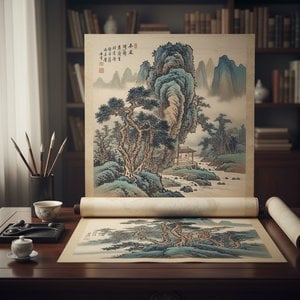
Dai Xi: A Master of Shanshui Landscape Painting
Dai Xi (戴熙), born Quanzhou, China in 1801 and died 1860, stands as a pivotal figure within Qing Dynasty art history—specifically recognized for his exceptional contribution to the Shanshui style landscape genre. Often paired with Tang Yifen, he formed one of the most celebrated artistic collaborations of his era, earning them the moniker “Tang-dai,” reflecting their shared aesthetic sensibilities and technical prowess. His legacy resides not merely in prolific output but in a profound understanding of Daoist principles embedded within his paintings, elevating them beyond mere visual representations to expressions of spiritual contemplation.
Early Life and Artistic Training
Dai Xi’s formative years were steeped in Confucian tradition, fostering an appreciation for scholarship and moral virtue—qualities that would profoundly inform his artistic vision. Biographical details concerning Dai Xi remain somewhat elusive, yet scholarly consensus suggests Guangzhou as his primary residence during much of his adult life, where he honed his skills amidst the vibrant artistic milieu of the Canton System. Crucially, Dai Xi’s artistic development was decisively shaped by Wang Hui (王羲周), a revered master from the preceding Ming Dynasty whose meticulous observation of nature and masterful brushwork established a benchmark for Shanshui painters. This connection is palpable in Dai Xi's work—characterized by serene compositions, subtle tonal gradations, and an unwavering commitment to capturing the essence of mountainous landscapes. He diligently practiced calligraphy alongside painting, mastering the art of *shan shu* (山水)—literally “mountain water”—a genre that championed the harmonious relationship between humanity and the natural world.
Style and Technique: Echoes of Wang Hui
Dai Xi’s artistic style can be unequivocally categorized as Shanshui (山水), mirroring Wang Hui's approach—one rooted in profound respect for the sublime beauty of the wilderness. Unlike artists who sought to depict idealized vistas, Dai Xi embraced realism, striving to convey not merely what he saw but also what he felt—a core tenet of Daoist philosophy that permeated Chinese art during his time. He skillfully employed *gongbi* (工筆)—a technique demanding painstaking attention to detail and tonal subtlety—to achieve remarkable textural accuracy and atmospheric depth. This meticulous process allowed him to capture the subtle interplay of light and shadow on rocky outcrops, cascading waterfalls, and verdant foliage, mirroring Wang Hui’s masterful rendering of natural forms. Dai Xi's palette favored muted hues—primarily blues and greens—reflecting the tranquil majesty of alpine panoramas.
Notable Works and Recognition
Dai Xi’s oeuvre comprises numerous landscape paintings showcasing his mastery of Shanshui aesthetics. Among his most celebrated pieces is “Distant Streams and Mountains,” currently housed in Yale University Art Gallery (9531), which exemplifies his signature style—characterized by expansive vistas rendered with breathtaking precision and imbued with a palpable sense of serenity. The painting’s composition skillfully utilizes perspective to convey depth, while subtle tonal variations capture the nuances of light and shadow on rocky outcrops and flowing watercourses. Furthermore, Dai Xi's exploration of genre subjects – plants and human figures—added another dimension to his artistic repertoire, demonstrating his versatility as a painter. Collections of his paintings appeared in China in 1920 and 1934, securing his place within the canon of Qing Dynasty art.
Tragic End and Legacy
Dai Xi’s life tragically concluded in 1860 during the Taiping Rebellion—a tumultuous period marked by civil unrest and dynastic instability. Faced with the siege of Hangzhou by rebel forces, Dai Xi bravely defended the city alongside loyalists, ultimately sacrificing himself by drowning in a pond—an act imbued with symbolic significance reflecting his unwavering devotion to duty and honor. He was posthumously honored with the title Wenjie (文節), signifying “cultured and moderate,” acknowledging his erudition and moral integrity. Dai Xi’s enduring influence extends beyond his artistic achievements; he also served as a respected scholar and collector of ancient coins, publishing a comprehensive treatise on the subject—Guchuan Zonghua (古泉叢話)—demonstrating his intellectual curiosity and commitment to preserving cultural heritage. His legacy continues to inspire artists and scholars alike, cementing Dai Xi’s position as one of China's most distinguished landscape painters and a testament to the enduring power of Daoist ideals within Chinese art.