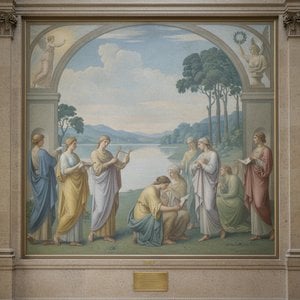
Early Life and Artistic Training
Charles Meynier, a name inextricably linked to the grandeur of Neoclassicism in France, was born on November 24th, 1768, within the bustling heart of Paris. His early life, however, wasn’t destined for the artistic heights he would eventually achieve. Initially, his family envisioned a future as a tailor – a practical profession rooted in tradition. Yet, from a young age, Charles displayed an undeniable passion for drawing, a nascent talent that stubbornly resisted the confines of his familial expectations. Recognizing this innate inclination, his father conceded to allow him to pursue his artistic inclinations, entrusting him to the tutelage of Pierre-Philippe Choffard, a distinguished engraver and artist renowned for his technical skill and meticulous approach. This formative apprenticeship proved invaluable, laying the foundation for Meynier’s future success by instilling in him the fundamental principles of draftsmanship and design.Rise to Prominence: The Prix de Rome and Academic Recognition
Meynier's trajectory dramatically shifted in 1789 when he secured a place as a student under François-André Vincent, a leading figure in the Parisian art scene. This opportunity proved decisive; it was during this period that Meynier’s exceptional talent truly began to blossom. The culmination of his efforts arrived in 1789 with his victory in the prestigious Prix de Rome competition – a contest widely considered the most important artistic prize in France at the time. Securing second place granted him membership in the Académie de France in Rome, an institution that provided unparalleled access to the artistic treasures and intellectual currents of Italy. During his years in Rome, Meynier immersed himself in the study of classical antiquity, meticulously copying masterpieces by Renaissance artists, honing his skills in composition, anatomy, and perspective – elements that would become hallmarks of his distinctive style.Notable Works and Commissions: Celebrating Napoleonic Triumphs
Upon his return to France, Meynier quickly established himself as a sought-after artist, commissioned to create works celebrating the rise of Napoleon Bonaparte. His artistic versatility was evident in a diverse range of projects, from grand historical paintings to intricate bas-reliefs adorning public monuments. A particularly noteworthy example is *Marshal Ney and the Soldiers of the 76th Regiment Retrieving their Flags from the Arsenal of Inspruck* (1808), a dramatic depiction of a pivotal moment during Napoleon’s campaigns in Germany, which garnered considerable acclaim at the Salon in Paris. Furthermore, Meynier was entrusted with designing the sculptural decorations for the Arc de Triomphe du Carrousel, a monumental gateway to the Tuileries Palace, showcasing his mastery of architectural design and artistic integration. His work *France Triumphant Encouraging the Sciences and the Arts* (1795) marked the beginning of his illustrious career.Legacy and Artistic Influence
Charles Meynier’s influence extended far beyond his own lifetime. He became a respected teacher at the École des Beaux-Arts de Paris, imparting his knowledge and expertise to generations of aspiring artists. Notably, he mentored James Pradier, whose own artistic development was profoundly shaped by Meynier's teachings. Meynier passed away on September 6th, 1832, leaving behind a substantial body of work that continues to be admired for its elegance, precision, and evocative power. His legacy endures not only through his paintings but also as a testament to the enduring appeal of Neoclassical ideals – a style characterized by clarity, order, and a profound respect for classical antiquity. His works can be found in prestigious collections worldwide, offering a window into a pivotal era of French art history.Questions et réponses
Puis-je explorer les œuvres de Charles Meynier par spectre de couleurs ?
Les œuvres de Charles Meynier peuvent être explorées par couleur sur la page Par couleur de l'artiste.
Puis-je parcourir les œuvres de Charles Meynier par ambiance ?
La page L'espace des émotions de l'artiste présente les œuvres de Charles Meynier classées par atmosphère.
Comment la carrière de Charles Meynier est-elle divisée en périodes ?
Retrouvez l'itinéraire chronologique de l'œuvre de Charles Meynier sur la page Parcours de carrière de l'artiste, où les œuvres se succèdent par périodes de création, chapitre par chapitre.