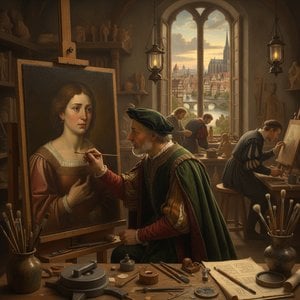
Early Life and Education
Carl Friedrich Lessing, a renowned German historical and landscape painter, was born on February 15, 1808, in Breslau (now Wrocław), Poland. He was the grandnephew of the esteemed poet and dramaturge Gotthold Ephraim Lessing. Lessing’s early education laid the foundation for his future artistic pursuits. He studied architecture at the Berlin Bauakademie in 1822, followed by enrollment at the königlich-preussische akademie der wissenschaften (royal prussian academy of the sciences) from 1823 to 1826. This formative period instilled within him a deep appreciation for both classical aesthetics and scientific observation—influences that would permeate his artistic vision throughout his career.Artistic Career and Influences
Lessing’s artistic trajectory gained momentum through his association with Friedrich Wilhelm von Schadow, under whose guidance he honed his skills in historical painting. Schadow's atelier served as a crucible for talent, fostering a collaborative spirit that propelled Lessing’s artistic development. In 1830, Lessing’s works—characterized by a masterful blend of history and landscape elements—earned him immediate recognition as one of the foremost artists of the Düsseldorf School. This school championed a distinctive approach to painting, prioritizing atmospheric perspective and capturing the sublime grandeur of nature alongside meticulously researched depictions of historical events. His notable paintings include:- Landscape with Castle Ruins and Riders (1878): Lessing’s canvases often explored themes of solitude and contemplation amidst dramatic natural settings, mirroring the spirit of Romanticism itself.
- Soldiers at Rest (1877): Demonstrating a keen understanding of human psychology alongside technical prowess, Lessing depicted figures imbued with emotion and vulnerability—a hallmark of his artistic style.
- Motif from the Harz Mountains (1870): The artist’s meticulous attention to detail—particularly in rendering textures and colors—elevated his landscapes beyond mere representation, transforming them into immersive experiences for the viewer.
- Landscape (1862): Lessing's canvases frequently conveyed a sense of melancholy beauty, reflecting the Romantic preoccupation with emotion and imagination.
- Upper Rhine Chapel (1860): Like Schadow’s work, Lessing’s paintings embraced monumental scale and dramatic lighting—techniques designed to evoke awe and inspire contemplation.
Leadership and Legacy
Lessing co-founded the artists’ association Malkasten (Paint Box) in 1848—a pivotal moment in German art history—establishing a forum for discussion and experimentation that challenged prevailing conventions. From 1858 until his death in 1880, he served as the director of the Grand Ducal Painting Gallery and Print Collection in Karlsruhe, safeguarding artistic heritage and fostering an environment conducive to creative innovation. His contribution to the gallery ensured that future generations would appreciate the beauty and significance of German art. Lessing’s legacy resides not only in his impressive oeuvre but also in his unwavering commitment to nurturing talent and upholding artistic standards—a testament to his enduring influence on the Düsseldorf School and beyond.Notable Achievements
Lessing achieved considerable success early in his career, securing a prominent position at the Berlin Art Exhibition of 1826 with *Kirchhof mit Leichensteinen und Ruinen im Schnee* (Churchyard with Gravestones and Ruins in the Snow)—a painting that immediately captivated audiences and established him as one of Düsseldorf’s most promising artists. He was accepted into Schadow's atelier, furthering his artistic development under the tutelage of a master craftsman. Furthermore, Lessing’s role as director of Karlsruhe cemented his reputation as a champion of art and culture—leaving an indelible mark on German intellectual life.Questions et réponses
Comment puis-je trouver toutes les œuvres de Carl Friedrich Lessing dans une technique donnée ?
La page Tous les médiums regroupe les œuvres de Carl Friedrich Lessing par technique.
Où et en quelle année Carl Friedrich Lessing est-il né ?
Carl Friedrich Lessing est né à Wrocław en 1808.
Comment l'art de Carl Friedrich Lessing a-t-il évolué au fil du temps ?
La carrière de Carl Friedrich Lessing se dévoile période par période sur la page Chronologie de l'artiste : une frise chronologique horizontale des œuvres, regroupées en chapitres correspondant aux différentes étapes de sa carrière.