L'Âme du Paysage Allemand : La Vie d'August Albert Zimmermann
August Albert Zimmermann s'érige comme un témoignage profond de l'esprit durable du romantisme allemand, une époque où la toile devint une fenêtre ouverte sur l'âme humaine à travers le prisme de la nature. Né en 1808 à Zittau, en Silésie — une région faisant aujourd'hui partie de la Pologne — le parcours artistique de Zimmermann s'est déployé sur fond de mutations culturelles privilégiant l'émotion brute et l'imagination sans limites face aux rigides conventions académiques du passé. Sa jeunesse fut profondément liée à une riche tapisserie familiale de talents ; il était le frère des éminents peintres Max, Richard et Robert Zimmermann. Cette lignée commune lui apporta une compréhension fondamentale des principes artistiques, pourtant, c'est sa sensibilité unique au sublime qui allait finalement distinguer sa main de celle de ses proches.
Bien que sa formation formelle inclût des études prestigieuses à l'Académie des Beaux-Arts de Dresde et à l'Académie des Beaux-Arts de Munich, le véritable génie de Zimmermann émergea par une exploration autodidacte. Il possédait un esprit inquiet et curieux qui cherch'en l'inspiration bien au-delà des frontières établies, lui permettant de cultiver un style distinctif caractérisé par un réalisme atmosphérique. Cette période de développement fut marquée par une étude intense de l'ombre et de la lumière, alors qu'il apprenait à traduire les qualités éphémères du monde naturel en peintures à l'huile permanentes et évocatrices, ainsi qu'en délicates aquarelles. Sa capacité à mêler la précision technique à une connexion spirituelle profonde avec ses sujets lui permit de transcender la simple représentation, transformant les paysages en de véritables expériences émotionnelles.
Maîtrise de la Lumière et Sublime Romantique
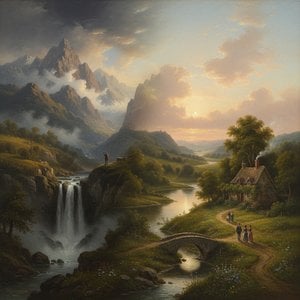
L'œuvre de Zimmermann est principalement célébrée pour sa capacité à capturer à la fois la grandeur et la tranquillité paisible du paysage allemand, avec un accent particulier sur les panoramas époustouflants de la Bavière. Ses toiles ne sont pas de simples images statiques, mais des environnements vibrants où les couleurs éclatantes et une touche magistrale convergent pour raconter l'histoire de la puissance de la nature. Il fut un maître du clair-obscur, utilisant le jeu dramatique entre l'ombre et la lumière pour intensifier la profondeur atmosphérique et évoquer des sentiments d'émerveillement, de contemplation, voire une touche de mélancolie. À travers son regard, une simple vue montagneuse pouvait devenir une confrontation monumentale avec l'infini.
Les motifs récurrents de son travail servent de fenêtres sur la préoccupation romantique pour le sublime. Un spectateur peut se retrouver perdu parmi :
- Des sommets enneigés qui évoquent la majesté silencieuse et glaciale des hautes Alpes ;
Cette dualité — cette aptitude à passer de l'échelle épique d'un massif montagneux au détail délicat d'une seule branche — définit son héritage technique. Qu'il peignât la silhouette lointaine de l'Etna ou le calme immobile d'une scène hivernale mettant en scène des ramasseurs de bois, Zimmermann maintenait un engagement indéfectible envers la vérité atmosphérique.
Héritage et Importance Historique
Au fil du XIXe siècle, l'œuvre de Zimmermann devint une pierre angulaire de la tradition du paysage romantique. Son influence s'étendit à travers son rôle d'enseignant — servant notamment de mentor à son frère Max — et par sa capacité à capturer le visage changeant de l'Europe, des terrains accidentés de l'Allemagne aux rythmes pastoraux de la vie rurale. Ses peintures font plus que documenter la géographie ; elles documentent une époque d'enquête philosophique profonde sur la relation entre l'humanité et le monde naturel.
Aujourd'hui, les œuvres d'August Albert Zimmermann continuent de résonner auprès des collectionneurs comme des historiens de l'art. Sa capacité à évoquer le sublime — ce mélange spécifique de beauté et de terreur trouvé dans la grandeur de la nature — assure sa place dans le panthéon des grands maîtres allemands. Par sa maîtrise de la lumière, sa profondeur émotionnelle et son dévouement inébranlable au paysage, Zimmermann a laissé derrière lui un héritage visuel qui continue de nous inviter à marquer une pause, à respirer et à contempler la beauté magnifique, et souvent accablante, du monde qui nous entoure.
Questions et réponses
Quelles couleurs August Albert Zimmermann a-t-il le plus souvent utilisées ?
L'usage de la couleur par August Albert Zimmermann à travers les œuvres répertoriées sur ce site web peut être étudié sur la page Génome de la palette de l'artiste.
Comment puis-je suivre l'évolution de l'œuvre de August Albert Zimmermann année après année ?
La page Chronologie des œuvres de l'artiste présente les œuvres de August Albert Zimmermann classées par date, année par année.
Où peut-on trouver les œuvres de August Albert Zimmermann regroupées par technique ?
La page Tous les médiums regroupe les œuvres de August Albert Zimmermann par technique.