Arkhip Kuindzhi: A Legacy Illuminated
Arkhip Ivanovych Kuindzhi (Архип Иванович Куинджи), born January 27, 1841 (O.S., February 15 in Gregorian Calendar) in Mariupol, Ukraine, and passing away July 24, 1910 (O.S., July 11 in Gregorian Calendar) in Saint Petersburg, Russia, stands as a singular figure within Russian landscape painting—a master whose ethereal depictions of nature continue to captivate audiences today. His artistic journey was marked by hardship, resilience, and an unwavering devotion to capturing the sublime beauty of the Russian countryside.Early Life and Influences: From Mariupol’s Poverty to Aivazovsky's Guidance
Kuindzhi’s formative years were steeped in poverty. Orphaned at just six years old after losing his parents—a tragedy that profoundly shaped his worldview—he endured a challenging childhood, working successively as a builder’s assistant, a corn merchant’s clerk, and even briefly as a church craftsman. Despite limited formal education, Kuindzhi benefited from the mentorship of Grigory Petrovich Semenov, a Greek teacher who instilled in him a love for literature and fostered his nascent artistic inclinations. Crucially, his exposure to Ivan Aivazovsky—a titan of seascape painting—proved transformative. At the age of thirteen, Kuindzhi embarked on a pilgrimage to Feodosia, Crimea, where he spent several weeks studying under Aivazovsky’s tutelage. Although tasked with merely mixing paints during this initial encounter, it nonetheless ignited his passion for color and technique—a fascination that would define his artistic style throughout his career. Adolf Fessler, Aivazovsky's student, further honed Kuindzhi's skills, solidifying the influence of Crimean Impressionism on his developing vision. Historian John E. Bowlt noted this formative connection as “remarkable,” highlighting its significance in shaping Kuindzhi’s artistic trajectory.The Dawn of Luminism: Embracing Light and Atmosphere
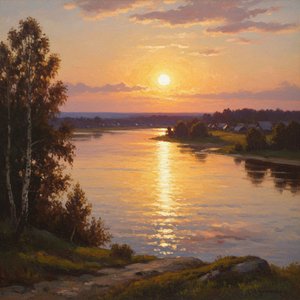
Kuindzhi’s breakthrough came during his time at the Imperial Academy of Arts in Saint Petersburg (1868–1901), where he embraced the principles of luminism—a movement championed by artists like Ilya Repin and Vasily Surikov. Luminists sought to depict landscapes not as mere representations of reality, but as expressions of emotion and spiritual contemplation, prioritizing atmospheric effects above precise detail. Kuindzhi’s canvases pulsated with luminescence—the radiant glow of twilight, the shimmering haze of dawn—creating scenes that seemed to transcend ordinary perception. This stylistic choice distinguished him from his contemporaries and cemented his reputation as a visionary artist. His paintings, such as *Red Sunset* (1873) and *Moonlit Night on the Dnieper* (1882), exemplify this distinctive approach, capturing fleeting moments of beauty with unparalleled sensitivity.Notable Achievements: Recognition and Patronage
Kuindzhi’s artistic prowess garnered considerable acclaim during his lifetime. His landscapes were exhibited repeatedly at the Salon des Beaux-Arts in Paris and secured prestigious awards—most notably a bronze medal at the International Art Exhibition of London in 1874. This recognition propelled him to prominence within the Russian art world, attracting the patronage of influential figures like Pavel Tretyakov, who amassed an unparalleled collection of Russian art. Tretyakov’s unwavering belief in Kuindzhi's talent ensured that his work would be showcased prominently in Moscow’s Tretyakov Gallery—a testament to his enduring legacy. Furthermore, Kuindzhi’s paintings were purchased by Grand Duke Konstantin Nikolaevich—the heir apparent to the throne—demonstrating the widespread admiration for his artistic vision.A Singular Vision: The Mystique of Ukrainian Landscapes
Kuindzhi's artistic output was inextricably linked to his deep connection with Ukraine—his birthplace and lifelong home. He captured the essence of Ukrainian landscapes with an extraordinary sensitivity, portraying scenes of rural life imbued with a palpable sense of melancholy and nostalgia. His paintings—particularly *Forgotten Village* (1874) and *Chumatski Path* (1875)—reflect the spirit of the Peredvizhniki movement—a group of Russian artists who championed realism and social commentary—while simultaneously conveying an individual’s profound appreciation for the natural world. His work continues to inspire awe and wonder, reminding us of the enduring power of art to illuminate the human experience. ## Legacy and Influence: An Artist Beyond His Time Arkhip Kuindzhi remains a pivotal figure in Russian landscape painting—a pioneer whose luminous style foreshadowed many developments in Impressionism and Expressionism. He established himself as one of Russia’s foremost artists, securing his place in art history through his distinctive approach to capturing light and atmosphere. His unwavering dedication to artistic excellence and his profound empathy for the human condition continue to resonate with audiences worldwide—a testament to the enduring power of his vision and a legacy that transcends time itself.Questions et réponses
Puis-je explorer les œuvres de Arkhip Kuindzhi par sujet ?
L'Atlas thématique de Arkhip Kuindzhi est une page qui répertorie les œuvres de l'artiste par thématiques.
Comment puis-je trouver toutes les œuvres de Arkhip Kuindzhi dans une technique donnée ?
La page Tous les médiums regroupe les œuvres de Arkhip Kuindzhi par technique.
Où puis-je voir la palette de couleurs des œuvres de Arkhip Kuindzhi ?
L'usage de la couleur par Arkhip Kuindzhi à travers les œuvres répertoriées sur ce site web peut être étudié sur la page Génome de la palette de l'artiste.