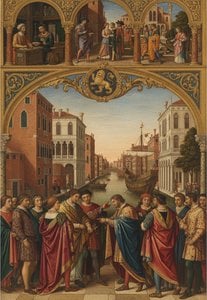
Le Maître Vénitien de la Grandeur Maniériste
Andrea Vicentino, un nom qui résonne encore à travers les couloirs de la fin de la Renaissance, s'impose comme une figure charnière du paysage artistique vénitien. Né dans la ville riche d'architecture qu'est Vicence vers 1542, ses premières années furent façonnées par les profondes traditions de l'école Maganza. Sous le regard attentif et la tutelle experte de Giovanni Battista Maganza, Vicentino développa une maîtrise des compositions monumentales et une esthétique raffinée qui allaient plus tard définir sa carrière. Cette période formative lui apporta bien plus qu'une simple compétence technique ; elle lui insuffla une compréhension profonde de la manière dont l'art pouvait servir de vecteur tant à la fierté civique qu'à la dévotion religieuse.
À mesure qu'il mûrissait, l'identité de l'artiste devint aussi fluide et vibrante que le monde de l'art vénitien lui-même. Connu sous les noms variés d'Andrea Michieli ou Michelli, son installation à Venise au milieu des années 1570 marqua une ère transformative dans son développement. Dès 1583, il s'inscrivit officiellement à la Fraglia, la prestigieuse guilde des peintres vénitiens. Cette affiliation ne fut pas seulement un jalon professionnel, mais une porte ouverte sur les cercles de mécénat les plus influents de la République, lui permettant d'entrelacer ses coups de pinceau dans la trame même de la vie politique et spirituelle de Venise.
Un Héritage Inscrit dans le Palazzo Ducale
L'ampleur véritable du talent de Vicentino s'admire peut-être mieux à travers ses collaborations monumentales au sein du Palazzo Ducale. Travaillant aux côtés du légendaire Tintoret, Vicentino contribua à certains des programmes décoratifs les plus significatifs de l'époque. Sa main est visible dans la grandeur de L'Arrivée de Henri III à Venise, un chef-d'œuvre situé dans la Sala delle Quattro Porte qui capture le poids historique de la visite du monarque des Habsbourg. Grâce à son œuvre, les salles du palais — notamment la Sala del Senato et la Sala dello Scrutinio — furent transformées en scènes théâtrales où l'histoire et le mythe convergeaient.
Sa capacité à naviguer dans les complexités du maniérisme lui permit de maîtriser un style caractérisé par :
- Une composition dramatique : l'utilisation de formes allongées et d'agencements complexes pour créer un sentiment de complexité intellectuelle.
- Une coloration lumineuse : une maîtrise de la lumière et des pigments qui reflétait les riches traditions atmosphériques de l'école vénitienne.
- Une profondeur narrative : une aptitude à mêler l'exactitude historique à un sens du mouvement et de l'émotion presque cinématographique.
L'Intersection de la Dévotion et du Drame Épique
Au-delà de la splendeur politique de Venise, l'œuvre de Vicentino atteignit le cœur sacré de l'Italie. Son entreprise ambitieuse à la cathédrale de Trévise, la Madone du Rosaire, témoigne de sa capacité pour une expression religieuse profonde. Dans cette œuvre, l'artiste s'éloigna de l'énergie chaotique des batailles pour adopter un langage plus intime et dévotionnel, utilisant des détails complexes et une lueur douce et lumineuse pour inspirer la piété des fidèles.
Pourtant, il était tout aussi capable de capturer le chaos viscéral du conflit. Sa représentation de 1603 de la Bataille de Lépante demeure l'une de ses réalisations les plus évocatrices. Dans cette huile sur toile, le spectateur est emporté dans un torrent d'embruns salés, de fumée de poudre à canon et de cris désespérés de combattants. C'est ici que les racines maniéristes de Vicentino rencontrent l'énergie brute de la fin de la Renaissance, créant un écho visuel du choc entre la Sainte Ligue chrétienne et la flotte ottomane. Par son pinceau, l'événement historique transcende la simple documentation pour devenir un drame épique de lutte humaine et de ferveur religieuse.
En fin de compte, la signification d'Andrea Vicentino réside dans son rôle de pont entre les époques. Il transporta l'élégance raffinée de la tradition Maganza dans le monde dramatique et intense du maniérisme vénitien, laissant derrière lui un héritage d'œuvres qui continuent de susciter la révérence par leur brillance technique et leur résonance émotionnelle.
Questions et réponses
Comment puis-je suivre l'évolution de l'œuvre de Andrea Vicentino année après année ?
Une chronologie des œuvres de Andrea Vicentino est disponible : la page Chronologie des œuvres classe les œuvres par date de création.
Puis-je explorer les œuvres de Andrea Vicentino par spectre de couleurs ?
Les œuvres de Andrea Vicentino peuvent être explorées par couleur sur la page Index spectral de l'artiste.
Où puis-je voir la palette de couleurs des œuvres de Andrea Vicentino ?
Le profil chromatique des œuvres de Andrea Vicentino est présenté sur la page Génome de la palette de l'artiste.