


 Aperçu en situation
 Envoyer
 Partager
 Détails de l'œuvre

 Télécharger
 Articles similaires
 Radiographie
 Diaporama
Palazzo Senatorio


 Lire la suite
Reproduction à l'huile faite à la main
Huile sur toile peinte à la main, avec cadre et dimensions personnalisés, réalisée sur commande par nos artistes. ( Commander l'impression Télécharger l'image haute résolution)




P118B $10

P118H $10

P118W $10

P438Z $10

P508JH $12

P508YH $12

P805H $10

P805Z $10

P919BZ $10

P919G $10

P919XJ $10

P959ZH $10

P968JZ $12

W106C $8

W218G $10

W218JH $8

W218Y $10

W307PJ $10

W316G $10

W316PJ $8

W316Y $10

W398PJ $8

W4111J $10

W500HY $15

W500JH $15

W692G $12

W849H $8

W940BG $15

W953PJ $8




Choisissez parmi nos formats prédéfinis qui respectent les proportions originales de l’œuvre.

Vous pouvez saisir vos propres dimensions pour l'adapter à un cadre ou à un espace spécifique. Si la taille sélectionnée ne correspond pas aux proportions de l'image d'origine, nous recadrerons l'œuvre ou prolongerons la peinture avec des éléments peints à la main supplémentaires. Une maquette numérique vous sera envoyée pour approbation avant le début de la production.
Veuillez noter que l'aperçu à l'écran ne reflète pas le recadrage ou l'extension réels. Seule la maquette montrera fidèlement la composition finale.
Bien que des tailles personnalisées soient disponibles, nous vous recommandons de sélectionner une dimension dans la liste prédéfinie afin de préserver les proportions d'origine.
Après la commande, l’équipe ArtsDot.com contactera le client par e-mail pour recueillir ses instructions et lui fournira une maquette d’aperçu
Livraison dans le monde entier () en 3 à 4 semaines au lieu des 5 semaines habituelles. (21 août). Aucun compromis sur la qualité.

Livraison express gratuite dans le monde entier

Toile de lin de qualité supérieure

Assurance transport complète

Garantie de remboursement des droits de douane

Garantie de fidélité des couleurs

Politique de retour de 60 jours (uniquement en cas de défaut)

Garantie de remboursement à 100%

Offre de tarifs dégressifs
 L'option verre n'est disponible que pour les dimensions inférieures à 110 cm.

Palazzo Senatorio
Technique de reproduction
Format de la reproduction
-


Prix total
$ 263
Description de l'œuvre
Michelangelo Buonarroti’s Vision for Rome: Palazzo Senatorio
The Piazza Campidoglio, nestled in the heart of Rome, is more than just a historic square; it’s a testament to Michelangelo Buonarroti’s unparalleled ambition and artistic genius. At its center stands Palazzo Senatorio – a monumental building that embodies the spirit of Renaissance urban planning and Michelangelo’s enduring legacy as an architect. This painting captures not merely a structure but a carefully considered statement about beauty, power, and the harmonious blend of antiquity and innovation. It’s a masterpiece designed to inspire awe and contemplation—a reflection of Michelangelo's profound understanding of human potential and his unwavering dedication to artistic excellence.Historical Context: Reimagining Roman Grandeur
Michelangelo was commissioned by Pope Julius II to revitalize Piazza Campidoglio, transforming it from a neglected medieval space into a magnificent Renaissance forum. The task wasn’t simply about constructing a building; it was about honoring Rome's imperial past while elevating its cultural future. Recognizing the influence of classical ideals, Michelangelo envisioned a plaza dominated by Marcus Aurelius’ equestrian statue – a symbol of Roman virtue and authority — framed by architectural masterpieces designed to inspire awe and contemplation. Palazzo Senatorio, alongside Palazzo dei Conservatori and Palazzo Nuovo, forms the Capitoline Museums complex — a deliberate effort to showcase Rome’s artistic heritage and intellectual prowess. This ambitious project aimed to recapture the grandeur of ancient Rome and establish it as the epicenter of humanist thought.Architectural Significance: A Dialogue Between Eras
The painting skillfully portrays Palazzo Senatorio as a masterful fusion of Roman and Renaissance styles. The building’s foundations hark back to ancient Rome's monumental architecture, while its façade incorporates classical proportions and decorative elements — a conscious nod to the artistic traditions of antiquity. Notably, the towering clock tower with its ornate steeple is adorned by two clocks — a symbol of time and progress — reflecting Michelangelo’s fascination with mathematical precision and humanist ideals. Furthermore, the statue of Marcus Aurelius at the plaza's center serves as a focal point for contemplation and embodies the virtues championed during the Renaissance. The design prioritizes visual harmony, creating a balanced composition that draws the eye upward towards the tower and outward toward the plaza—a testament to Michelangelo’s belief in the transformative power of art.Artistic Representation: Detail and Harmony
The artist meticulously renders Palazzo Senatorio with remarkable attention to detail — from the textured stone surfaces to the intricate carvings adorning its walls. The horse statue positioned before the palazzo adds grandeur and symbolizes imperial power. Michelangelo’s design incorporates classical elements—such as Corinthian columns and pilasters—to elevate the building's aesthetic appeal, mirroring the artistic achievements of his time. The meticulous craftsmanship demonstrates a profound understanding of sculptural techniques and contributes to the overall impression of monumental beauty.Relevance Today: An Enduring Legacy
Today, Michelangelo Buonarroti: Palazzo Senatorio continues to captivate visitors from around the globe — a testament to Michelangelo’s visionary design and its enduring influence on urban planning. The Capitoline Museums, housing an unparalleled collection of art and artifacts, stand as a beacon of cultural heritage, inviting contemplation and fostering appreciation for the artistic achievements of the Renaissance. For those seeking inspiration or desiring to own a stunning reproduction of this iconic masterpiece, explore The Museum Piazza Campidoglio (Rome, Italy) at ArtsDot.com — where you can acquire hand-painted reproductions crafted with the same precision and artistry as Michelangelo’s original vision.- Michelangelo Buonarroti: Palazzo Senatorio
- The Museum Piazza Campidoglio (Rome, Italy)
- Michelangelo on Wikipedia
A Renaissance Forged in Stone and Paint
Michelangelo Buonarroti, a name synonymous with the High Renaissance, resonates through centuries as a testament to human artistic potential. Born on March 6, 1475, in Caprese Michelangelo, nestled in the Tuscan hills of Italy, his life was an extraordinary convergence of talent, ambition, and divine inspiration. Though initially met with resistance from his father regarding an artistic path, young Michelangelo’s innate gift for drawing proved undeniable, setting him on a course to redefine the boundaries of sculpture, painting, and architecture. His early apprenticeship under Domenico Ghirlandaio provided foundational skills in fresco and draftsmanship, but it was within the Medici gardens — a haven of classical antiquity — that his artistic soul truly awakened. Immersed in the study of Greek and Roman sculptures, Michelangelo absorbed the principles of anatomy, proportion, and idealized beauty that would become hallmarksŒuvres similaires


Biographie de l'artiste
Michel-Ange Buonarroti : Un Titan de la Renaissance
Jeunesse et Formation (1475-1496)
- Michel-Ange di Lodovico Buonarroti Simoni est né le 6 mars 1475 à Caprese Michelangelo, en Toscane.
- Initialement, son père résistait à une carrière artistique, mais a cédé à l'exceptionnelle talent de son fils pour le dessin.
- À l’âge de 13 ans, il est devenu apprenti de Domenico Ghirlandaio, apprenant les techniques de fresque et de dessin.
- Il s'est rapidement tourné vers la sculpture, étudiant les œuvres classiques dans les jardins des Médicis – une influence décisive.
Période Précoce : Établissement du Maîtrise (1490-1505)
- Autour de 1496, il reçoit sa première commande majeure : la sculpture de la Piéta, achevée en 1499.
- La Piéta, hébergée dans la basilique Saint-Pierre, a fait preuve de son maîtrise du travail de la pierre et de sa profondeur émotionnelle.
- Son prochain chef-d'œuvre emblématique est la statue colossale de David (1501-1504), symbolisant les idéaux républicains florentins.
- Le David, plus de 17 pieds de haut, a démontré sa compréhension de l'anatomie et sa capacité à insuffler la vie aux pierres.
La Renaissance Italienne : Fresques de la Chapelle Sixtine (1505-1520)
- Le pape Jules II a commandé à Michel-Ange de peindre le plafond de la chapelle Sixtine en 1508.
- Sur une période de quatre ans, il a peint plus de 300 figures représentant des scènes de la Genèse, y compris La Création d'Adam.
- Ce cycle de fresques monumental est une réalisation marquante dans l’art occidental, démontrant ses compétences en composition et son pouvoir narratif.
- Il a également commencé à travailler sur la tombe du pape Jules II – un projet qui durera des décennies mais restera inachevé tel qu'initialement envisagé.
Années Ultérieures : Architecture et le Jugement Dernier (1520-1564)
- En 1520, Michel-Ange devient architecte de la basilique Saint-Pierre à Rome, modifiant considérablement le projet de Bramante.
- Entre 1536 et 1541, il a peint Le Jugement Dernier sur le mur d'autel de la chapelle Sixtine.
- Ce vaste cycle de fresques a dépeint le Second Coming du Christ avec une composition dramatique et une intensité émotionnelle, reflétant un passage vers le Manichéisme.
Influences et Développement Artistique
- Antiquité Classique : L'étude des sculptures grecques et romaines a profondément influencé sa compréhension de l'anatomie et de la proportion.
- Humanisme Renaissance : L'accent mis sur le potentiel humain est évident dans sa célébration de la forme humaine.
- Tradition Florentine : Il s’est appuyé sur la lignée d'artistes tels que Donatello et Masaccio.
- Son style a évolué de l'idéalisme classique à un Manichéisme plus dynamique et expressif.
Signification Historique et Héritage
- Michel-Ange est considéré comme l’un des plus grands artistes de tous les temps, incarnant le “homme de la Renaissance”.
- Ses sculptures, ses peintures et son architecture ont inspiré des générations et continuent de captiver les publics du monde entier.
- Il a profondément influencé les mouvements artistiques de la Renaissance italienne et du Manichéisme.
- Son exactitude anatomique, ses compositions dramatiques et sa profondeur émotionnelle ont établi de nouvelles normes d'excellence artistique.
Années Finales
- Michel-Ange est décédé le 18 février 1564 à Rome, laissant derrière lui un ouvrage inestimable.
- Son héritage continue de façonner notre compréhension de la beauté, du pouvoir et du potentiel humain.

Michel-Ange Buonarroti
1475 - 1564 , Italie
L'essentiel de l'artiste
- Artistes Influents:
- Donatello
- Masaccio
- Antiquité Classique
- Date De Décès: 18 février 1564
- Date De Naissance: 6 mars 1475
- Influences Artistiques:
- Manierisme
- Haute Renaissance
- Lieu De Naissance: Caprese Michelangelo, Italie
- Mouvement Artistique: Haute Renaissance, Manierisme
- Nationalité: Italienne
- Nom Complet: Michel-Ange Buonarroti
- Oeuvres Notables:
- La Pietà
- David
- Plafond de la Chapelle Sixtine
- Le Jugement Dernier
Articles connexes

Michelangelo : Les 25 Chefs-d'œuvre Incontournables pour Embellir Votre Intérieur
Plongez dans l'univers de Michelangelo : découvrez les 25 œuvres incontournables du maître italien. De David à la Chapelle Sixtine, explorez son génie et trouvez l'inspiration déco Renaissance sur ArtsDot.com.
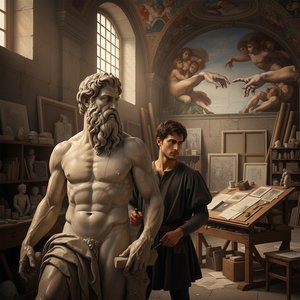
Michel-Ange : Genèse d'un Titan de la Renaissance – Vie, Œuvres et Héritage Impérissable
Explorez la vie et l'œuvre de Michel-Ange, titan de la Renaissance italienne. Découvrez ses sculptures iconiques, le plafond de la Chapelle Sixtine et son héritage artistique durable. Analyse approfondie et passionnée.

Uffizi : Les 25 Chefs-d'Œuvre Incontournables pour Embellir Votre Intérieur
Plongez au cœur de la Galerie des Offices à Florence ! Découvrez les 25 chefs-d'œuvre incontournables de Botticelli, Léonard de Vinci et autres maîtres italiens. Inspirez votre décoration avec l'art Renaissance : reproductions de qualité muséale sur ArtsDot.com

Bartolomeo Pinelli: Neoclassical Linearity & Roman Topography of Memory
Explore the captivating world of Bartolomeo Pinelli, a master Italian engraver renowned for his evocative Roman scenes & historical narratives. Discover his art and legacy with ArtsDot.

Michelangelo Morlaiter: Venetian Landscapes & the Pursuit of Atmospheric Realism
Explore the captivating landscapes of Michelangelo Morlaiter, a key figure in 18th-century Venetian painting. Discover his mastery of atmospheric perspective and lasting influence on Italian art history. Learn more at ArtsDot.



