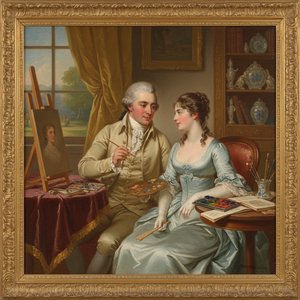
The Remarkable Life of Richard Gibson
In the vibrant and often turbulent tapestry of seventeenth-century England, few figures possess a story as singular and captivating as Richard Gibson. Known to his contemporaries by the evocative moniker "Dwarf Gibson," he navigated the highest echelons of the English court with a unique blend of artistic mastery and social presence. His life spanned one of the most transformative eras in British history, witnessing the reigns of Charles I, the interregnum of Oliver Cromwell, the Restoration of Charles II, and the eventual ascension of William III and Mary II. While his physical stature was a subject of poetic reflection by luminaries such as Andrew Marvell and Edmund Waller, it was his delicate brushwork and profound talent for portrait miniatures that truly defined his enduring legacy.
Though the earliest details of his youth remain shrouded in the mists of time, Gibson’s ascent within the artistic community is a testament to raw, unrecognized talent. Legend suggests he began his journey as a page in the service of a noblewoman in Mortlake, whose keen eye recognized the potential hidden within the young man. Under her patronage, he was able to study under Francis Cleyn, the esteemed director of design at the Mortlyake Tapestry Works. This foundational training provided him with the technical rigor necessary to master the miniature format—a medium that demands extreme precision and an intimate understanding of light and pigment.
Artistic Mastery and Courtly Influence
As Gibson’s reputation grew, so did his proximity to power. In the 1630s, he found himself working for Philip Herbert, 4th Earl of Pembroke, a connection that would prove pivotal to his professional trajectory. During this period, he was often noted in historical records as a skilled copyist of royal and aristocratic collections, yet it was his original compositions that showcased his true genius. His ability to capture the subtle nuances of human expression allowed him to move seamlessly between the roles of a court official—serving as "Page of the Back Stairs" under Charles I—and a respected portraitist.
The development of his style was deeply intertwined with the leading figures of his age. He enjoyed a close and productive relationship with Sir Peter Lely, one of the most prominent painters of the era, whose influence can be seen in the sophisticated elegance of Gibson's work. His talent for the miniature allowed him to create portable pieces of art that served as intimate keepsakes for the aristocracy, capturing not just a likeness, but the very essence and status of his sitters. This period of his life was marked by an incredible versatility; even during the political upheaval of the English Civil War, Gibson maintained his relevance, navigating the shifting allegiances between Royalist and Parliamentary factions with remarkable grace.
Legacy and Historical Significance
Beyond his individual portraits, Richard Gibson’s historical significance lies in his role as a bridge between different eras of English court life. His career was not merely one of survival through political change, but one of continuous artistic contribution. He even served as a drawing master to Princess Mary and Princess Anne, the daughters of James II, demonstrating a level of trust and respect from the royal family that transcended his unconventional social position.
The legacy of Richard Gibson is preserved not only in the surviving miniatures that adorn museum collections but also in the cultural memory of the English Baroque. He remains a symbol of how profound talent can flourish despite the constraints of circumstance, turning a life of service into a lifetime of artistic distinction. His work continues to offer a window into the intimate, private world of the seventeenth-century elite, reminding us of the delicate beauty found in the smallest of canvases.