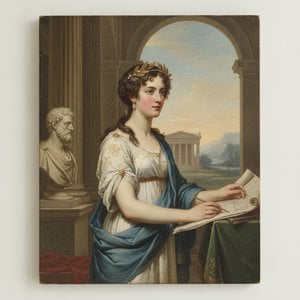
The Legacy of Mauro Gandolfi: Bolognese Elegance and Venetian Echoes
In the vibrant tapestry of the late eighteenth-century Italian art scene, few names resonate with the refined grace of Mauro Gandolfi. Born in Bologna in 1764 into a lineage of profound creative talent, Gandolfi was destined to become a pivotal figure within the Bolognese School. As the son of the celebrated painter Gaetano Gandolfi and nephew to the esteemed Ubaldo Gandolfi, his very existence was steeped in the traditions of the grand manner. This artistic heritage, rooted in the anatomical precision and realistic fervor established by the Carracci academy centuries earlier, provided Mauro with a foundation of unparalleled technical mastery. His early years were not merely spent observing the brushstrokes of his father, but also serving as a model for them, an intimate apprenticeship that instilled in him a deep, visceral understanding of human form and light.
The trajectory of Gandolfi’s life was marked by a restless, wandering spirit that mirrored the shifting political landscapes of his era. At the tender age of sixteen, he sought adventure beyond the walls of Bologna, enlisting in the French army's Corsican Royal Regiment. This period of military service in Marseille, Strassbourg, and Arras served as an unexpected window to the wider European aesthetic, exposing him to diverse artistic currents that would later infuse his work with a subtle, cosmopolitan flair. Upon his return to Bologna in 1791, he formally entered the Accademia Clementina, where his academic rigor met his burgeoning personal style. His talent was so readily recognized that by 1794, he was appointed a professor of figure drawing, a role that allowed him to refine the very techniques of observation and anatomical accuracy that had been his birthright.
A Versatile Mastery: From Portraiture to the Precision of Engraving
While his roots remained firmly planted in the Bolognese tradition, Gandolfi’s artistic evolution was characterized by an extraordinary versatility. His oeuvre is a testament to a creator who refused to be confined by a single medium. In his early career, he worked closely within his father's workshop, contributing to large-scale projects that demanded a seamless integration of skill and classical sensibility. However, as the century turned, a new fascination emerged: the delicate, exacting world of engraving and watercolor. This transition was not merely a change in technique but a profound expansion of his artistic language, allowing him to explore textures and nuances that the broader strokes of oil painting could not capture.
<The year 1801 marked a transformative chapter as Gandolfi relocated to Paris, the beating heart of the Neoclassical movement. In the shadow of the great French museums, he dedicated himself to the meticulous task of creating engraved reproductions of masterpieces. This period of intense focus on the works of others served to deepen his own understanding of composition and line, effectively bridging the gap between Italian tradition and French innovation. His time in Paris allowed him to absorb the sophisticated elegance of the era, a quality that would later permeate his portraits, which captured the dignity and character of his subjects with an almost poetic clarity. Whether through the fluid grace of a watercolor wash or the sharp, decisive line of an engraving, Gandolfi possessed the rare ability to translate the soul of his subject onto the surface.
Historical Significance and the Enduring Spirit of the Bolognese School
The life of Mauro Gandolfi was as much a drama of personal relationships as it was one of artistic triumph. His domestic life, marked by his marriage to Laura Maria Zanetti and later to Caterina Delpino, was intertwined with the very fabric of the art world; his children, Clementina and Democrito, would both follow in his footsteps, ensuring the Gandolfi name continued to influence the sculptural and painterly landscapes of Italy. Even as he traveled as far as the United States in 1816, the echoes of his Bolognese training remained a constant, guiding force in his creative output.
Ultimately, the historical significance of Mauro Gandolfi lies in his role as a bridge between eras. He stood at the crossroads where the robust, anatomical realism of the late Baroque and Bolognese traditions met the refined, disciplined ideals of Neoclassicism. Through his mastery of engraving, he helped disseminate the beauty of classical art to a wider audience, acting as a vital conduit for cultural exchange across Europe. Today, his works remain cherished not only for their technical brilliance but for the way they encapsulate a moment in history when the traditions of the past were being elegantly reimagined for a new, modern world.