Early Life and Career
Maurice de Vlaminck was born April 4th, 1876, in Paris, France – a city steeped in artistic tradition that would profoundly shape his creative journey. His father, Edmond Julien, instilled in him a love for music through violin instruction, while his mother from Lorraine nurtured his musical sensibilities with piano lessons. This early exposure to the arts cultivated within him an instinctive and passionate approach to visual expression, setting the stage for his remarkable artistic development. He began painting around the age of twenty, embarking on a path that would ultimately redefine Fauvist art. Initially self-taught, Vlaminck honed his skills through tireless experimentation and observation—a characteristic that permeated throughout his entire oeuvre.The Fauvist Movement and Artistic Style
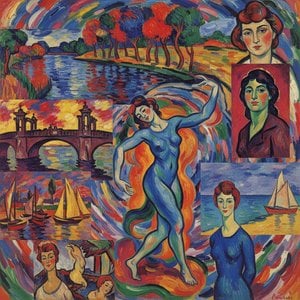
Maurice de Vlaminck stands as one of the cornerstone figures of the Fauvist movement (1904–1908), a revolutionary artistic endeavor that irrevocably altered the landscape of early 20th-century painting. Alongside André Derain and Henri Matisse, he formed an influential trio who challenged the conventions of Impressionism and Academic art alike. The Fauves—meaning “wild beasts”—rejected naturalistic representation in favor of bold color palettes and simplified forms—a daring decision that shocked Parisian audiences at the time. Vlaminck’s artistic style is instantly recognizable by its distinctive features:- Bold Color Choices: He eschewed muted tones, opting instead for vibrant hues – crimson reds, sapphire blues, lemon yellows – to convey emotion and psychological depth rather than mirroring reality accurately. These colors weren't merely decorative; they pulsed with an inner vitality that mirrored Vlaminck’s own fervent spirit.
- Energetic Brushwork: Thick, visible brushstrokes dominated his canvases—a technique born from a desire to capture movement and spontaneity. Each stroke seemed imbued with palpable energy, conveying the artist's immediate response to his subject matter.
- Simplified Forms: Vlaminck reduced landscapes and objects to their essential shapes, prioritizing expressive power over meticulous detail. This stylistic choice allowed him to distill the essence of a scene—its mood and atmosphere—into its purest form.
Influences and Artistic Development
Vlaminck’s artistic vision was undeniably shaped by the legacy of Impressionism—particularly Monet’s exploration of light and atmosphere—but he found an even deeper inspiration in Vincent van Gogh. A visit to a Van Gogh exhibition ignited within him an ardent admiration for the artist's expressive brushwork and profound emotional intensity. This influence is palpable throughout Vlaminck’s paintings, where swirling textures and emotionally charged colors echo Van Gogh’s stylistic hallmarks. Cézanne’s geometric simplification of form also exerted considerable sway over Vlaminck’s artistic sensibilities—particularly after 1908—leading him to adopt a more monochromatic palette reminiscent of Cézanne's explorations of tonal harmony.Major Achievements and Historical Significance
Vlaminck’s participation in the Salon des Refusés (1905) – where his paintings were rejected by the official jury – solidified his position as a champion of artistic rebellion and cemented Fauvism’s place within the broader context of modern art. His canvases—such as “Bougival” and “The Bridge at Chatou”—became emblems of this groundbreaking movement, capturing the dynamism of rural landscapes with unparalleled vibrancy. Vlaminck's work continues to resonate today because it embodies a rare blend of spontaneity, passion, and technical mastery—a testament to his enduring contribution to artistic history. He bridged the gap between Impressionism and Expressionism, propelling art forward into uncharted territories.Legacy and Available Works
Today, Maurice de Vlaminck’s paintings reside in prestigious museums across Europe and North America – a tangible reminder of his indelible mark on the art world. His canvases—characterized by their bold colors and energetic brushstrokes—remain highly sought after by collectors eager to experience the visceral power of Fauvist art. ArtsDot offers a curated selection of Vlaminck’s masterpieces, allowing visitors to immerse themselves in the captivating beauty of his artistic vision.Kysymykset ja vastaukset
Mistä voin nähdä Maurice de Vlaminck's teokset tunnelman mukaan järjestettynä?
Taiteilijan Tunnelman mukaan -sivulla Maurice de Vlaminck:n teokset on järjestetty niiden tunnelman mukaan.
Mihin tyylisuuntauksiin Maurice de Vlaminck kuului?
Kaikki suuntaukset-sivulla Maurice de Vlaminck:n teokset on ryhmitelty taidesuuntauksen mukaan.
Onko Maurice de Vlaminck teoksista saatavilla täydellinen lista?
Jokaisen tämä verkkosivusto-sivustolla olevan Maurice de Vlaminck teoksen voi selata artistin Kaikki teokset -sivulta.
Missä ja minä vuonna Maurice de Vlaminck on syntynyt?
Maurice de Vlaminck syntyi Pariisissä vuonna 1876.
Voinko selata Maurice de Vlaminck teoksia tekniikan mukaan?
Maurice de Vlaminck:n teoksia voi selata tekniikan mukaan artistin Kaikki tekniikat -sivulla.
Mistä Maurice de Vlaminck on kotoisin?
Maurice de Vlaminck on syntynyt Ranska.
Missä kaupungissa ja maassa Maurice de Vlaminck on syntynyt?
Maurice de Vlaminck on syntynyt Pariisi, Ranska.